Myriapoda
Searched as Myriapoda indet.. The Paleobiology Database treats Myriapoda as the accepted name.
Myriapods are the members of subphylum Myriapoda, containing arthropods such as millipedes and centipedes. The group contains about 13,000 species, all of them terrestrial.

Collage: Animalparty (collage), original authors: see source images. · CC BY-SA 4.0 · via Wikipedia/Commons. May be a photograph of a specimen, or an artist’s reconstruction — an interpretation of a skeleton, since colour and soft tissue are almost never preserved.
On record
Recorded, not inferred- Sits inside
- ArthropodaPBDB
- Motility
- actively mobilePBDB, for Arthropoda
Time the record covers
At least 412 million years on record.
The record covers at least 413.02 Mya to 129 ka. No occurrence read is dated outside 419.62 Mya to 11.7 ka.
12 occurrences of Myriapoda on record, most of them in the Carboniferous. The Paleobiology Database records this as a living group. Bar height is expected occurrences, not a count: each fossil is spread across the span it is dated to, so a tall narrow bar means tight dating and a low wide one means loose.
When
12 occurrences- Devonian8%
- Carboniferous58%
- Permian8%
- Miocene17%
- Pleistocene8%
These are dates about fossils, not the animal: the record can only begin after it arose and end before it died out, so either end may reach further. Shares are expected occurrences: a fossil dated to a span is counted partly in each period it straddles. More on what this infers.
Found in
7 formations
- Wild Cow Formation · Madera Group4
- Maboko Formation1
- Dundee Flagstone Formation · Arbuthnott Group1
- Madera Formation1
- East Kirkton Limestone Formation · Upper Oil Shale Group1
- Tambach Formation · Rotliegend Group1
Loading coastlines…
The named rock units Myriapoda has been recovered from, largest first. Drawn where the rock is now, not where it formed. 2 occurrences have no formation on record, which is common for older literature.
Myriapoda and its relatives
CarboniferousWhere Myriapoda and its relatives were recorded in the Carboniferous.
Found in the same rock
6,156 taxa- Arthropleura22 sites
- Arthropleura armata22 sites
- Diplopoda9 sites
- Euphoberia armigera9 sites
- Polydesmida9 sites
- Arachnida7 sites
- Acantherpestes major6 sites
- Araneae6 sites
- Archimylacridae6 sites
- Palaeocampa anthrax6 sites
- Protosilvestria sculpta6 sites
- Salticinae6 sites
- Archaea paradoxa5 sites
- Architarbus rotundatus5 sites
- Arthropleura maillieuxi5 sites
- Arthropleura mammata5 sites
- Arthropoda5 sites
- Aves5 sites
- Blattodea5 sites
- Eucaenus ovalis5 sites
- Euphoberia ferox5 sites
- Euphoberia granosa5 sites
- Gastropoda5 sites
- Insecta5 sites
The Paleobiology Database records 232 sites for Myriapoda, and this reads all of them. The number is how many of those sites it was catalogued from too. The 24 sharing the most are listed.
This is not a list of everything alive at the time. It is only what has come out of the same ground as this animal and been written down.
Entered from
11 references- Overview of Upper Pennsylvanian stratigraphy and paleontology, Kinney Quarry, Manzanita Mountains, New Mexico2
- Late Pleistocene biota from Pubenza, Colombia; turtles, mammals, birds, invertebrates and plant remains1
- The Montceau-les-Mines Lagerstätte (Late Carboniferous, France)1
- A fossil harvestman (Arachnida, Opiliones) from the Mississippian of East Kirkton, Scotland1
- The Bromacker Quarry - the Most Important Locality of Lower Permian Terrestrial Vertebrate Fossils Outside of North America1
- Habitat of Llandoverian-Lochkovian eurypterids1
- Faunal distribution, seasonal deposition, and fish taphonomy at the Upper Pennsylvanian (Missourian) Kinney Brick Company Quarry, central New Mexico1
- Terrestrial arthropods from Upper Pennsylvanian rocks at the Kinney Brick Quarry, New Mexico1
- New Higher Primate Fossils from the Middle Miocene Deposits at Majiwa and Kaloma, Western Kenya1
- Some shrimp of the Madera Formation (Pennsylvanian) Manzanita Mountains, New Mexico.1
- Fossil Mammal Locality on Mount Elgon, Eastern Uganda1
Each of the 12 occurrences read was entered from one of these publications, ordered by how many each accounts for. This is not a search for papers mentioning the name. Entries link to doi.org where the Paleobiology Database holds an identifier, and to its own record where it does not. Relayed as the Paleobiology Database holds them, not checked against what they resolve to.
Media and terms
Media content1
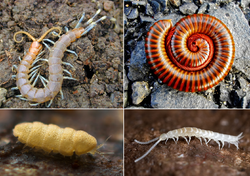
Picture of Myriapoda
- Source
- Wikipedia/Commons
- Credit
- Collage: Animalparty (collage), original authors: see source images.
- Licence
- CC BY-SA 4.0
- Commercial use
- the licence allows it
No 3D scan of Myriapoda was found in Sketchfab.
Smithsonian Open Access and MorphoSource were not reached for this taxon, so this list is what the others held rather than everything there is.
The description on this site
- Source
- Wikipedia, “Myriapoda”
- Licence
- CC BY-SA 4.0
This is what the site found, which is not the same as what exists.
Keep going
What may have been alongside itArthropoda through timeFormations of the CarboniferousThe world it lived on
Occurrence data from the Paleobiology Database, CC BY 4.0. (Latreille 1802)