Noctilio leporinus
The greater bulldog bat or fisherman bat is a species of fishing bat native to Latin America. The bat uses echolocation to detect water ripples made by the fish upon which it preys, then uses the pouch between its legs to scoop the fish up and its sharp claws to catch and cling to it. It is not to be confused with the lesser bulldog bat, which, though belonging to the same genus, merely catches water insects, such as water striders and water beetles.

Susan Ellis, Bugwood.org · CC BY 3.0 us · via Wikipedia/Commons. May be a photograph of a specimen, or an artist’s reconstruction — an interpretation of a skeleton, since colour and soft tissue are almost never preserved.
On record
Recorded, not inferred- Also called
- greater bulldog batPBDB
- Sits inside
- NoctilioPBDB
- Diet
- piscivore, insectivorePBDB, for Noctilionidae
- Life habit
- volantPBDB, for Chiroptera
- Motility
- actively mobilePBDB, for Osteichthyes
- Environment
- terrestrialPBDB, for Chiroptera
Time the record covers
At most 12 thousand years on record.
Every occurrence read is dated to somewhere between 11.7 ka and 0 Mya, and nothing in the dating separates them, so that window is what the record shows rather than a span.
2 occurrences of Noctilio leporinus on record, most of them in the Holocene. The Paleobiology Database records this as a living group. Bar height is expected occurrences, not a count: each fossil is spread across the span it is dated to, so a tall narrow bar means tight dating and a low wide one means loose.
When
2 occurrences- Holocene100%
These are dates about fossils, not the animal: the record can only begin after it arose and end before it died out, so either end may reach further. Shares are expected occurrences: a fossil dated to a span is counted partly in each period it straddles. More on what this infers.
Noctilio leporinus and its relatives
HoloceneWhere Noctilio leporinus and its relatives were recorded in the Holocene.
Found in the same rock
62 taxa- Puma concolor2 sites
- Alouatta seniculus1 site
- Ametrida centurio1 site
- Artibeus jamaicensis1 site
- Carollia1 site
- Cebus nigrivittatus1 site
- Cerdocyon thous1 site
- Chrotopterus auritus1 site
- Coendou prehensilis1 site
- Conepatus semistriatus1 site
- Cuniculus paca1 site
- Dasyprocta1 site
- Dasypus (Dasypus) novemcinctus1 site
- Desmodus rotundus1 site
- Didelphis marsupialis1 site
- Echimys1 site
- Eira barbara1 site
- Eptesicus1 site
- Eumops1 site
- Eumops glaucinus1 site
- Furipterus1 site
- Galictis vittata1 site
- Glossophaga1 site
- Heteromys1 site
The Paleobiology Database records 2 sites for Noctilio leporinus, and this reads all of them. The number is how many of those sites it was catalogued from too. The 24 sharing the most are listed.
This is not a list of everything alive at the time. It is only what has come out of the same ground as this animal and been written down.
Entered from
2 references- Mammalian fossils from Gruta do Ioiô cave and past of the Chapada Diamantina, northeastern Brazil, using taphonomy, radiocarbon dating and paleoecology1
- Density, Productivity, and Distribution of Mammals in Two Venezuelan Habitats1
Each of the 2 occurrences read was entered from one of these publications, ordered by how many each accounts for. This is not a search for papers mentioning the name. Entries link to doi.org where the Paleobiology Database holds an identifier, and to its own record where it does not. Relayed as the Paleobiology Database holds them, not checked against what they resolve to.
Media and terms
Media content2

Picture of Noctilio leporinus
- Source
- Wikipedia/Commons
- Credit
- Susan Ellis, Bugwood.org
- Licence
- CC BY 3.0 us
- Commercial use
- the licence allows it
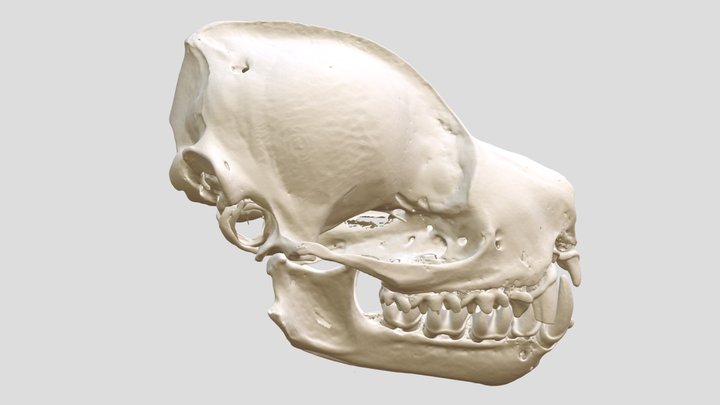
3D model
- Source
- Sketchfab
- Credit
- Biodiversity
- Licence
- CC Attribution
- Commercial use
- cannot be read from the licence given — check the record
Smithsonian Open Access and MorphoSource were not reached for this taxon, so this list is what the others held rather than everything there is.
The description on this site
- Licence
- CC BY-SA 4.0
This is what the site found, which is not the same as what exists.
Keep going
What may have been alongside itNoctilio through timeFormations of the HoloceneThe world it lived on
Occurrence data from the Paleobiology Database, CC BY 4.0. (Linnaeus 1758)