Ochotona princeps
The American pika is a small, herbivorous mammal of the family Ochotonidae, closely related to rabbits and hares. It is native to the mountainous regions of western North America, typically inhabiting rocky slopes and talus fields at or above the tree line. Unlike most mammals of similar size, the American pika is diurnal, being active primarily during the day. It employs two distinct foraging strategies: directly consuming vegetation or gathering and storing plant materials in "haypiles" to sustain itself through the winter months, a behavior known as haying.

Charles J. Sharp · CC BY-SA 4.0 · via Wikipedia/Commons. May be a photograph of a specimen, or an artist’s reconstruction — an interpretation of a skeleton, since colour and soft tissue are almost never preserved.
On record
Recorded, not inferred- Also called
- American pikaPBDB
- Sits inside
- OchotonaPBDB
- Diet
- herbivorePBDB, for Ochotonidae
- Life habit
- ground dwellingPBDB, for Ochotonidae
- Motility
- actively mobilePBDB, for Osteichthyes
- Environment
- terrestrialPBDB, for Eutheria
- Mass
- 148.5 gWikidata
Time the record covers
At least 198 thousand years on record.
The record covers at least 210 ka to 11.7 ka. No occurrence read is dated outside 1.4 Mya to 0 Mya.
11 occurrences of Ochotona princeps on record, most of them in the Pleistocene. The Paleobiology Database records this as a living group. Bar height is expected occurrences, not a count: each fossil is spread across the span it is dated to, so a tall narrow bar means tight dating and a low wide one means loose.
When
11 occurrences- Pleistocene90%
- Holocene10%
These are dates about fossils, not the animal: the record can only begin after it arose and end before it died out, so either end may reach further. Shares are expected occurrences: a fossil dated to a span is counted partly in each period it straddles. More on what this infers.
Ochotona princeps and its relatives
PleistoceneWhere Ochotona princeps and its relatives were recorded in the Pleistocene.
Found in the same rock
348 taxa- Vulpes vulpes8 sites
- Canis latrans7 sites
- Neotoma cinerea7 sites
- Ovis canadensis7 sites
- Lemmiscus curtatus6 sites
- Lepus americanus6 sites
- Marmota flaviventris6 sites
- Brachyprotoma obtusata5 sites
- Equus5 sites
- Microtus5 sites
- Neogale frenata5 sites
- Neotoma5 sites
- Odocoileus hemionus5 sites
- Tamiasciurus hudsonicus5 sites
- Taxidea taxus5 sites
- Buteo4 sites
- Canis lupus4 sites
- Cervus canadensis4 sites
- Lepus townsendii4 sites
- Mustela nigripes4 sites
- Peromyscus maniculatus4 sites
- Spilogale putorius4 sites
- Thomomys4 sites
- Vulpes velox4 sites
The Paleobiology Database records 11 sites for Ochotona princeps, and this reads all of them. The number is how many of those sites it was catalogued from too. The 24 sharing the most are listed.
This is not a list of everything alive at the time. It is only what has come out of the same ground as this animal and been written down.
Entered from
9 references- Middle Pleistocene arvicoline rodents and environmental change at 2900-meters elevation, Porcupine Cave, South Park, Colorado2
- Late Pleistocene vertebrates from Gunnison County, Colorado2
- Mid-Wisconsinan vertebrates and their environment from January Cave, Alberta, Canada1
- Quaternary paleontology and paleocology of Crystal Ball Cave, Millard County, Utah: with emphasis on mammals and description of a new species of fossil skunk1
- Stratigraphic, Sedimentological and Faunal Evidence for the Occurrence of Pre-Sangamonian Artefacts in Northern Yukon1
- Quaternary vertebrate faunas of Canada and Alaska and their suggested chronological sequence1
- New Quaternary mammal localities in the upper Clark Fork River valley, western Montana1
- Significance of the late Pleistocene fauna from the Little Box Elder Cave, Wyoming, to studies of zoogeography of recent mammals1
- Preliminary report on a recently discovered Pleistocene cave deposit near Cumberland, Maryland1
Each of the 11 occurrences read was entered from one of these publications, ordered by how many each accounts for. This is not a search for papers mentioning the name. Entries link to doi.org where the Paleobiology Database holds an identifier, and to its own record where it does not. Relayed as the Paleobiology Database holds them, not checked against what they resolve to.
Media and terms
Media content2

Picture of Ochotona princeps
- Source
- Wikipedia/Commons
- Credit
- Charles J. Sharp
- Licence
- CC BY-SA 4.0
- Commercial use
- the licence allows it
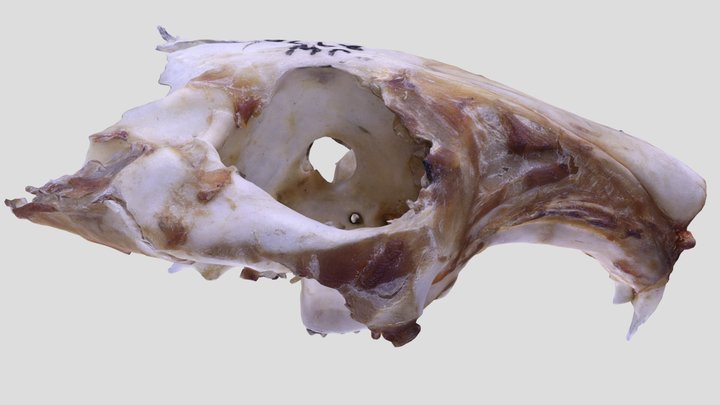
3D model
- Source
- Sketchfab
- Licence
- CC Attribution
- Commercial use
- cannot be read from the licence given — check the record
Smithsonian Open Access and MorphoSource were not reached for this taxon, so this list is what the others held rather than everything there is.
The description on this site
- Licence
- CC BY-SA 4.0
This is what the site found, which is not the same as what exists.
Keep going
What may have been alongside itOchotona through timeFormations of the PleistoceneThe world it lived on
Occurrence data from the Paleobiology Database, CC BY 4.0. (Richardson 1828)