Palaeeudyptes
Palaeeudyptes is an extinct genus of large penguins, currently containing four accepted species. They were probably larger than almost all living penguins, with the smaller species being about the size of an emperor penguin, and the largest species, Palaeeudyptes klekowskii, estimated to reach 2 m long and weighed up to 116 kg (256 lb).

User AHA on sv.wikipedia · Public Domain · via Wikipedia/Commons. May be a photograph of a specimen, or an artist’s reconstruction — an interpretation of a skeleton, since colour and soft tissue are almost never preserved.
On record
Recorded, not inferred- Sits inside
- SpheniscidaePBDB
- Diet
- carnivorePBDB, for Coelurosauria
- Life habit
- ground dwelling, solitaryPBDB, for Theropoda
- Motility
- actively mobilePBDB, for Theropoda
- Environment
- marinePBDB, for Sphenisciformes
Time the record covers
At least 15 million years on record.
The record covers at least 41.03 Mya to 25.2 Mya. No occurrence read is dated outside 48.07 Mya to 15.98 Mya.
33 occurrences of Palaeeudyptes on record, most of them in the Eocene. Bar height is expected occurrences, not a count: each fossil is spread across the span it is dated to, so a tall narrow bar means tight dating and a low wide one means loose.
When
33 occurrencesThese are dates about fossils, not the animal: the record can only begin after it arose and end before it died out, so either end may reach further. Shares are expected occurrences: a fossil dated to a span is counted partly in each period it straddles. More on what this infers.
Found in
10 formations
- Submeseta Formation10
- La Meseta Formation9
- Burnside Formation3
- Concord Formation2
- Leticia Formation1
- Ototara Limestone Formation1
Loading coastlines…
The named rock units Palaeeudyptes has been recovered from, largest first. Drawn where the rock is now, not where it formed. 3 occurrences have no formation on record, which is common for older literature.
Palaeeudyptes and its relatives
EoceneWhere Palaeeudyptes and its relatives were recorded in the Eocene.
Found in the same rock
97 taxa- Delphinornis6 sites
- Spheniscidae5 sites
- Anthropornis grandis4 sites
- Anthropornis nordenskjoeldi4 sites
- Archaeospheniscus wimani3 sites
- Delphinornis larseni3 sites
- Marambiornis exilis3 sites
- Pelagornithidae3 sites
- Testudines3 sites
- "Mesetaichthys" sp.2 sites
- Anthropornis2 sites
- Archaeoceti2 sites
- Basilosauridae2 sites
- Carcharias2 sites
- Cetacea2 sites
- Cucullaea2 sites
- Delphinornis arctowskii2 sites
- Gastropoda2 sites
- Lingula2 sites
- Notolophus arquinotiensis2 sites
- Pristiophorus laevis2 sites
- Pristiophorus lanceolatus2 sites
- Rhinoptera2 sites
- Sphenisciformes2 sites
The Paleobiology Database records 22 sites for Palaeeudyptes, and this reads all of them. The number is how many of those sites it was catalogued from too. The 24 sharing the most are listed.
This is not a list of everything alive at the time. It is only what has come out of the same ground as this animal and been written down.
Entered from
17 references- Annotated catalogue of the fossil vertebrates from Antarctica housed in the Museo de la Plata, Argentina. I. Birds and Land Mammals from La Meseta Formation (Eocene - Early Oligocene)7
- Taxonomic revision of Eocene Antarctic penguins based on tarsometatarsal morphology4
- A review of the pre-Pliocene penguins of New Zealand3
- Fossil penguins form the mid-Tertiary of Seymour Island3
- Weddellian marine/coastal vertebrates diversity from a basal horizon (Ypresian, Eocene) of the Cucullaea I Allomember, La Meseta formation, Seymour (Marambio) Island, Antarctica2
- Catalogue of fossil birds. Part 1 (Archaeopterygiformes through Ardeiformes)2
- Early Tertiary penguins of New Zealand2
- A new penguin fossil from Seymour Island and reassessment of taxonomy and diversity of Eocene Antarctic penguins1
- First fossilized skin of a giant penguin from the Eocene of Antarctica1
- New mammalian and avian records from the late Eocene La Meseta and Submeseta formations of Seymour Island, Antarctica1
- Re-evaluation of the fossil penguin Palaeeudyptes gunnari from the Eocene Leticia Formation, Argentina: additional material, systematics and palaeobiology1
- First articulated skeleton of Palaeeudyptes gunnari from the Late Eocene of Isla Marimbo (Seymour Island), Antarctica1
Each of the 33 occurrences read was entered from one of these publications, ordered by how many each accounts for. This is not a search for papers mentioning the name. 5 further references are not listed. Entries link to doi.org where the Paleobiology Database holds an identifier, and to its own record where it does not. Relayed as the Paleobiology Database holds them, not checked against what they resolve to.
Media and terms
Media content2
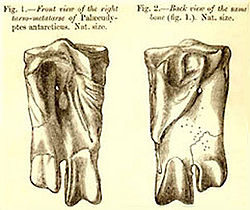
Picture of Palaeeudyptes
- Source
- Wikipedia/Commons
- Credit
- User AHA on sv.wikipedia
- Licence
- Public Domain
- Commercial use
- the licence allows it
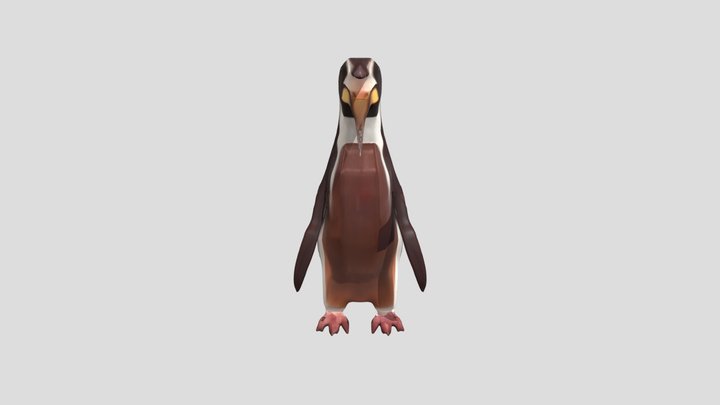
3D model
- Source
- Sketchfab
- Credit
- santsclaus945
- Licence
- CC Attribution
- Commercial use
- cannot be read from the licence given — check the record
MorphoSource was not reached for this taxon, so this list is what the others held rather than everything there is.
The description on this site
- Licence
- CC BY-SA 4.0
This is what the site found, which is not the same as what exists.
Keep going
What may have been alongside itSpheniscidae through timeFormations of the EoceneThe world it lived on
Occurrence data from the Paleobiology Database, CC BY 4.0. Huxley 1859