Pararotalia
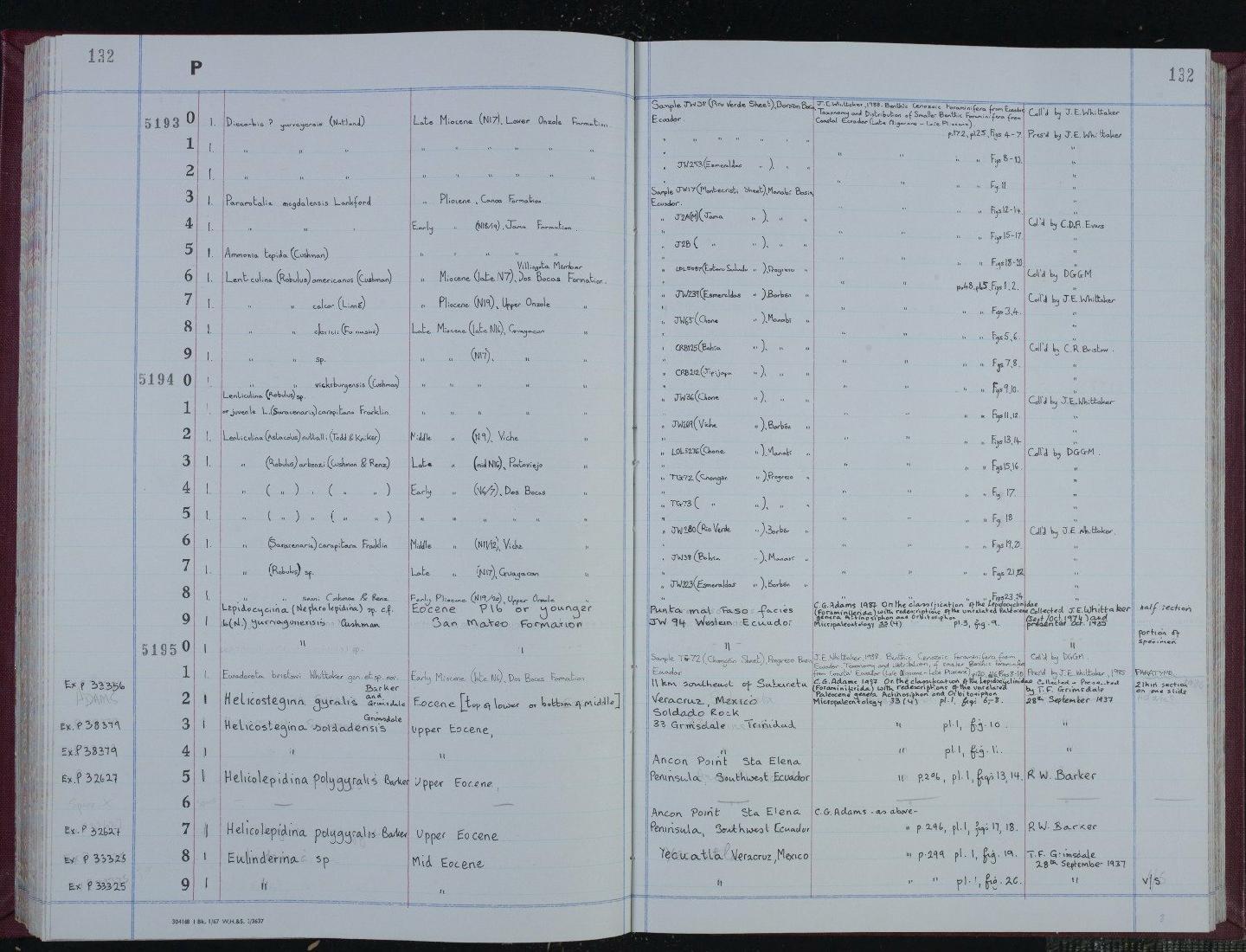
via iDigBio · CC BY · via iDigBio. May be a photograph of a specimen, or an artist’s reconstruction — an interpretation of a skeleton, since colour and soft tissue are almost never preserved.
On record
Recorded, not inferred- Sits inside
- RotaliidaePBDB
- Diet
- omnivorePBDB, for Foraminifera
- Life habit
- semi-infaunalPBDB, for Foraminifera
- Motility
- stationaryPBDB, for Rotaliina
- Environment
- outer shelf,marinePBDB, for Rotaliina
Time the record covers
At least 65 million years on record.
The record covers at least 66 Mya to 774 ka. No occurrence read is dated outside 72.2 Mya to 11.7 ka.
41 occurrences of Pararotalia on record, most of them in the Paleocene. The Paleobiology Database records this as a living group. Bar height is expected occurrences, not a count: each fossil is spread across the span it is dated to, so a tall narrow bar means tight dating and a low wide one means loose.
When
41 occurrences- Late Cretaceous2%
- Paleocene37%
- Eocene20%
- Oligocene18%
- Miocene16%
- Pleistocene7%
These are dates about fossils, not the animal: the record can only begin after it arose and end before it died out, so either end may reach further. Shares are expected occurrences: a fossil dated to a span is counted partly in each period it straddles. More on what this infers.
Found in
13 formations
- Molare Formation3
- Al Jir Formation2
- Selsey Formation · Bracklesham Group1
- Marada Formation1
- Wadi Thamat Formation1
- Ziman Formation1
Loading coastlines…
The named rock units Pararotalia has been recovered from, largest first. Drawn where the rock is now, not where it formed. 25 occurrences have no formation on record, which is common for older literature.
Pararotalia and its relatives
PaleoceneWhere Pararotalia and its relatives were recorded in the Paleocene.
Found in the same rock
461 taxa- Cibicides17 sites
- Discorbis15 sites
- Echinoidea11 sites
- Anomalinoides9 sites
- Boldia9 sites
- Quinqueloculina9 sites
- Valvulina9 sites
- Elphidium8 sites
- Nonion8 sites
- Discorbis midwayensis7 sites
- Smoutina7 sites
- Storrsella7 sites
- Bolivina6 sites
- Bulimina6 sites
- Rotalia6 sites
- Amphistegina5 sites
- Lockhartia5 sites
- Planulina5 sites
- Pulsiphonina prima5 sites
- Ammonia4 sites
- Bryozoa4 sites
- Clavulina4 sites
- Nonionella4 sites
- Nummulites4 sites
The Paleobiology Database records 34 sites for Pararotalia, and this reads all of them. The number is how many of those sites it was catalogued from too. The 24 sharing the most are listed.
This is not a list of everything alive at the time. It is only what has come out of the same ground as this animal and been written down.
Entered from
20 references- The Paleocene-Eocene succession in the Guiana Basin14
- The Upper Cretaceous-Tertiary Formations of northern Libya: a synthesis4
- Oligocene coral and algal reef and related facies of Valzemola (Savona, NW Italy)3
- Middle Eocene foraminifer, mollusc and ostracod fauna from the Csordakut Basin (Gerecse Mountains, Hungary): palaeoenvironments recorded in a transgressive sequence2
- Paleoecology of Baripada beds (Middle Miocene), East Coast of India2
- Tertiary brachiopods from Puerto Rico and their paleontologic and paleoecologic significance2
- Site U13871
- Revisiting the Quaternary development history of the western New Caledonian shelf system: from ramp to barrier reef1
- The Quilon Limestone, Kerala Basin, India: an archive for Miocene Indo-Pacific seagrass beds1
- Maastrichtian and Danian species of Turkostreini (Ostreidae, Crassostreinae) from the Neuquén Basin, Argentina1
- Oligocene reefal deposits in the Pisang Ridge and the origin of the Lucipara Block (Banda Sea, eastern Indonesia)1
- Sedimentology and diagenesis of Tertiary carbonates on the Mangkalihat Peninsula, Borneo: implications for subsurface reservoir quality1
Each of the 41 occurrences read was entered from one of these publications, ordered by how many each accounts for. This is not a search for papers mentioning the name. 8 further references are not listed. Entries link to doi.org where the Paleobiology Database holds an identifier, and to its own record where it does not. Relayed as the Paleobiology Database holds them, not checked against what they resolve to.
Media and terms
Media content1
Picture of Pararotalia
- Source
- iDigBio
- Credit
- via iDigBio
- Licence
- CC BY
- Commercial use
- the licence allows it
No 3D scan of Pararotalia was found in MorphoSource and Sketchfab.
Smithsonian Open Access was not reached for this taxon, so this list is what the others held rather than everything there is.
This is what the site found, which is not the same as what exists.
Keep going
What may have been alongside itRotaliidae through timeFormations of the PaleoceneThe world it lived on
Occurrence data from the Paleobiology Database, CC BY 4.0.