Phacopida
Phacopida ("lens-face") is an order of trilobites that lived from the Late Cambrian to the Late Devonian. It is made up of a morphologically diverse assemblage of taxa in three related suborders.

DanielCD · CC BY-SA 3.0 · via Wikipedia/Commons. May be a photograph of a specimen, or an artist’s reconstruction — an interpretation of a skeleton, since colour and soft tissue are almost never preserved.
On record
Recorded, not inferred- Sits inside
- TrilobitaPBDB
- Diet
- carnivorePBDB, for Trilobita
- Life habit
- low-level epifaunalPBDB, for Trilobita
- Motility
- fast-movingPBDB, for Trilobita
- Environment
- marinePBDB, for Trilobita
Time the record covers
At least 127 million years on record.
The record covers at least 486.85 Mya to 358.86 Mya. No occurrence read is dated outside 497 Mya to 353.7 Mya.
12,000+ occurrences of Phacopida on record. Bar height is expected occurrences, not a count: each fossil is spread across the span it is dated to, so a tall narrow bar means tight dating and a low wide one means loose.
When
12,000 occurrences read- Cambrianunder 1%
- Ordovician58%
- Silurian20%
- Devonian21%
- Carboniferousunder 1%
These are dates about fossils, not the animal: the record can only begin after it arose and end before it died out, so either end may reach further. Shares are expected occurrences: a fossil dated to a span is counted partly in each period it straddles. The read hit its cap, so every figure above is a floor and the shares are of the occurrences read. More on what this infers.
Found in
at least 1376 formations
- Whittaker Formation228
- Jupiter Formation · Anticosti Group217
- Ludlowville Formation · Hamilton Group183
- Kope Formation150
- Esbataottine Formation139
- Volkhov Formation129
Loading coastlines…
The named rock units Phacopida has been recovered from, largest first. Drawn where the rock is now, not where it formed. The read hit its cap, so each count is a floor. 1,352 further formations hold fewer occurrences each and are not listed. 1,155 occurrences have no formation on record, which is common for older literature.
Found in the same rock
1,763 taxa- Crinoidea56 sites
- Isotelus56 sites
- Lingula48 sites
- Flexicalymene45 sites
- Leptaena45 sites
- Hallopora43 sites
- Strophomena43 sites
- Nuculites40 sites
- Ctenodonta38 sites
- Pterinea38 sites
- Modiolopsis37 sites
- Platystrophia37 sites
- Rafinesquina37 sites
- Tentaculites37 sites
- Zygospira36 sites
- Calymene35 sites
- Atrypa33 sites
- Sowerbyella33 sites
- Cornulites29 sites
- Dalmanites29 sites
- Ambonychia28 sites
- Camarotoechia28 sites
- Ceraurus28 sites
- Lophospira28 sites
The Paleobiology Database records at least 979 sites for Phacopida, and this reads 240 of them. The number is how many of those sites it was catalogued from too. The 24 sharing the most are listed.
This is not a list of everything alive at the time. It is only what has come out of the same ground as this animal and been written down.
Entered from
at least 1,111 references- Gradient ecology of a biotic invasion: biofacies of the type Cincinnatian Series (Upper Ordovician), Cincinnati, Ohio region, USA338
- Early Silurian trilobites of Anticosti Island, Québec, Canada282
- Calymenacea (Trilobita) aus dem Ordovizium von Spanien; ihre Biostratigraphie, Oekologie und Systematik236
- The Clinton of Western and Central New York130
- Upper Arenig trilobite biostratigraphy and sea-level changes at Lynna River near Volkhov, Russia111
- Trilobites ordoviciens du Massif armoricain110
- Ordovician formations and faunas, southern Mackenzie Mountains107
- Trilobite assemblages in the Devonian of the Barrandian area and their relations to palaeoenvironments106
- The biostratigraphy of the Ordovician of Bohemia101
- The Bohemian Lower Devonian Stages98
- The Upper Ordovician Trilobites from the Cautley and Dent Districts of Westmorland and Yorkshire94
- Lower Ordovician trilobites from western Utah and eastern Nevadea94
Each of the 12,000 occurrences read was entered from one of these publications, ordered by how many each accounts for. This is not a search for papers mentioning the name. That read hit its cap, so each count is a floor. 1,099 further references are not listed. Entries link to doi.org where the Paleobiology Database holds an identifier, and to its own record where it does not. Relayed as the Paleobiology Database holds them, not checked against what they resolve to.
Media and terms
Media content2

Picture of Phacopida
- Source
- Wikipedia/Commons
- Credit
- DanielCD
- Licence
- CC BY-SA 3.0
- Commercial use
- the licence allows it
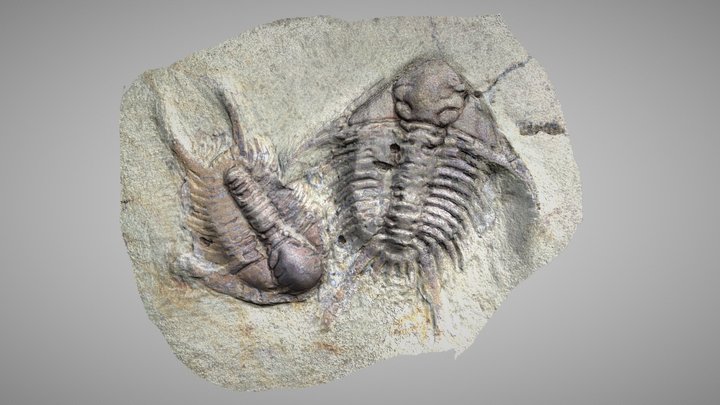
3D model
- Source
- Sketchfab
- Licence
- Free Standard
- Commercial use
- cannot be read from the licence given — check the record
The description on this site
- Source
- Wikipedia, “Phacopida”
- Licence
- CC BY-SA 4.0
This is what the site found, which is not the same as what exists.
Keep going
What may have been alongside itTrilobita through timeThe world it lived on
Occurrence data from the Paleobiology Database, CC BY 4.0. Salter 1864