Phocoenidae
Porpoises are small dolphin-like cetaceans classified under the family Phocoenidae. Although similar in appearance to dolphins, they are more closely related to narwhals and belugas. There are eight extant species of porpoise, all among the smallest of the toothed whales. Porpoises are distinguished from dolphins by their flattened, spade-shaped teeth distinct from the conical teeth of dolphins, and lack of a pronounced beak, although some dolphins also lack a pronounced beak. Porpoises, and other cetaceans, belong to the clade Cetartiodactyla with even-toed ungulates.

Erik Christensen · CC BY-SA 3.0 · via Wikipedia/Commons. May be a photograph of a specimen, or an artist’s reconstruction — an interpretation of a skeleton, since colour and soft tissue are almost never preserved.
On record
Recorded, not inferred- Also called
- porpoisePBDB
- Sits inside
- DelphinoideaPBDB
- Diet
- piscivorePBDB
- Life habit
- aquatic, depth=surfacePBDB, for Cetacea
- Motility
- actively mobilePBDB, for Cetacea
- Environment
- marine,freshwaterPBDB, for Odontoceti
Time the record covers
At least 13 million years on record.
The record covers at least 13.82 Mya to 11.7 ka. No occurrence read is dated outside 15.98 Mya to 0 Mya.
110 occurrences of Phocoenidae on record. The Paleobiology Database records this as a living group. Bar height is expected occurrences, not a count: each fossil is spread across the span it is dated to, so a tall narrow bar means tight dating and a low wide one means loose.
When
110 occurrences- Miocene30%
- Pliocene24%
- Pleistocene4%
- Holocene43%
These are dates about fossils, not the animal: the record can only begin after it arose and end before it died out, so either end may reach further. Shares are expected occurrences: a fossil dated to a span is counted partly in each period it straddles. More on what this infers.
Found in
23 formations
- Pisco Formation13
- Purisima Formation8
- Monterey Formation4
- Almejas Formation3
- Wakkanai Formation3
- Koetoi Formation3
Loading coastlines…
The named rock units Phocoenidae has been recovered from, largest first. Drawn where the rock is now, not where it formed. 52 occurrences have no formation on record, which is common for older literature.
Found in the same rock
579 taxa- Phocoena phocoena21 sites
- Balaenopteridae14 sites
- Cetotheriidae9 sites
- Delphinidae9 sites
- Otodus megalodon9 sites
- Phocoena9 sites
- Phocoenoides dalli9 sites
- Mysticeti8 sites
- Carcharodon carcharias7 sites
- Carcharodon hastalis7 sites
- Neophocaena phocaenoides7 sites
- Odontoceti7 sites
- Phalacrocorax7 sites
- Sula7 sites
- Callorhinus ursinus6 sites
- Enhydra lutris6 sites
- Monachinae6 sites
- Myliobatis6 sites
- Phoca vitulina6 sites
- Alosidae5 sites
- Eumetopias jubatus5 sites
- Isurus oxyrinchus5 sites
- Megatheriidae5 sites
- Phocidae5 sites
The Paleobiology Database records 88 sites for Phocoenidae, and this reads all of them. The number is how many of those sites it was catalogued from too. The 24 sharing the most are listed.
This is not a list of everything alive at the time. It is only what has come out of the same ground as this animal and been written down.
Entered from
63 references- Alaska marine mammal stock assessments10
- Hidden population turnover of small odontocetes in the northwestern North Pacific during the Holocene5
- A new marine vertebrate assemblage from the Late Neogene Purisima Formation in Central California, part II: Pinnipeds and Cetaceans5
- Los vertebrados del Neogeno de La Costa Sur del Perú: Ambiente sedimentario y condiciones de fosilización5
- Catalog of Living Whales5
- Determining the ages of sub-fossil cetacean remains, found in the Carse of Stirling, Scotland4
- Unique feeding morphology in a new prognathous extinct porpoise from the Pliocene of California4
- A morphological comparison of skulls of the finless porpoise Neophocaena phocaenoides from the Indian Ocean, Yangtze River and Japanese waters4
- Archaeological and Historical Evidence for an 18th-Century "Blip" in the Distribution of the Northern Fur Seal at Kodiak Island, Alaska4
- Earliest Records of Holocene Cetaceans in the Black Sea3
- Geology and paleontology of late Cenozoic marine deposits in the Sacaco area (Peru)3
- First porpoise fossils (Cetacea: Phocoenidae) from the western North Atlantic, South Carolina2
Each of the 110 occurrences read was entered from one of these publications, ordered by how many each accounts for. This is not a search for papers mentioning the name. 51 further references are not listed. Entries link to doi.org where the Paleobiology Database holds an identifier, and to its own record where it does not. Relayed as the Paleobiology Database holds them, not checked against what they resolve to.
Media and terms
Media content2
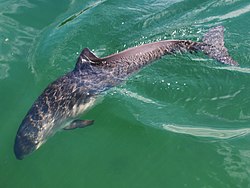
Picture of Phocoenidae
- Source
- Wikipedia/Commons
- Credit
- Erik Christensen
- Licence
- CC BY-SA 3.0
- Commercial use
- the licence allows it
CT scan
- Source
- MorphoSource
- Licence
- In Copyright
- Commercial use
- cannot be read from the licence given — check the record
- Specimen
- Phocoenidae indet. · sdhm:65276
The description on this site
- Source
- Wikipedia, “Porpoise”
- Licence
- CC BY-SA 4.0
This is what the site found, which is not the same as what exists.
Keep going
What may have been alongside itDelphinoidea through timeThe world it lived on
Occurrence data from the Paleobiology Database, CC BY 4.0. (Gray 1825)