Pirenella
Pirenella is a genus of sea snails, marine gastropod mollusks in the family Potamididae.

H. Zell · CC BY-SA 3.0 · via Wikipedia/Commons. May be a photograph of a specimen, or an artist’s reconstruction — an interpretation of a skeleton, since colour and soft tissue are almost never preserved.
On record
Recorded, not inferred- Sits inside
- PotamidinaePBDB
- Diet
- grazerPBDB, for Potamididae
- Life habit
- epifaunalPBDB, for Potamididae
- Motility
- actively mobilePBDB, for Potamididae
- Vision
- limitedPBDB, for Gastropoda
Time the record covers
At least 83 million years on record.
The record covers at least 83.6 Mya to 129 ka. No occurrence read is dated outside 85.7 Mya to 11.7 ka.
47 occurrences of Pirenella on record, most of them in the Miocene. The Paleobiology Database records this as a living group. Bar height is expected occurrences, not a count: each fossil is spread across the span it is dated to, so a tall narrow bar means tight dating and a low wide one means loose.
When
47 occurrences- Late Cretaceous2%
- Paleocene6%
- Eocene21%
- Miocene57%
- Pliocene6%
- Pleistocene6%
These are dates about fossils, not the animal: the record can only begin after it arose and end before it died out, so either end may reach further. Shares are expected occurrences: a fossil dated to a span is counted partly in each period it straddles. More on what this infers.
Found in
8 formations
- Cresnes Formation2
- Calcaire de Mons Formation1
- Babica Beds Formation1
- Hochmoos Formation · Gosau Group1
- Bredasdorp Formation1
- Alexandria Formation1
Loading coastlines…
The named rock units Pirenella has been recovered from, largest first. Drawn where the rock is now, not where it formed. 38 occurrences have no formation on record, which is common for older literature.
Pirenella and its relatives
MioceneWhere Pirenella and its relatives were recorded in the Miocene.
Found in the same rock
753 taxa- Cardium9 sites
- Ampullina7 sites
- Cerithium (Ptychocerithium)6 sites
- Calyptraea (Trochita) aperta5 sites
- Dorsanum5 sites
- Ervilia5 sites
- Hipponix5 sites
- Hydrobia5 sites
- Sassia5 sites
- Thericium5 sites
- Triforis5 sites
- Alvania4 sites
- Cerithiopsis4 sites
- Clava (Striovertagus)4 sites
- Leiostraca4 sites
- Rissoa4 sites
- Vicinocerithium4 sites
- Zebinella4 sites
- Ampullaria sigaretina3 sites
- Architectonica3 sites
- Architectonica (Granosolarium)3 sites
- Balcis3 sites
- Batillaria3 sites
- Bittium3 sites
The Paleobiology Database records 28 sites for Pirenella, and this reads all of them. The number is how many of those sites it was catalogued from too. The 24 sharing the most are listed.
This is not a list of everything alive at the time. It is only what has come out of the same ground as this animal and been written down.
Entered from
16 references- Mollusca of Neogene in the area around Velké Bílovice and their ecological aspects20
- Les Mesogastropoda Fossiles du Cenozoïque étranger des Collections de L'Institute Royale des Sciences Naturelles de Belgique: Cyclophoridae à Stilifetidae9
- Calcareous microfacies in the Sarmatian deposits from Romania2
- Zanthoxylon europaeum Unger 1847 in der fossilen Flora Rumaniens [2
- The Tertiary limestone of the southern coastal regions of Cape Province, South Africa2
- Karagyuleva, 19642
- Pleistocene Coral Reef Terraces on the Saudi Arabian Side of the Gulf of Aqaba, Red Sea1
- Middle Miocene (Badenian) gastropods from Korytnica, Poland; Part V Addenda et Corrigenda ad Prosobranchia1
- Serpulid-bryozoan-foraminiferal biostromes controlled by temperate climate and reduced salinity: middle Miocene of the Styrian Basin, Austria1
- Facies analysis, paleoecology and sequence stratigraphy in a Pliocene siliciclastic succession, Sanb Miniato (Pisa, Italy)1
- Faziesverteilung und Fossilvergesellschaftungen im karbonatischen Flachwassser-Milieu der alpinen Oberkreide (Gosau-Formation) [Facies and fossils from the Upper Cretaceous carbonate shallow water deposits of the Eastern Alps (Gosau Formation)]1
- The faunal remains of Iraq e Zigan, a Late Pleistocene site on Mt. Carmel1
Each of the 47 occurrences read was entered from one of these publications, ordered by how many each accounts for. This is not a search for papers mentioning the name. 4 further references are not listed. Entries link to doi.org where the Paleobiology Database holds an identifier, and to its own record where it does not. Relayed as the Paleobiology Database holds them, not checked against what they resolve to.
Media and terms
Media content2

Picture of Pirenella
- Source
- Wikipedia/Commons
- Credit
- H. Zell
- Licence
- CC BY-SA 3.0
- Commercial use
- the licence allows it
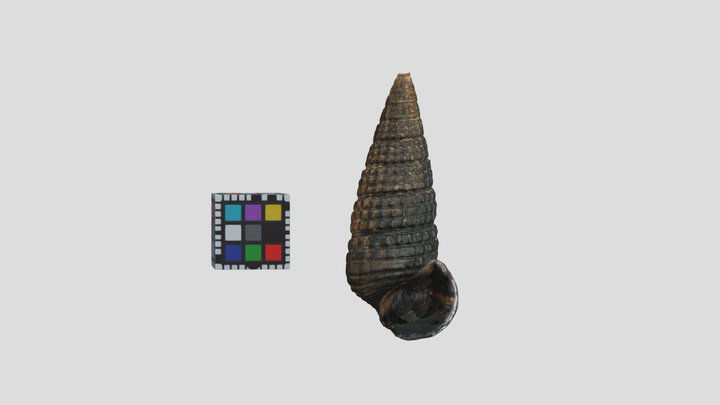
3D model
- Source
- Sketchfab
- Licence
- CC0 Public Domain
- Commercial use
- the licence allows it
Smithsonian Open Access was not reached for this taxon, so this list is what the others held rather than everything there is.
The description on this site
- Source
- Wikipedia, “Pirenella”
- Licence
- CC BY-SA 4.0
This is what the site found, which is not the same as what exists.
Keep going
What may have been alongside itPotamidinae through timeFormations of the MioceneThe world it lived on
Occurrence data from the Paleobiology Database, CC BY 4.0. Gray 1847