Plesiosauroidea
Plesiosauroidea is an extinct clade of carnivorous marine reptiles. They have the snake-like longest neck to body ratio of any reptile. Plesiosauroids are known from the Jurassic and Cretaceous periods. After their discovery, some plesiosauroids were said to have resembled "a snake threaded through the shell of a turtle", although they had no shell.

Ryan Somma · CC BY-SA 2.0 · via Wikipedia/Commons. May be a photograph of a specimen, or an artist’s reconstruction — an interpretation of a skeleton, since colour and soft tissue are almost never preserved.
On record
Recorded, not inferred- Sits inside
- PlesiosauriaPBDB
- Diet
- carnivorePBDB, for Plesiosauria
- Life habit
- aquatic, depth=surfacePBDB, for Plesiosauria
- Motility
- actively mobilePBDB, for Plesiosauria
- Environment
- marinePBDB, for Plesiosauria
Time the record covers
At least 138 million years on record.
The record covers at least 211.18 Mya to 72.2 Mya. No occurrence read is dated outside 227.3 Mya to 56 Mya.
607 occurrences of Plesiosauroidea on record, most of them in the Late Cretaceous. Bar height is expected occurrences, not a count: each fossil is spread across the span it is dated to, so a tall narrow bar means tight dating and a low wide one means loose.
When
607 occurrences- Late Triassic1%
- Early Jurassic7%
- Middle Jurassic5%
- Late Jurassic13%
- Early Cretaceous12%
- Late Cretaceous62%
- Paleoceneunder 1%
These are dates about fossils, not the animal: the record can only begin after it arose and end before it died out, so either end may reach further. Shares are expected occurrences: a fossil dated to a span is counted partly in each period it straddles. More on what this infers.
Found in
153 formations
- Conway Formation · Eyre Group28
- Kimmeridge Clay Formation · Ancholme Group27
- Oxford Clay Formation · Ancholme Group26
- López de Bertodano Formation21
- Pierre Shale Formation · Montana Group16
- Niobrara Formation · Colorado Group14
Loading coastlines…
The named rock units Plesiosauroidea has been recovered from, largest first. Drawn where the rock is now, not where it formed. 129 further formations hold fewer occurrences each and are not listed. 124 occurrences have no formation on record, which is common for older literature.
Plesiosauroidea and its relatives
Late CretaceousWhere Plesiosauroidea and its relatives were recorded in the Late Cretaceous.
Found in the same rock
1,090 taxa- Elasmosauridae63 sites
- Plesiosauria26 sites
- Mosasauridae19 sites
- Polycotylidae17 sites
- Teleostei15 sites
- Trinacromerum bentonianum14 sites
- Squalicorax13 sites
- Chelonioidea12 sites
- Pliosauridae12 sites
- Carcharias10 sites
- Cretalamna appendiculata10 sites
- Inoceramus10 sites
- Plioplatecarpinae10 sites
- Theropoda10 sites
- Enchodus9 sites
- Enchodus elegans9 sites
- Pycnodontidae9 sites
- Squalicorax pristodontus9 sites
- Stephanodus9 sites
- Testudines9 sites
- Elasmosaurus8 sites
- Ostrea8 sites
- Plesiosaurus8 sites
- Plicatoscyllium8 sites
The Paleobiology Database records 510 sites for Plesiosauroidea, and this reads 240 of them. The number is how many of those sites it was catalogued from too. The 24 sharing the most are listed.
This is not a list of everything alive at the time. It is only what has come out of the same ground as this animal and been written down.
Entered from
330 references- The Mesozoic reptiles of Dorset. Part two19
- Late Cretaceous marine reptiles of New Zealand18
- A stratigraphic and taxonomic review of plesiosaurs from the old "Fort Benton Group" of central Kansas: a new assessment of old records13
- Late Cretaceous reptiles (families Elasmosauridae and Pliosauridae) from the Mangahouanga Stream, North Island, New Zealand10
- On the fossil Reptilia of New Zealand10
- Elasmosaur remains from the Maastrichtian type area, and a review of latest Cretaceous elasmosaurs (Reptilia, Plesiosauroidea)9
- The English Upper Jurassic Plesiosauroidea (Reptilia) and a review of the phylogeny and classification of the Plesiosauria9
- Reptiles from the Senonian (U Cret) of Scania (S Sweden)9
- The marine vertebrate faunas from the Late Cretaceous phosphates of Syria8
- Northernmost occurrences of plesiosaurs and turtles in the Upper Cretaceous of Eurasia7
- New plesiosaurs from the Upper Cretaceous of Antarctica7
- Lydekker, 18897
Each of the 607 occurrences read was entered from one of these publications, ordered by how many each accounts for. This is not a search for papers mentioning the name. 318 further references are not listed. Entries link to doi.org where the Paleobiology Database holds an identifier, and to its own record where it does not. Relayed as the Paleobiology Database holds them, not checked against what they resolve to.
Media and terms
Media content1
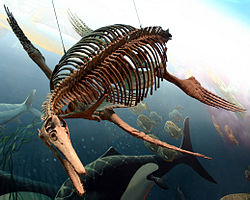
Picture of Plesiosauroidea
- Source
- Wikipedia/Commons
- Credit
- Ryan Somma
- Licence
- CC BY-SA 2.0
- Commercial use
- the licence allows it
No 3D scan of Plesiosauroidea was found in Sketchfab.
Smithsonian Open Access and MorphoSource were not reached for this taxon, so this list is what the others held rather than everything there is.
The description on this site
- Licence
- CC BY-SA 4.0
This is what the site found, which is not the same as what exists.
Keep going
What may have been alongside itPlesiosauria through timeFormations of the Late CretaceousThe world it lived on
Occurrence data from the Paleobiology Database, CC BY 4.0. Welles 1943