Propithecus verreauxi
Verreaux's sifaka, or the white sifaka, is a medium-sized primate in one of the lemur families, the Indriidae. Critically Endangered, it lives in Madagascar and can be found in a variety of habitats from rainforest to dry deciduous forests of western Madagascar and the spiny thickets of the south. Its fur is thick and silky and generally white with brown on the sides, top of the head, and on the arms; its ventral area is relatively glabrous. Its body is adapted to an arboreal existence in which the major form of locomotion is vertical leaping; on the ground its only means of locomotion is a "dancing" form of hopping. The species lives in smallish groups and is primarily folivorous.

JialiangGao www.peace-on-earth.org · CC BY-SA 4.0 · via Wikipedia/Commons. May be a photograph of a specimen, or an artist’s reconstruction — an interpretation of a skeleton, since colour and soft tissue are almost never preserved.
On record
Recorded, not inferred- Sits inside
- PropithecusPBDB
- Diet
- folivore, frugivorePBDB, for Indriidae
- Life habit
- arborealPBDB, for Indriidae
- Motility
- actively mobilePBDB, for Osteichthyes
- Environment
- terrestrialPBDB, for Eutheria
Time the record covers
At most 12 thousand years on record.
Every occurrence read is dated to somewhere between 11.7 ka and 0 Mya, and nothing in the dating separates them, so that window is what the record shows rather than a span.
2 occurrences of Propithecus verreauxi on record, most of them in the Holocene. The Paleobiology Database records this as a living group. Bar height is expected occurrences, not a count: each fossil is spread across the span it is dated to, so a tall narrow bar means tight dating and a low wide one means loose.
When
2 occurrences- Holocene100%
These are dates about fossils, not the animal: the record can only begin after it arose and end before it died out, so either end may reach further. Shares are expected occurrences: a fossil dated to a span is counted partly in each period it straddles. More on what this infers.
Propithecus verreauxi and its relatives
HoloceneWhere Propithecus verreauxi and its relatives were recorded in the Holocene.
Found in the same rock
75 taxa- Aldabrachelys2 sites
- Archaeolemur majori2 sites
- Bos indicus2 sites
- Canis familiaris2 sites
- Cheirogaleus medius2 sites
- Geochelone radiata2 sites
- Geogale aurita2 sites
- Hadropithecus stenognathus2 sites
- Hippopotamus lemerlei2 sites
- Hypogeomys2 sites
- Lemur catta2 sites
- Megaladapis edwardsi2 sites
- Microcebus2 sites
- Microgale2 sites
- Mus musculus2 sites
- Pachylemur insignis2 sites
- Rattus2 sites
- Rousettus2 sites
- Tenrec ecaudatus2 sites
- Acrantophis1 site
- Aepyornis1 site
- Apus1 site
- Archaeolemur edwardsi1 site
- Artamella viridis1 site
The Paleobiology Database records 2 sites for Propithecus verreauxi, and this reads all of them. The number is how many of those sites it was catalogued from too. The 24 sharing the most are listed.
This is not a list of everything alive at the time. It is only what has come out of the same ground as this animal and been written down.
Entered from
1 referenceEach of the 2 occurrences read was entered from one of these publications, ordered by how many each accounts for. This is not a search for papers mentioning the name. Each entry links to the Paleobiology Database's own record for the work.
Media and terms
Media content2
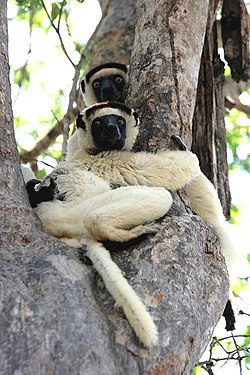
Picture of Propithecus verreauxi
- Source
- Wikipedia/Commons
- Credit
- JialiangGao www.peace-on-earth.org
- Licence
- CC BY-SA 4.0
- Commercial use
- the licence allows it
CT scan
- Source
- MorphoSource
- Credit
- AMNH Mammal Collections
- Licence
- not stated by the source
- Commercial use
- cannot be read from the licence given — check the record
- Specimen
- Propithecus verreauxi coquereli · AMNH:Mammals:M-208990
The description on this site
- Licence
- CC BY-SA 4.0
This is what the site found, which is not the same as what exists.
Keep going
What may have been alongside itPropithecus through timeFormations of the HoloceneThe world it lived on
Occurrence data from the Paleobiology Database, CC BY 4.0. Grandidier 1867