Rana catesbeiana
The American bullfrog, often simply known as the bullfrog in Canada and the United States, is a species of large frog in the family Ranidae. The species is native to eastern North America. It typically inhabits large permanent water bodies such as swamps, ponds, and lakes. The bullfrog can also be found in manmade habitats such as pools, koi ponds, canals, ditches, reservoirs and culverts. The bullfrog gets its common name from the sound the male makes during the breeding season, which sounds similar to a bull bellowing. It is a generalist carnivore, consuming a wide variety of prey. In turn, it is eaten by predators such as alligators, snakes, and birds.

Carl D. Howe · CC BY-SA 2.5 · via Wikipedia/Commons. May be a photograph of a specimen, or an artist’s reconstruction — an interpretation of a skeleton, since colour and soft tissue are almost never preserved.
On record
Recorded, not inferred- Also called
- American bullfrogPBDB
- Sits inside
- RanaPBDB
- Diet
- carnivorePBDB, for Temnospondyli
- Life habit
- amphibiousPBDB, for Temnospondyli
- Motility
- actively mobilePBDB, for Temnospondyli
- Environment
- brackish,freshwater,terrestrialPBDB, for Tetrapoda
Time the record covers
At least 4.5 million years on record.
The record covers at least 4.7 Mya to 129 ka. No occurrence read is dated outside 9.4 Mya to 11.7 ka.
16 occurrences of Rana catesbeiana on record, most of them in the Pleistocene. The Paleobiology Database records this as a living group. Bar height is expected occurrences, not a count: each fossil is spread across the span it is dated to, so a tall narrow bar means tight dating and a low wide one means loose.
When
16 occurrences- Miocene14%
- Pliocene8%
- Pleistocene78%
These are dates about fossils, not the animal: the record can only begin after it arose and end before it died out, so either end may reach further. Shares are expected occurrences: a fossil dated to a span is counted partly in each period it straddles. More on what this infers.
Found in
3 formations
Loading coastlines…
The named rock units Rana catesbeiana has been recovered from, largest first. Drawn where the rock is now, not where it formed. 10 occurrences have no formation on record, which is common for older literature.
Rana catesbeiana and its relatives
PleistoceneWhere Rana catesbeiana and its relatives were recorded in the Pleistocene.
Found in the same rock
543 taxa- Thamnophis10 sites
- Ambystoma tigrinum8 sites
- Bufo8 sites
- Bufo woodhousei6 sites
- Geomys6 sites
- Microtus pennsylvanicus6 sites
- Nerodia6 sites
- Thamnophis sirtalis6 sites
- Bufo cognatus5 sites
- Rana pipiens5 sites
- Spea bombifrons5 sites
- Amblystoma4 sites
- Canis4 sites
- Chrysemys picta4 sites
- Cryptotis parva4 sites
- Heterodon4 sites
- Heterodon nasicus4 sites
- Holbrookia4 sites
- Leporidae4 sites
- Microtus meadensis4 sites
- Microtus paroperarius4 sites
- Ondatra zibethicus4 sites
- Scalopus aquaticus4 sites
- Spermophilus4 sites
The Paleobiology Database records 16 sites for Rana catesbeiana, and this reads all of them. The number is how many of those sites it was catalogued from too. The 24 sharing the most are listed.
This is not a list of everything alive at the time. It is only what has come out of the same ground as this animal and been written down.
Entered from
12 references- Middle Pleistocene (late Irvingtonian: Nebraskan) climatic changes in south-central Colorado4
- Frogs in Hemphillian deposits of Nebraska, with the description of a new species of Bufo2
- The Pipe Creek Sinkhole biota, a diverse late Tertiary continental fossil assemblage from Grant County, Indiana1
- Late Pliocene anurans from Inglis 1A, Citrus County, Florida1
- A late Pleistocene herpetofauna from Bell Cave, Alabama1
- The Shelton Mastodon Site: Multidisciplinary study of a late Pleistocene (Twocreekan) locality in Southeastern Michigan1
- Herpetofaunas of the Big Springs and Hornet's Nest quarries (northeastern Nebraska, Pleistocene: Late Blancan)1
- The late Pleistocene herpetofauna of Devil's Den Sinkhole, Levy County, Florida1
- America's northernmost Pleistocene herpetofauna (Java, North-Central South Dakota)1
- Herpetofauna of the Kanopolis Local Fauna (Pleistocene: Yarmouth) of Kansas1
- The Pleistocene amphibians of Pit II, Arredondo, Florida1
- A Kansas Pleistocene herpetofauna1
Each of the 16 occurrences read was entered from one of these publications, ordered by how many each accounts for. This is not a search for papers mentioning the name. Entries link to doi.org where the Paleobiology Database holds an identifier, and to its own record where it does not. Relayed as the Paleobiology Database holds them, not checked against what they resolve to.
Media and terms
Media content2

Picture of Rana catesbeiana
- Source
- Wikipedia/Commons
- Credit
- Carl D. Howe
- Licence
- CC BY-SA 2.5
- Commercial use
- the licence allows it
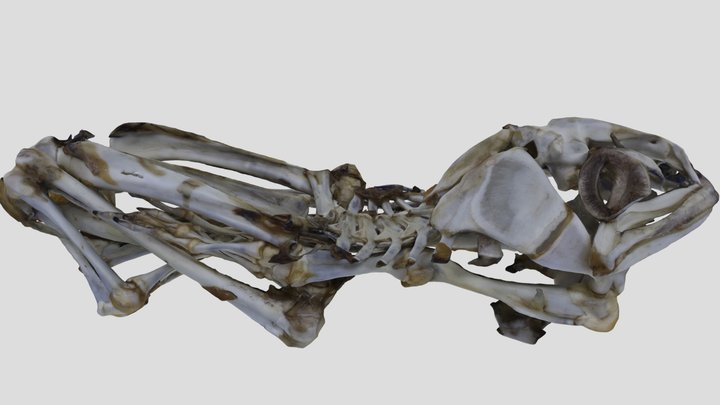
3D model
- Source
- Sketchfab
- Licence
- CC Attribution
- Commercial use
- cannot be read from the licence given — check the record
Smithsonian Open Access and MorphoSource were not reached for this taxon, so this list is what the others held rather than everything there is.
The description on this site
- Licence
- CC BY-SA 4.0
This is what the site found, which is not the same as what exists.
Keep going
What may have been alongside itRana through timeFormations of the PleistoceneThe world it lived on
Occurrence data from the Paleobiology Database, CC BY 4.0. Shaw 1802