Sarcosuchus
Sarcosuchus, from Ancient Greek σάρξ (sárx), meaning "flesh", and Σοῦχος (Soûkhos), meaning "Sobek", is a genus of crocodyliform that lived during the Early Cretaceous in North Africa and Brazil. The genus was first described in 1966 by French paleontologists Frances de Broin and Philippe Taquet on the basis of an incomplete skull that was discovered in Gadoufaoua, northern Niger. They named the type species S. imperator. Prior to 1966, fragmentary fossils of S. imperator had been found in French expeditions to the Sahara as well. In 1977, the species Crocodylus hartti, which had been discovered in Early Cretaceous deposits in Brazil in the 1850s-60s, was reassigned to Sarcosuchus. S. hartti is known from largely fragmentary material compared to S. imperator and is smaller in size. The best-preserved remains of Sarcosuchus were not unearthed until 1997 and 2000, when American paleontologist Paul Sereno and University of Chicago crews collected six new specimens, including several skulls and postcranial remains, of S. imperator.

Shadowgate from Novara, ITALY · CC BY 2.0 · via Wikipedia/Commons. May be a photograph of a specimen, or an artist’s reconstruction — an interpretation of a skeleton, since colour and soft tissue are almost never preserved.
On record
Recorded, not inferred- Sits inside
- PholidosauridaePBDB
- Diet
- carnivorePBDB, for Pseudosuchia
- Motility
- actively mobilePBDB, for Osteichthyes
- Environment
- marinePBDB, for Mesoeucrocodylia
- Length
- 9.5 mWikidata
- Mass
- 4.3 tonneWikidata
Time the record covers
At least 25 million years on record.
The record covers at least 125.77 Mya to 100.5 Mya. No occurrence read is dated outside 143.1 Mya to 93.9 Mya.
17 occurrences of Sarcosuchus on record, most of them in the Early Cretaceous. Bar height is expected occurrences, not a count: each fossil is spread across the span it is dated to, so a tall narrow bar means tight dating and a low wide one means loose.
When
17 occurrencesThese are dates about fossils, not the animal: the record can only begin after it arose and end before it died out, so either end may reach further. Shares are expected occurrences: a fossil dated to a span is counted partly in each period it straddles. More on what this infers.
Found in
10 formations
- Aïn el Guettar Formation3
- Elrhaz Formation · Tegama Group2
- Continental Intercalaire Formation1
- Gara Sbaa Formation · Kem Kem Group1
- Tagrezou Sandstone Formation · Téfidet Group1
- Marfim Formation · Ilhas Group1
Loading coastlines…
The named rock units Sarcosuchus has been recovered from, largest first. Drawn where the rock is now, not where it formed. 4 occurrences have no formation on record, which is common for older literature.
Sarcosuchus and its relatives
Early CretaceousWhere Sarcosuchus and its relatives were recorded in the Early Cretaceous.
Found in the same rock
63 taxa- Lepidotes5 sites
- Carcharodontosaurus saharicus4 sites
- Theropoda4 sites
- Ouranosaurus nigeriensis3 sites
- Crocodylomorpha2 sites
- Lithostrotia2 sites
- Plantae2 sites
- Rebbachisaurinae2 sites
- Spinosaurus aegyptiacus2 sites
- Teneremys lapparenti2 sites
- Testudines2 sites
- Amiidae1 site
- Anhangueridae1 site
- Araripemys1 site
- Archosauria1 site
- Arganodus tiguidiensis1 site
- Baryonychinae1 site
- Brachiosauridae1 site
- Calamopleurus mawsoni1 site
- Candona candida1 site
- Carcharodontosauria1 site
- Ceratodus1 site
- Conichnus1 site
- Crocodylia1 site
The Paleobiology Database records 15 sites for Sarcosuchus, and this reads all of them. The number is how many of those sites it was catalogued from too. The 24 sharing the most are listed.
This is not a list of everything alive at the time. It is only what has come out of the same ground as this animal and been written down.
Entered from
10 references- Systematic revision of Sarcosuchus hartti (Crocodyliformes) from the Recôncavo Basin (Early Cretaceous) of Bahia, north-eastern Brazil4
- Découverte d'un Crocodilien nouveau dans le Crétacé inférieur du Sahara [Discovery of a new crocodilian in the Lower Cretaceous of the Sahara]3
- Taquet, 19762
- Notice of some new reptilian remains from the Cretaceous of Brazil2
- The Lower Cretaceous “Continental Intercalaire” around Tidikelt (Central Sahara, Algeria): sedimentology, palaeontology and ichnology1
- New fossils of the giant pholidosaurid genus Sarcosuchus from the Early Cretaceous of Tunisia1
- Oxygen and carbon isotope compositions of middle Cretaceous vertebrates from North Africa and Brazil: Ecological and environmental significance1
- Titanosaurian (Dinosauria: Sauropoda) remains from the "Continental Intercalaire" of Mali1
- Predatory dinosaurs from the Sahara and Late Cretaceous faunal differentiation1
- Découvertes paléontologiques récentes dans le Nord du Niger [Recent paleontological discoveries in the north of Niger]1
Each of the 17 occurrences read was entered from one of these publications, ordered by how many each accounts for. This is not a search for papers mentioning the name. Entries link to doi.org where the Paleobiology Database holds an identifier, and to its own record where it does not. Relayed as the Paleobiology Database holds them, not checked against what they resolve to.
Media and terms
Media content2

Picture of Sarcosuchus
- Source
- Wikipedia/Commons
- Credit
- Shadowgate from Novara, ITALY
- Licence
- CC BY 2.0
- Commercial use
- the licence allows it
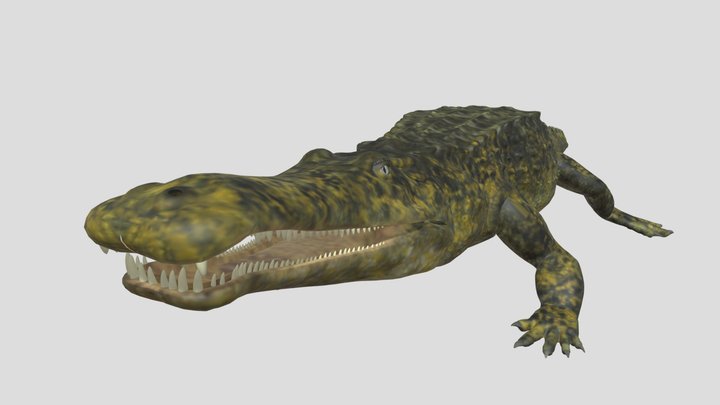
3D model
- Source
- Sketchfab
- Credit
- Nobilis the Palaeovespa
- Licence
- CC Attribution
- Commercial use
- cannot be read from the licence given — check the record
The description on this site
- Source
- Wikipedia, “Sarcosuchus”
- Licence
- CC BY-SA 4.0
This is what the site found, which is not the same as what exists.
Keep going
What may have been alongside itPholidosauridae through timeFormations of the Early CretaceousThe world it lived on
Occurrence data from the Paleobiology Database, CC BY 4.0. de Broin and Taquet 1966