Scheenstia
Scheenstia is an extinct genus of neopterygian ray-finned fish from the Late Jurassic–Early Cretaceous of Europe. Fossils have been found in both marine and freshwater environments.

Anagoria · CC BY 3.0 · via Wikipedia/Commons. May be a photograph of a specimen, or an artist’s reconstruction — an interpretation of a skeleton, since colour and soft tissue are almost never preserved.
On record
Recorded, not inferred- Sits inside
- LepisosteiformesPBDB
- Diet
- carnivorePBDB, for Lepisosteiformes
- Life habit
- nektonicPBDB, for Lepisosteiformes
- Motility
- actively mobilePBDB, for Lepisosteiformes
- Environment
- freshwaterPBDB, for Lepisosteiformes
Time the record covers
At least 29 million years on record.
The record covers at least 149.2 Mya to 119.57 Mya. No occurrence read is dated outside 154.8 Mya to 100.5 Mya.
21 occurrences of Scheenstia on record, most of them in the Early Cretaceous. Bar height is expected occurrences, not a count: each fossil is spread across the span it is dated to, so a tall narrow bar means tight dating and a low wide one means loose.
When
21 occurrencesThese are dates about fossils, not the animal: the record can only begin after it arose and end before it died out, so either end may reach further. Shares are expected occurrences: a fossil dated to a span is counted partly in each period it straddles. More on what this infers.
Found in
7 formations
- Sainte-Barbe Clays Formation · Wealden Group2
- Wadhurst Clay Formation · Wealden Group2
- Painten Formation · Weißjura Group1
- Arcillas de Morella Formation1
- Wessex Formation · Wealden Group1
- Woburn Sands Formation1
Loading coastlines…
The named rock units Scheenstia has been recovered from, largest first. Drawn where the rock is now, not where it formed. 12 occurrences have no formation on record, which is common for older literature.
Scheenstia and its relatives
Early CretaceousWhere Scheenstia and its relatives were recorded in the Early Cretaceous.
Found in the same rock
260 taxa- Caturus7 sites
- Theropoda6 sites
- Goniopholis5 sites
- Gyrodus5 sites
- Lepidotes5 sites
- Pycnodontidae5 sites
- Theriosuchus5 sites
- Egertonodus basanus4 sites
- Heterodontus4 sites
- Planohybodus ensis4 sites
- Crocodylia3 sites
- Hybodus3 sites
- Iguanodon3 sites
- Lonchidion breve3 sites
- Ocloedus3 sites
- Pachythrissops vectensis3 sites
- Parvodus parvidens3 sites
- Pycnodontiformes3 sites
- Reptilia3 sites
- Steneosaurus3 sites
- Aspidorhynchiformes2 sites
- Baryonychinae2 sites
- Belonostomus2 sites
- Bernissartia2 sites
The Paleobiology Database records 19 sites for Scheenstia, and this reads all of them. The number is how many of those sites it was catalogued from too. The 24 sharing the most are listed.
This is not a list of everything alive at the time. It is only what has come out of the same ground as this animal and been written down.
Entered from
15 references- Los vertebrados del Cretácico Español [The vertebrates from the Spanish Cretaceous]3
- Microvertebrates from the Lower Greensand Group (Lower Cretaceous) of Clophill, Bedfordshire, UK, and Nutfield, Surrey, UK2
- Nouveaux restes de Vertébrés du Jurassique terminal du Boulonnais (Nord de la France) [New vertebrate remains from the latest Jurassic of the Boulonnais (northern France)]2
- Les Poissons et les Reptiles du Jurassique supérieur de Fumel (Lot-et-Garonne) [The fishes and reptiles from the Upper Jurassic of Fumel (Lot-et-Garonne)]2
- Catalogue of the Fossil Fishes in the British Museum (Natural History), Part III2
- Comptonatus chasei, a new iguanodontian dinosaur from the Lower Cretaceous Wessex Formation of the Isle of Wight, southern England1
- Scheenstia bernissartensis (Actinopterygii: Ginglymodi) from the Early Cretaceous of Bernissart, Belgium, with an appraisal of ginglymodian evolutionary history1
- A Berriasian actinopterygian fauna from Cherves-de-Cognac, France: biodiversity and palaeoenvironmental implications1
- A tiny maniraptoran dinosaur in the Lower Cretaceous Hastings Group: evidence from a new vertebrate-bearing locality in south-east England1
- New Semionotiform (Actinopterygii, Neopterygii) from the Late Jurassic of Southern Germany1
- Les Actinoptérygiens de l'Aptien inférieur (Töck) d'Helgoland1
- Aegialodon dawsoni, a new trituberculosectorial tooth from the Lower Wealden1
Each of the 21 occurrences read was entered from one of these publications, ordered by how many each accounts for. This is not a search for papers mentioning the name. 3 further references are not listed. Entries link to doi.org where the Paleobiology Database holds an identifier, and to its own record where it does not. Relayed as the Paleobiology Database holds them, not checked against what they resolve to.
Media and terms
Media content1
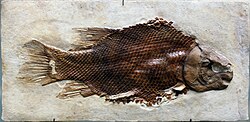
Picture of Scheenstia
- Source
- Wikipedia/Commons
- Credit
- Anagoria
- Licence
- CC BY 3.0
- Commercial use
- the licence allows it
No 3D scan of Scheenstia was found in Sketchfab.
Smithsonian Open Access and MorphoSource were not reached for this taxon, so this list is what the others held rather than everything there is.
The description on this site
- Source
- Wikipedia, “Scheenstia”
- Licence
- CC BY-SA 4.0
This is what the site found, which is not the same as what exists.
Keep going
What may have been alongside itLepisosteiformes through timeFormations of the Early CretaceousThe world it lived on
Occurrence data from the Paleobiology Database, CC BY 4.0. López-Arbarello and Sfercoa 2009