Sigmodontinae
Sigmodontinae is a subfamily of rodents that includes New World rats and mice, with at least 376 species. Their distribution includes much of the New World, but the genera are predominantly South American, such as brucies. They invaded South America from Central America as part of the Great American Interchange near the end of the Miocene, about 5 million years ago. Sigmodontines proceeded to diversify explosively in the formerly isolated continent. They inhabit many of the same ecological niches that the Murinae occupy in the Old World.

James Gathany · Public Domain · via Wikipedia/Commons. May be a photograph of a specimen, or an artist’s reconstruction — an interpretation of a skeleton, since colour and soft tissue are almost never preserved.
On record
Recorded, not inferred- Sits inside
- CricetidaePBDB
- Diet
- herbivorePBDB, for Rodentia
- Life habit
- ground dwellingPBDB, for Rodentia
- Motility
- actively mobilePBDB, for Osteichthyes
- Environment
- terrestrialPBDB, for Eutheria
Time the record covers
At least 9.3 million years on record.
The record covers at least 9.4 Mya to 11.7 ka. No occurrence read is dated outside 12.5 Mya to 0 Mya.
563 occurrences of Sigmodontinae on record, most of them in the Pleistocene. The Paleobiology Database records this as a living group. Bar height is expected occurrences, not a count: each fossil is spread across the span it is dated to, so a tall narrow bar means tight dating and a low wide one means loose.
When
563 occurrences- Miocene5%
- Pliocene22%
- Pleistocene59%
- Holocene14%
These are dates about fossils, not the animal: the record can only begin after it arose and end before it died out, so either end may reach further. Shares are expected occurrences: a fossil dated to a span is counted partly in each period it straddles. More on what this infers.
Found in
63 formations
- Palm Spring Formation33
- "unnamed sandstone" Formation22
- St. David Formation14
- Botucatu Formation14
- Tafí del Valle Formation11
- San Andres Formation10
Loading coastlines…
The named rock units Sigmodontinae has been recovered from, largest first. Drawn where the rock is now, not where it formed. 39 further formations hold fewer occurrences each and are not listed. 303 occurrences have no formation on record, which is common for older literature.
Sigmodontinae and its relatives
PleistoceneWhere Sigmodontinae and its relatives were recorded in the Pleistocene.
Found in the same rock
2,184 taxa- Equus100 sites
- Sigmodon minor77 sites
- Sigmodon59 sites
- Perognathinae43 sites
- Odocoileus virginianus42 sites
- Platygonus42 sites
- Sylvilagus42 sites
- Peromyscus37 sites
- Camelops36 sites
- Dasypus bellus35 sites
- Hemiauchenia35 sites
- Dipodomys33 sites
- Sigmodon hispidus32 sites
- Neotoma31 sites
- Sylvilagus floridanus27 sites
- Leporidae26 sites
- Lynx rufus26 sites
- Odocoileus26 sites
- Spermophilus26 sites
- Canis latrans25 sites
- Hemiauchenia macrocephala25 sites
- Oryzomys palustris25 sites
- Scalopus aquaticus24 sites
- Aenocyon dirus22 sites
The Paleobiology Database records 298 sites for Sigmodontinae, and this reads 240 of them. The number is how many of those sites it was catalogued from too. The 24 sharing the most are listed.
This is not a list of everything alive at the time. It is only what has come out of the same ground as this animal and been written down.
Entered from
176 references- Synonymies and reidentifications of North American fossil mammals33
- Fauna de mamíferos do Quaternário de Serra da Mesa (Goiás, Brasil)25
- Chronology of Florida Pleistocene mammals19
- Small mammals taphonomy and environmental evolution during Late Pleistocene-Holocene in Monte Desert: The evidence of Gruta del Indio (central west Argentina)18
- Biostratigraphy of Blancan and Irvingtonian mammals in the Fish Creek-Vallecito Creek section, southern California, and a review of the Blancan-Irvingtonian boundary15
- Diversidade de pequenos mamíferos (Didelphimorphia e Rodentia) do Holoceno do nordeste do estado do Rio Grande do Sul, Brasil: implicações taxonômicas e paleo ambientais14
- A review of the biostratigraphy of Pliocene and Pleistocene sediments in the Elsinore Fault Zone, Riverside County, California14
- Reassesment of the Pliocene-Pleistocene continental time scale of Southern South America. Correlation of the type Chapadmalalan with Bolivian sections13
- La Faune Pleistocene du Piaui (Nordeste du Bresil): Implications Paleoecologiques et Biochronologiques12
- Magnetic Polarity Stratigraphy of Pliocene-Pleistocene Terrestrial Deposits and Vertebrate Faunas, San Pedro Valley, Arizona11
- Síntesis actualizada del registro paleontológico pleistoceno en el Noroeste argentino10
- Advances in the understanding of Neogene mammalian fauna in the Pampean region (central Argentina) through revising “biozone” hypotheses based on new dates and biochronological analyses9
Each of the 563 occurrences read was entered from one of these publications, ordered by how many each accounts for. This is not a search for papers mentioning the name. 164 further references are not listed. Entries link to doi.org where the Paleobiology Database holds an identifier, and to its own record where it does not. Relayed as the Paleobiology Database holds them, not checked against what they resolve to.
Media and terms
Media content1
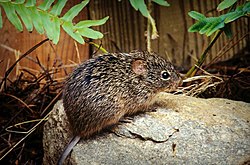
Picture of Sigmodontinae
- Source
- Wikipedia/Commons
- Credit
- James Gathany
- Licence
- Public Domain
- Commercial use
- the licence allows it
No 3D scan of Sigmodontinae was found in MorphoSource and Sketchfab.
Smithsonian Open Access was not reached for this taxon, so this list is what the others held rather than everything there is.
The description on this site
- Licence
- CC BY-SA 4.0
This is what the site found, which is not the same as what exists.
Keep going
What may have been alongside itCricetidae through timeFormations of the PleistoceneThe world it lived on
Occurrence data from the Paleobiology Database, CC BY 4.0. Wagner 1843