Sula leucogaster
The brown booby is a large seabird in the booby and gannet family Sulidae, of which it is one of the most common and widespread species. It has a pantropical range, which overlaps with that of other booby species. The gregarious brown booby commutes and forages at low height over inshore waters. Flocks plunge-dive to take small fish, especially when these are driven near the surface by their predators. They nest only on the ground, and roost on solid objects rather than the water surface.

Danilo da Castro · CC BY-SA 3.0 · via Wikipedia/Commons. May be a photograph of a specimen, or an artist’s reconstruction — an interpretation of a skeleton, since colour and soft tissue are almost never preserved.
On record
Recorded, not inferred- Also called
- brown boobyPBDB
- Sits inside
- SulaPBDB
- Diet
- carnivorePBDB, for Coelurosauria
- Life habit
- ground dwelling, solitaryPBDB, for Theropoda
- Motility
- actively mobilePBDB, for Theropoda
- Environment
- terrestrialPBDB, for Theropoda
- Mass
- 53 gWikidata
Time the record covers
At most 12 thousand years on record.
Every occurrence read is dated to somewhere between 11.7 ka and 0 Mya, and nothing in the dating separates them, so that window is what the record shows rather than a span.
13 occurrences of Sula leucogaster on record, most of them in the Holocene. The Paleobiology Database records this as a living group. Bar height is expected occurrences, not a count: each fossil is spread across the span it is dated to, so a tall narrow bar means tight dating and a low wide one means loose.
When
13 occurrences- Holocene100%
These are dates about fossils, not the animal: the record can only begin after it arose and end before it died out, so either end may reach further. Shares are expected occurrences: a fossil dated to a span is counted partly in each period it straddles. More on what this infers.
Sula leucogaster and its relatives
HoloceneWhere Sula leucogaster and its relatives were recorded in the Holocene.
Found in the same rock
114 taxa- Anous stolidus9 sites
- Sula sula8 sites
- Gallus gallus7 sites
- Puffinus lherminieri6 sites
- Fregata minor5 sites
- Phaethon lepturus5 sites
- Pseudobulweria rostrata5 sites
- Sterninae5 sites
- Fregata ariel4 sites
- Onychoprion fuscatus4 sites
- Anous minutus3 sites
- Ardenna pacifica3 sites
- Fregata3 sites
- Fregata magnificens3 sites
- Nesotrochis debooyi3 sites
- Nyctanassa violacea3 sites
- Pterodroma3 sites
- Zapornia tabuensis3 sites
- Alopecoenas erythropterus2 sites
- Ardea herodias2 sites
- Butorides striata2 sites
- Columbidae2 sites
- Ducula galeata2 sites
- Egretta sacra2 sites
The Paleobiology Database records 13 sites for Sula leucogaster, and this reads all of them. The number is how many of those sites it was catalogued from too. The 24 sharing the most are listed.
This is not a list of everything alive at the time. It is only what has come out of the same ground as this animal and been written down.
Entered from
10 references- Extinction, biogeography, and human exploitation of birds on Tikopia and Anuta, Polynesian outliers in the Solomon Islands4
- Avian remains from late pre-colonial Amerindian sites on islands of the Venezuelan Caribbean1
- Avifauna from the Teouma Lapita site, Efate Island, Vanuatu, including a new genus and species of megapode1
- Extinction and biogeography of birds on Huahine, Society Islands, French Polynesia1
- Extinction of birds in eastern Polynesia: A review of the record, and comparison with other Pacific island groups1
- Additional notes on subfossil bird remains from Ascension Island1
- Bird remains from pre-Columbian middens in the Virgin Islands1
- Bird remains from the West Indies1
- Ancient records of birds from the island of St. Croix with observations on extinct and living birds of Puerto Rico1
- Bones of birds collected by Theodoor de Booy from kitchen midden deposits in the islands of St. Thomas and St. Croix1
Each of the 13 occurrences read was entered from one of these publications, ordered by how many each accounts for. This is not a search for papers mentioning the name. Entries link to doi.org where the Paleobiology Database holds an identifier, and to its own record where it does not. Relayed as the Paleobiology Database holds them, not checked against what they resolve to.
Media and terms
Media content1
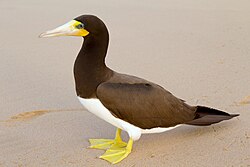
Picture of Sula leucogaster
- Source
- Wikipedia/Commons
- Credit
- Danilo da Castro
- Licence
- CC BY-SA 3.0
- Commercial use
- the licence allows it
No 3D scan of Sula leucogaster was found in Sketchfab.
Smithsonian Open Access and MorphoSource were not reached for this taxon, so this list is what the others held rather than everything there is.
The description on this site
- Source
- Wikipedia, “Brown booby”
- Licence
- CC BY-SA 4.0
This is what the site found, which is not the same as what exists.
Keep going
What may have been alongside itSula through timeFormations of the HoloceneThe world it lived on
Occurrence data from the Paleobiology Database, CC BY 4.0. (Boddaert 1783)