Anous stolidus
The brown noddy, common noddy or noddy tern is a seabird in the family Laridae. The largest of the noddies, it can be told from the closely related black noddy by its larger size and plumage, which is dark brown rather than black. The brown noddy is a tropical seabird with a worldwide distribution, ranging from Hawaii to the Tuamotu Archipelago and Australia in the Pacific Ocean, from the Red Sea to the Seychelles and Australia in the Indian Ocean and in the Caribbean to Tristan da Cunha in the Atlantic Ocean. The brown noddy is colonial, usually nesting on elevated situations on cliffs or in short trees or shrubs. It only occasionally nests on the ground. A single egg is laid by the female of a pair each breeding season. In India, the brown noddy is protected in the PM Sayeed Marine Birds Conservation Reserve.

Charles J. Sharp · CC BY-SA 4.0 · via Wikipedia/Commons. May be a photograph of a specimen, or an artist’s reconstruction — an interpretation of a skeleton, since colour and soft tissue are almost never preserved.
On record
Recorded, not inferred- Also called
- brown noddyPBDB
- Sits inside
- AnousPBDB
- Diet
- carnivorePBDB, for Coelurosauria
- Life habit
- ground dwelling, solitaryPBDB, for Theropoda
- Motility
- actively mobilePBDB, for Theropoda
- Environment
- marinePBDB, for Charadriiformes
Time the record covers
At most 129 thousand years on record.
Every occurrence read is dated to somewhere between 129 ka and 0 Mya, and nothing in the dating separates them, so that window is what the record shows rather than a span.
59 occurrences of Anous stolidus on record, most of them in the Holocene. The Paleobiology Database records this as a living group. Bar height is expected occurrences, not a count: each fossil is spread across the span it is dated to, so a tall narrow bar means tight dating and a low wide one means loose.
When
59 occurrences- Pleistocene2%
- Holocene98%
These are dates about fossils, not the animal: the record can only begin after it arose and end before it died out, so either end may reach further. Shares are expected occurrences: a fossil dated to a span is counted partly in each period it straddles. More on what this infers.
Anous stolidus and its relatives
HoloceneWhere Anous stolidus and its relatives were recorded in the Holocene.
Found in the same rock
181 taxa- Gallus gallus31 sites
- Sula sula19 sites
- Phaethon lepturus18 sites
- Anous minutus16 sites
- Sula15 sites
- Sterninae13 sites
- Fregata minor11 sites
- Puffinus lherminieri11 sites
- Alopecoenas xanthonurus9 sites
- Fregata ariel9 sites
- Gygis alba candida9 sites
- Porzana9 sites
- Sula leucogaster9 sites
- Ducula pacifica8 sites
- Pluvialis dominica8 sites
- Porphyrio porphyrio8 sites
- Ardenna pacifica7 sites
- Gallirallus7 sites
- Onychoprion fuscatus7 sites
- Pseudobulweria rostrata7 sites
- Pterodroma7 sites
- Squamata7 sites
- Anous ceruleus6 sites
- Aplonis opaca6 sites
The Paleobiology Database records 59 sites for Anous stolidus, and this reads all of them. The number is how many of those sites it was catalogued from too. The 24 sharing the most are listed.
This is not a list of everything alive at the time. It is only what has come out of the same ground as this animal and been written down.
Entered from
17 references- Extinction, biogeography, and human exploitation of birds on Tikopia and Anuta, Polynesian outliers in the Solomon Islands21
- The prehistory of vertebrates, especially birds, on Tinian, Aguiguan, and Rota, Northern Mariana Islands8
- Fossil and archaeological avifauna of Niue Island, Pacific Ocean7
- Biogeography and prehistoric exploitation of birds from Fais Island, Yap State, Federated States of Micronesia4
- Fossil vertebrates from Palau, Micronesia: a resource assessment3
- Prehistoric extinction of birds on Mangaia, Cook Islands, Polynesia3
- Prehistoric butchery and consumption of birds in the Kingdom of Tonga, south Pacific2
- Extinct and extirpated birds from Aitutaki and Atiu, southern Cook Islands2
- Avian remains from late pre-colonial Amerindian sites on islands of the Venezuelan Caribbean1
- Bird, reptile and mammal remains from archaeological sites on Rapa Island1
- Avifaunal assemblages from Nenega-iti and Onemea1
- Bird bones from the To’aga site: prehistoric loss of seabirds and megapodes1
Each of the 59 occurrences read was entered from one of these publications, ordered by how many each accounts for. This is not a search for papers mentioning the name. 5 further references are not listed. Entries link to doi.org where the Paleobiology Database holds an identifier, and to its own record where it does not. Relayed as the Paleobiology Database holds them, not checked against what they resolve to.
Media and terms
Media content3

Picture of Anous stolidus
- Source
- Wikipedia/Commons
- Credit
- Charles J. Sharp
- Licence
- CC BY-SA 4.0
- Commercial use
- the licence allows it
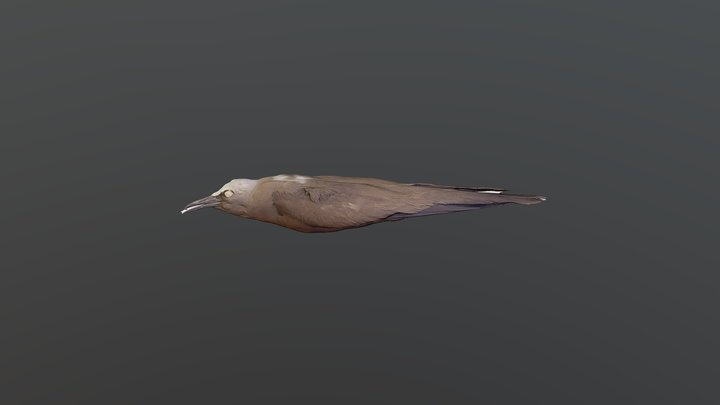
Structured light scan
- Source
- MorphoSource
- Licence
- In Copyright
- Commercial use
- cannot be read from the licence given — check the record
- Specimen
- Anous stolidus · FMNH:Birds:346102
The description on this site
- Source
- Wikipedia, “Brown noddy”
- Licence
- CC BY-SA 4.0
This is what the site found, which is not the same as what exists.
Keep going
What may have been alongside itAnous through timeFormations of the HoloceneThe world it lived on
Occurrence data from the Paleobiology Database, CC BY 4.0. (Linnaeus 1758)