Triphoridae
Triphoridae is a family of very small sea snails, marine gastropod molluscs in the informal group Ptenoglossa, within the clade Hypsogastropoda. Almost all the species in this family are micromollusks and almost all are left-handed in shell-coiling.

Jan Delsing · Public Domain · via Wikipedia/Commons. May be a photograph of a specimen, or an artist’s reconstruction — an interpretation of a skeleton, since colour and soft tissue are almost never preserved.
On record
Recorded, not inferred- Sits inside
- TriphoroideaPBDB
- Diet
- carnivorePBDB
- Life habit
- epifaunalPBDB
- Motility
- actively mobilePBDB
- Vision
- limitedPBDB, for Gastropoda
Time the record covers
At least 61 million years on record.
The record covers at least 61.66 Mya to 11.7 ka. No occurrence read is dated outside 66 Mya to 0 Mya.
369 occurrences of Triphoridae on record, most of them in the Pleistocene. The Paleobiology Database records this as a living group. Bar height is expected occurrences, not a count: each fossil is spread across the span it is dated to, so a tall narrow bar means tight dating and a low wide one means loose.
When
369 occurrencesThese are dates about fossils, not the animal: the record can only begin after it arose and end before it died out, so either end may reach further. Shares are expected occurrences: a fossil dated to a span is counted partly in each period it straddles. More on what this infers.
Found in
90 formations
- Gurabo Formation26
- Bowden Formation · Coastal Group13
- Cercado Formation12
- Palos Verdes Sand Formation10
- Cook Mountain Formation · Claiborne Group9
- Quaternary terrace Formation7
Loading coastlines…
The named rock units Triphoridae has been recovered from, largest first. Drawn where the rock is now, not where it formed. 66 further formations hold fewer occurrences each and are not listed. 139 occurrences have no formation on record, which is common for older literature.
Triphoridae and its relatives
PleistoceneWhere Triphoridae and its relatives were recorded in the Pleistocene.
Found in the same rock
4,197 taxa- Triphora32 sites
- Cerithiopsis20 sites
- Cerithiella19 sites
- Turbonilla19 sites
- Diodora17 sites
- Turritella17 sites
- Odostomia16 sites
- Chama15 sites
- Limopsis15 sites
- Thylacodes squamigerus15 sites
- Californiconus californicus14 sites
- Callianax biplicata14 sites
- Littorina (Littorina) scutulata14 sites
- Polinices14 sites
- Turricula14 sites
- Abra13 sites
- Acteon13 sites
- Bittium13 sites
- Clavilithes13 sites
- Dentalium13 sites
- Epilucina californica13 sites
- Lacuna (Epheria) unifasciata13 sites
- Mitrella tuberosa13 sites
- Amphissa versicolor12 sites
The Paleobiology Database records 161 sites for Triphoridae, and this reads all of them. Of that, one read hit the database's own return limit, so every count below is a floor rather than a total. The number is how many of those sites it was catalogued from too. The 24 sharing the most are listed.
This is not a list of everything alive at the time. It is only what has come out of the same ground as this animal and been written down.
Entered from
119 references- Unpublished notes on Caribbean collection of the Naturhistorisches Museum Basel42
- Cenozoic fossil mollusks from Western Pacific Islands; Gastropods (Turritellidae through Strombidae)27
- Die Fauna des marinen Miozäns von Kevelaer (Niederrhein)19
- Les Mesogastropoda Fossiles du Cenozoïque étranger des Collections de L'Institute Royale des Sciences Naturelles de Belgique: Cyclophoridae à Stilifetidae13
- Resilience of marine invertebrate communities during the early Cenozoic hyperthermals10
- Palaeoecology of the Pleistocene (MIS 5) outcrops of Santa Maria Island (Azores) in a complex oceanic tectonic setting10
- Unpublished census data from Atlantic coastal plain and circum-Caribbean Neogene assemblages and taxonomic opinions10
- Microgastropod trophic structure of the Yongshu reef, South China Sea, since the late Pleistocene in relation to paleoenvironment9
- Late Pleistocene molluscan faunas from upper terraces of the Palos Verdes Hills, California9
- Late Pleistocene invertebrates of the Newport Bay area, California9
- Miocene and Pliocene mollusks from Trinidad8
- The paleoenvironment of an early Middle Miocene Paratethys sequence in NE Austria with special emphasis on mollusks and foraminifera7
Each of the 369 occurrences read was entered from one of these publications, ordered by how many each accounts for. This is not a search for papers mentioning the name. 107 further references are not listed. Entries link to doi.org where the Paleobiology Database holds an identifier, and to its own record where it does not. Relayed as the Paleobiology Database holds them, not checked against what they resolve to.
Media and terms
Media content1
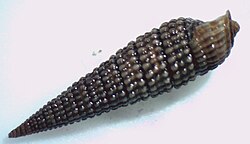
Picture of Triphoridae
- Source
- Wikipedia/Commons
- Credit
- Jan Delsing
- Licence
- Public Domain
- Commercial use
- the licence allows it
No 3D scan was found. Smithsonian Open Access, MorphoSource and Sketchfab were all searched.
The description on this site
- Source
- Wikipedia, “Triphoridae”
- Licence
- CC BY-SA 4.0
This is what the site found, which is not the same as what exists.
Keep going
What may have been alongside itTriphoroidea through timeFormations of the PleistoceneThe world it lived on
Occurrence data from the Paleobiology Database, CC BY 4.0. Gray 1847