Tritheledontidae
Tritheledontidae, the tritheledontids or ictidosaurs, is an extinct family of small to medium-sized cynodonts. They were highly mammal-like, specialized cynodonts, although they still retained a few reptile-like anatomical traits. Tritheledontids were mainly carnivorous or insectivorous, though some species may have developed omnivory. Their skeletons show that they had a close relationship to mammals. Tritheledontids or their closest relatives may have given rise to the mammaliaforms. The tritheledontids were one of the longest lived non-mammalian therapsid lineages, living from the late Triassic to the Jurassic period. Tritheledontids became extinct in the Jurassic period, possibly due to competition with prehistoric mammals such as the eutriconodonts. They are known from finds in South America and South Africa, indicating that they may have lived only on the supercontinent of Gondwana. The family Tritheledontidae was named by South African paleontologist Robert Broom in 1912. The family is often misspelled "Trithelodontidae".

Smokeybjb · CC BY-SA 3.0 · via Wikipedia/Commons. May be a photograph of a specimen, or an artist’s reconstruction — an interpretation of a skeleton, since colour and soft tissue are almost never preserved.
On record
Recorded, not inferred- Sits inside
- MammaliamorphaPBDB
- Motility
- actively mobilePBDB, for Osteichthyes
- Environment
- terrestrialPBDB, for Amniota
Time the record covers
At least 4.3 million years on record.
The record covers at least 205.7 Mya to 201.4 Mya. No occurrence read is dated outside 227.3 Mya to 192.9 Mya.
29 occurrences of Tritheledontidae on record. Bar height is expected occurrences, not a count: each fossil is spread across the span it is dated to, so a tall narrow bar means tight dating and a low wide one means loose.
When
29 occurrencesThese are dates about fossils, not the animal: the record can only begin after it arose and end before it died out, so either end may reach further. Shares are expected occurrences: a fossil dated to a span is counted partly in each period it straddles. More on what this infers.
Found in
8 formations
- Elliot Formation · Stormberg Group11
- Caturrita Formation · Rosário do Sul Group6
- McCoy Brook Formation · Meriden Group3
- Quebrada del Barro Formation · Marayes Group3
- Los Colorados Formation · Agua de la Peña Group2
- Elliot Formation · Stormberg Group2
Loading coastlines…
The named rock units Tritheledontidae has been recovered from, largest first. Drawn where the rock is now, not where it formed.
Found in the same rock
115 taxa- Pachygenelus8 sites
- Massospondylus5 sites
- Pachygenelus monus4 sites
- Riograndia guaibensis4 sites
- Archosauriformes3 sites
- Crocodylomorpha3 sites
- Protosuchus micmac3 sites
- Brasilitherium riograndensis2 sites
- Brasilodontidae2 sites
- Chaliminia musteloides2 sites
- Clevosaurus2 sites
- Clevosaurus brasiliensis2 sites
- Guaibasaurus candelariensis2 sites
- Irajatherium hernandezi2 sites
- Mystriosuchinae2 sites
- Ornithischia2 sites
- Pterosauria2 sites
- Sauropodomorpha2 sites
- Sphenodontia2 sites
- Sphenotitan leyesi2 sites
- Stagonolepididae2 sites
- Theropoda2 sites
- Trilophosaurus2 sites
- Trilophosaurus buettneri2 sites
The Paleobiology Database records 26 sites for Tritheledontidae, and this reads all of them. The number is how many of those sites it was catalogued from too. The 24 sharing the most are listed.
This is not a list of everything alive at the time. It is only what has come out of the same ground as this animal and been written down.
Entered from
17 references- Fossils from the Elliot and Clarens Formations (Karoo Sequence) of the northeastern Cape, Orange Free State and Lesotho, and a suggested biozonation based on tetrapods8
- A new Late Triassic vertebrate assemblage from northwestern Argentina3
- New fossil evidence on the sister-group of mammals and early Mesozoic faunal distributions3
- New information on Riograndia guaibensis Bonaparte, Ferigolo & Ribeiro, 2001 (Eucynodontia, Tritheledontidae) from the Late Triassic of southern Brazil: anatomical and biostratigraphic implications2
- New information about Irajatherium hernandezi Martinelli, Bonaparte, Schultz & Rubert 2005 (Eucynodontia, Tritheledontidae) from the upper triassic (Caturrita Formation, Parana Basin) of Brazil1
- The continental tetrapod-bearing Triassic of south Brazil1
- On Chaliminia musteloides (Eucynodontia: Tritheledontidae) from the Late Triassic of Argentina, and a phylogeny of Ictidosauria1
- Elliotherium kersteni, a new tritheledontid from the lower Elliot Formation (Upper Triassic) of South Africa1
- A new tritheledontid (Therapsida, Eucynodontia) from the Late Triassic of Rio Grande do Sul (Brazil) and its phylogenetic relationships among carnivorous non-mammalian eucynodonts1
- Tetrapod association and palaeoenvironment of the Los Colorados Formation (Argentina): a significant sample from western Gondwana at the end of the Triassic1
- Late Triassic microvertebrates from the lower Chinle Group (Otischalkian-Adamanian: Carnian), southwestern U.S.A.1
- A primitive Late Triassic 'ictidosaur' from Rio Grande do Sul, Brazil1
Each of the 29 occurrences read was entered from one of these publications, ordered by how many each accounts for. This is not a search for papers mentioning the name. 5 further references are not listed. Entries link to doi.org where the Paleobiology Database holds an identifier, and to its own record where it does not. Relayed as the Paleobiology Database holds them, not checked against what they resolve to.
Media and terms
Media content1
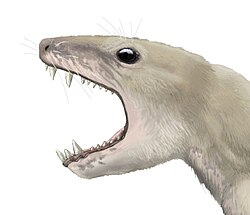
Picture of Tritheledontidae
- Source
- Wikipedia/Commons
- Credit
- Smokeybjb
- Licence
- CC BY-SA 3.0
- Commercial use
- the licence allows it
No 3D scan of Tritheledontidae was found in Sketchfab.
Smithsonian Open Access and MorphoSource were not reached for this taxon, so this list is what the others held rather than everything there is.
The description on this site
- Licence
- CC BY-SA 4.0
This is what the site found, which is not the same as what exists.
Keep going
What may have been alongside itMammaliamorpha through timeThe world it lived on
Occurrence data from the Paleobiology Database, CC BY 4.0. (Broom 1912)