Tursiops
The bottlenose dolphin is a toothed whale in the genus Tursiops. They are common, cosmopolitan members of the family Delphinidae, the family of oceanic dolphins. Molecular studies show the genus contains three species: the common bottlenose dolphin, the Indo-Pacific bottlenose dolphin, and Tamanend's bottlenose dolphin. Others, like the Burrunan dolphin, may be alternately considered their own species or be subspecies of T. aduncus. Bottlenose dolphins inhabit warm and temperate seas worldwide, being found everywhere except for the Arctic and Antarctic Circle regions. Their name derives from the Latin tursio (dolphin) and truncatus for the truncated teeth.

NASA · Public Domain · via Wikipedia/Commons. May be a photograph of a specimen, or an artist’s reconstruction — an interpretation of a skeleton, since colour and soft tissue are almost never preserved.
On record
Recorded, not inferred- Sits inside
- DelphininaePBDB
- Diet
- piscivore, carnivorePBDB, for Delphinidae
- Life habit
- aquatic, depth=surfacePBDB, for Cetacea
- Motility
- actively mobilePBDB, for Cetacea
- Environment
- marine,freshwaterPBDB, for Odontoceti
Time the record covers
At least 3.5 million years on record.
The record covers at least 3.6 Mya to 11.7 ka. No occurrence read is dated outside 7.246 Mya to 0 Mya.
54 occurrences of Tursiops on record. The Paleobiology Database records this as a living group. Bar height is expected occurrences, not a count: each fossil is spread across the span it is dated to, so a tall narrow bar means tight dating and a low wide one means loose.
When
54 occurrences- Mioceneunder 1%
- Pliocene23%
- Pleistocene23%
- Holocene54%
These are dates about fossils, not the animal: the record can only begin after it arose and end before it died out, so either end may reach further. Shares are expected occurrences: a fossil dated to a span is counted partly in each period it straddles. More on what this infers.
Found in
10 formations
- Yorktown Formation · Chesapeake Group2
- Talbot Formation1
- Silver Bluff Formation1
- Whaler's Bluff Formation1
- Palos Verdes Sand Formation1
- Kattendijk Formation1
Loading coastlines…
The named rock units Tursiops has been recovered from, largest first. Drawn where the rock is now, not where it formed. 43 occurrences have no formation on record, which is common for older literature.
Found in the same rock
756 taxa- Delphinus delphis6 sites
- Ziphiidae6 sites
- Balaenopteridae5 sites
- Delphinidae5 sites
- Balaena4 sites
- Delphinus4 sites
- Equus4 sites
- Mysticeti4 sites
- Phocidae4 sites
- Physeter macrocephalus4 sites
- Sus scrofa4 sites
- Balaenidae3 sites
- Cervus elaphus3 sites
- Globicephala macrorhynchus3 sites
- Kogia3 sites
- Kogia breviceps3 sites
- Larus3 sites
- Megaptera3 sites
- Mesoplodon3 sites
- Ontocetus emmonsi3 sites
- Phocoena phocoena3 sites
- Physeteridae3 sites
- Podiceps auritus3 sites
- Aenocyon dirus2 sites
The Paleobiology Database records 51 sites for Tursiops, and this reads all of them. The number is how many of those sites it was catalogued from too. The 24 sharing the most are listed.
This is not a list of everything alive at the time. It is only what has come out of the same ground as this animal and been written down.
Entered from
41 references- Abundance and density of cetaceans in the California Current ecosystem5
- Earliest Records of Holocene Cetaceans in the Black Sea3
- Marine mammal strandings in the New Caledonia region, Southwest Pacific3
- Catalog of Living Whales3
- Remarkable mandibular fracture healing in an early Holocene bottlenose dolphin (Tursiops truncatus)2
- Sopra un cranio di Tursiops cortesii (Desm.) var astensis Sacc. dell'Astigiana2
- Lydekker, 18872
- Determining the ages of sub-fossil cetacean remains, found in the Carse of Stirling, Scotland1
- Revalidation of Tursiops gephyreus Lahille, 1908 (Cetartiodactyla: Delphinidae) from the southwestern Atlantic Ocean1
- Taphonomic variation despite catastrophic mortality: Analysis of a mass stranding of false killer whales (Pseudorca crassidens), Gulf of California, Mexico1
- Pliocene marine mammals from the Whalers Bluff Formation of Portland, Victoria, Australia1
- Neogene climatic change and the emergence of the modern whale fauna of the North Atlantic Ocean1
Each of the 54 occurrences read was entered from one of these publications, ordered by how many each accounts for. This is not a search for papers mentioning the name. 29 further references are not listed. Entries link to doi.org where the Paleobiology Database holds an identifier, and to its own record where it does not. Relayed as the Paleobiology Database holds them, not checked against what they resolve to.
Media and terms
Media content3

Picture of Tursiops
- Source
- Wikipedia/Commons
- Credit
- NASA
- Licence
- Public Domain
- Commercial use
- the licence allows it
CT scan
- Source
- MorphoSource
- Licence
- In Copyright
- Commercial use
- cannot be read from the licence given — check the record
- Specimen
- Tursiops aduncus · SAMA:Mammalogy:M15598
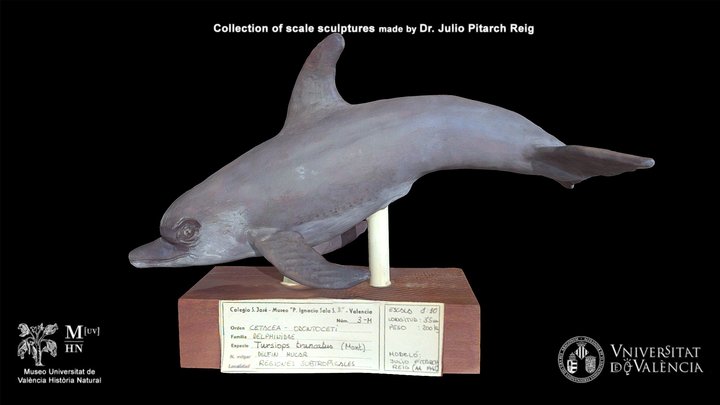
3D model
- Source
- Sketchfab
- Licence
- CC Attribution
- Commercial use
- cannot be read from the licence given — check the record
The description on this site
- Licence
- CC BY-SA 4.0
This is what the site found, which is not the same as what exists.
Keep going
What may have been alongside itDelphininae through timeThe world it lived on
Occurrence data from the Paleobiology Database, CC BY 4.0. Gervais 1855