Delphinus
The common dolphin is the most abundant cetacean in the world, with an estimated global population of about six million. It is currently the only member of the genus Delphinus, the type genus of the subfamily Delphininae. This places it as a close relative of the bottlenose dolphin, humpback dolphin, striped dolphin, spinner dolphin, Clymene dolphin, spotted dolphin, Fraser's dolphin, the tucuxi, and the Guiana dolphin.

NOAA NMFS · Public Domain · via Wikipedia/Commons. May be a photograph of a specimen, or an artist’s reconstruction — an interpretation of a skeleton, since colour and soft tissue are almost never preserved.
On record
Recorded, not inferred- Also called
- common dolphinPBDB
- Sits inside
- DelphininaePBDB
- Diet
- piscivore, carnivorePBDB, for Delphinidae
- Life habit
- aquatic, depth=surfacePBDB, for Cetacea
- Motility
- actively mobilePBDB, for Cetacea
- Environment
- marine,freshwaterPBDB, for Odontoceti
Time the record covers
At least 11 million years on record.
The record covers at least 11.63 Mya to 11.7 ka. No occurrence read is dated outside 23.04 Mya to 0 Mya.
58 occurrences of Delphinus on record. The Paleobiology Database records this as a living group. Bar height is expected occurrences, not a count: each fossil is spread across the span it is dated to, so a tall narrow bar means tight dating and a low wide one means loose.
When
58 occurrences- Miocene16%
- Pliocene30%
- Pleistocene14%
- Holocene40%
These are dates about fossils, not the animal: the record can only begin after it arose and end before it died out, so either end may reach further. Shares are expected occurrences: a fossil dated to a span is counted partly in each period it straddles. More on what this infers.
Found in
10 formations
- Tangahoe Formation3
- Yorktown Formation · Chesapeake Group2
- Norwich Crag Formation2
- Cromer Forest Bed Formation2
- Pisco Formation1
- Tatsunokuchi Formation1
Loading coastlines…
The named rock units Delphinus has been recovered from, largest first. Drawn where the rock is now, not where it formed. 43 occurrences have no formation on record, which is common for older literature.
Found in the same rock
904 taxa- Cetacea8 sites
- Cervus elaphus6 sites
- Delphinidae6 sites
- Mesoplodon6 sites
- Tursiops truncatus6 sites
- Cervus5 sites
- Globicephala5 sites
- Mysticeti5 sites
- Sus scrofa5 sites
- Ziphiidae5 sites
- Balaenoptera4 sites
- Balaenopteridae4 sites
- Bos primigenius4 sites
- Grampus griseus4 sites
- Kogia4 sites
- Melanitta nigra4 sites
- Otodus megalodon4 sites
- Panthera pardus4 sites
- Phocidae4 sites
- Physeter macrocephalus4 sites
- Stenella4 sites
- Tursiops4 sites
- Bovinae3 sites
- Canis lupus3 sites
The Paleobiology Database records 53 sites for Delphinus, and this reads all of them. The number is how many of those sites it was catalogued from too. The 24 sharing the most are listed.
This is not a list of everything alive at the time. It is only what has come out of the same ground as this animal and been written down.
Entered from
41 references- Geographic Variation of the Common Dolphin, Delphinus delphis (Odontoceti Delphinidae)7
- Earliest Records of Holocene Cetaceans in the Black Sea4
- Catalog of Localities of Tertiary Vertebrates of the USSR3
- Report on the bones of Cetacea3
- Geology and vertebrate palaeontology of the Tangahoe Formation, South Taranaki Coast, New Zealand2
- Catalogo dei mammiferi fossili dell' Italia meridionale continentale2
- The Vertebrata of the Forest Bed Series of Norfolk and Suffolk2
- Rapport de M. Van Beneden2
- Determining the ages of sub-fossil cetacean remains, found in the Carse of Stirling, Scotland1
- The Herpetocetinae, a new subfamily of extinct baleen whales (Mammalia, Cetacea, Cetotheriidae)1
- Pliocene marine mammals from the Whalers Bluff Formation of Portland, Victoria, Australia1
- The sedimentology and palaeoecology of the Westleton Member of the Norwich Crag Formation (Early Pleistodene) at Thorigton, Suffolk, England1
Each of the 58 occurrences read was entered from one of these publications, ordered by how many each accounts for. This is not a search for papers mentioning the name. 29 further references are not listed. Entries link to doi.org where the Paleobiology Database holds an identifier, and to its own record where it does not. Relayed as the Paleobiology Database holds them, not checked against what they resolve to.
Media and terms
Media content3
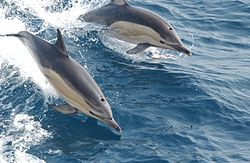
Picture of Delphinus
- Source
- Wikipedia/Commons
- Credit
- NOAA NMFS
- Licence
- Public Domain
- Commercial use
- the licence allows it
Laser scan
- Source
- MorphoSource
- Licence
- In Copyright
- Commercial use
- cannot be read from the licence given — check the record
- Specimen
- Delphinus delphis · MZRC:10088
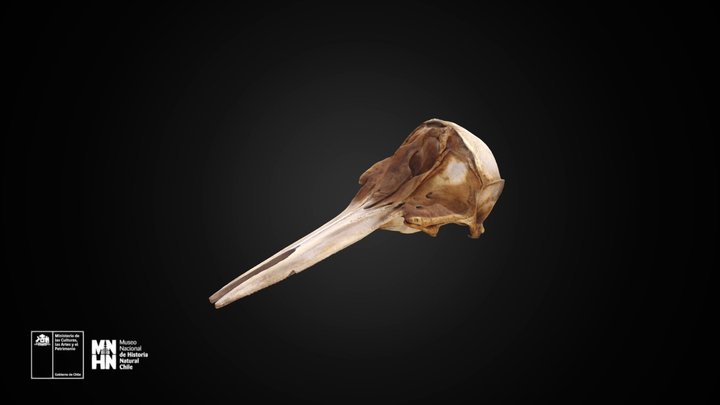
3D model
- Source
- Sketchfab
- Licence
- CC Attribution-NonCommercial-ShareAlike
- Commercial use
- the licence does not allow it
The description on this site
- Licence
- CC BY-SA 4.0
This is what the site found, which is not the same as what exists.
Keep going
What may have been alongside itDelphininae through timeThe world it lived on
Occurrence data from the Paleobiology Database, CC BY 4.0. Linnaeus 1758