Ursidae
Bears are carnivoran mammals of the family Ursidae. They are classified as caniforms within the suborder Caniformia. Although only eight species of bears are extant, they are widespread, appearing in a wide variety of habitats throughout most of the Northern Hemisphere and partially in the Southern Hemisphere. Bears are found on the continents of North America, South America, and Eurasia. Common characteristics of modern bears include large bodies with stocky legs, long snouts, small rounded ears, shaggy hair, plantigrade paws with five nonretractile claws, and short tails.

Jean-noël Lafargue · FAL · via Wikipedia/Commons. May be a photograph of a specimen, or an artist’s reconstruction — an interpretation of a skeleton, since colour and soft tissue are almost never preserved.
On record
Recorded, not inferred- Also called
- bearPBDB
- Sits inside
- UrsoideaPBDB
- Diet
- herbivore, carnivorePBDB
- Life habit
- ground dwellingPBDB
- Motility
- actively mobilePBDB, for Osteichthyes
- Environment
- terrestrialPBDB, for Eutheria
Time the record covers
At least 33 million years on record.
The record covers at least 33.9 Mya to 11.7 ka. No occurrence read is dated outside 37 Mya to 0 Mya.
1,027 occurrences of Ursidae on record, most of them in the Pleistocene. The Paleobiology Database records this as a living group. Bar height is expected occurrences, not a count: each fossil is spread across the span it is dated to, so a tall narrow bar means tight dating and a low wide one means loose.
When
1,027 occurrencesThese are dates about fossils, not the animal: the record can only begin after it arose and end before it died out, so either end may reach further. Shares are expected occurrences: a fossil dated to a span is counted partly in each period it straddles. More on what this infers.
Found in
123 formations
- Hsanda Gol Formation7
- Chadron Formation6
- White River Formation6
- Cromer Forest Bed Formation6
- Runningwater Formation5
- Glenns Ferry Formation5
Loading coastlines…
The named rock units Ursidae has been recovered from, largest first. Drawn where the rock is now, not where it formed. 99 further formations hold fewer occurrences each and are not listed. 819 occurrences have no formation on record, which is common for older literature.
Ursidae and its relatives
PleistoceneWhere Ursidae and its relatives were recorded in the Pleistocene.
Found in the same rock
3,222 taxa- Equus72 sites
- Mimomys31 sites
- Lepus28 sites
- Microtus27 sites
- Camelidae26 sites
- Odocoileus virginianus26 sites
- Ursus26 sites
- Cervus23 sites
- Chiroptera22 sites
- Stephanorhinus etruscus22 sites
- Aves21 sites
- Hemiauchenia21 sites
- Pliomys21 sites
- Rana21 sites
- Ursus etruscus21 sites
- Allocricetus20 sites
- Arctodus pristinus20 sites
- Spermophilus20 sites
- Hemiauchenia macrocephala19 sites
- Myodes19 sites
- Paramylodon harlani19 sites
- Apodemus sylvaticus18 sites
- Bufo18 sites
- Dasypus bellus17 sites
The Paleobiology Database records 839 sites for Ursidae, and this reads 240 of them. The number is how many of those sites it was catalogued from too. The 24 sharing the most are listed.
This is not a list of everything alive at the time. It is only what has come out of the same ground as this animal and been written down.
Entered from
502 references- Polar bear fossil and archaeological records from the Pleistocene and Holocene in relation to sea ice extent and open water polynyas45
- Ursidae29
- Mittelpleistozane Saugetierfaunen aus Mitteleuropa - der Versuch einer biostratigraphischen Zuordnung21
- I giacimenti Quaternari di vertebrati fossili nell'Italia Nord-Orientale18
- Pleistocene vertebrate faunas of Hungary16
- Quaternary vertebrate localities of Virginia and their avian and mammalian fauna15
- A preliminary report on Carnivora from the Ramapithecus locality, Lufeng, Yunnan15
- Synonymies and reidentifications of North American fossil mammals12
- Les fossiles de mammifères miocènes de la colletion de J.-P. Hartmann conservés dans le Musée du Savignéen10
- Principaux gisements paleontologiques Francais du Pleistocene Moyen: Essai de classification10
- Arctoid genetic characters as related to the genus Parictis10
- The evolution of Arctic marine mammals9
Each of the 1,027 occurrences read was entered from one of these publications, ordered by how many each accounts for. This is not a search for papers mentioning the name. 490 further references are not listed. Entries link to doi.org where the Paleobiology Database holds an identifier, and to its own record where it does not. Relayed as the Paleobiology Database holds them, not checked against what they resolve to.
Media and terms
Media content3
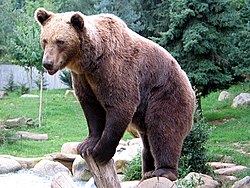
Picture of Ursidae
- Source
- Wikipedia/Commons
- Credit
- Jean-noël Lafargue
- Licence
- FAL
- Commercial use
- the licence allows it
CT scan
- Source
- MorphoSource
- Licence
- not stated by the source
- Commercial use
- cannot be read from the licence given — check the record
- Specimen
- Ursidae indet. · ucmp:v:22462
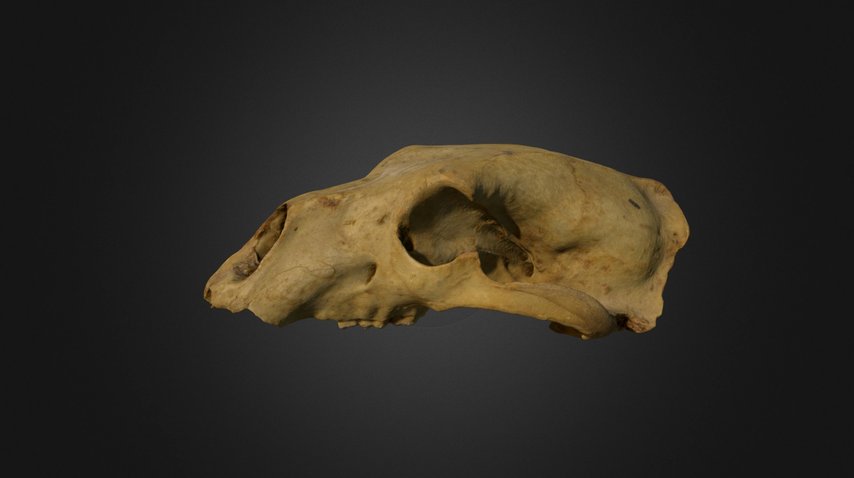
3D model
- Source
- Sketchfab
- Credit
- Abby Gancz
- Licence
- CC Attribution
- Commercial use
- cannot be read from the licence given — check the record
The description on this site
- Source
- Wikipedia, “Bear”
- Licence
- CC BY-SA 4.0
This is what the site found, which is not the same as what exists.
Keep going
What may have been alongside itUrsoidea through timeFormations of the PleistoceneThe world it lived on
Occurrence data from the Paleobiology Database, CC BY 4.0. Gray 1825