Velatida
The Velatida are an order of sea stars containing about 200 species in five families. These sea stars normally have thick bodies with large discs.

Peter Southwood · CC BY-SA 3.0 · via Wikipedia/Commons. May be a photograph of a specimen, or an artist’s reconstruction — an interpretation of a skeleton, since colour and soft tissue are almost never preserved.
On record
Recorded, not inferred- Sits inside
- ChevronidaPBDB
- Diet
- carnivore, detritivorePBDB
- Life habit
- epifaunal, solitary, depth=subthermoclinePBDB
- Motility
- actively mobilePBDB
- Vision
- limitedPBDB, for Asteroidea
- Environment
- outer shelf,oceanic,marinePBDB
Time the record covers
At least 127 million years on record.
The record covers at least 199.5 Mya to 72.2 Mya. No occurrence read is dated outside 201.4 Mya to 66 Mya.
14 occurrences of Velatida on record, most of them in the Early Jurassic. The Paleobiology Database records this as a living group, and the chart stops with its fossils rather than at the present. Bar height is expected occurrences, not a count: each fossil is spread across the span it is dated to, so a tall narrow bar means tight dating and a low wide one means loose.
When
14 occurrencesThese are dates about fossils, not the animal: the record can only begin after it arose and end before it died out, so either end may reach further. Shares are expected occurrences: a fossil dated to a span is counted partly in each period it straddles. More on what this infers.
Found in
5 formations
- Unterer Hauptraugenstein Formation1
- Charmouth Mudstone Formation1
- Gulpen Formation1
- White Chalk Formation1
- Lully Foothills Formation · LeMay Group1
Loading coastlines…
The named rock units Velatida has been recovered from, largest first. Drawn where the rock is now, not where it formed. 9 occurrences have no formation on record, which is common for older literature.
Velatida and its relatives
Early JurassicWhere Velatida and its relatives were recorded in the Early Jurassic.
Found in the same rock
314 taxa- Plesiastropecten hallovensis3 sites
- Bourgueticrinus2 sites
- Cardiotaxis2 sites
- Chladocrinus2 sites
- Chomataster acules2 sites
- Coulonia2 sites
- Echinocorys2 sites
- Echinogalerus2 sites
- Ophiocoma senonensis2 sites
- Ophiomusium granulosum2 sites
- Ophiopetra oertlii2 sites
- Ophiura astonensis2 sites
- Palaeocoma milleri2 sites
- Plumaster2 sites
- Pteraster2 sites
- Recurvaster radiatus2 sites
- Sinosura brodiei2 sites
- Sinosura schneideri2 sites
- Stegophiura hagenowi2 sites
- Terminaster cancriformis2 sites
- Tropidaster pectinatus2 sites
- Achistrum1 site
- Acrosalenia1 site
- Adamanteryon fourneti1 site
The Paleobiology Database records 12 sites for Velatida, and this reads all of them. The number is how many of those sites it was catalogued from too. The 24 sharing the most are listed.
This is not a list of everything alive at the time. It is only what has come out of the same ground as this animal and been written down.
Entered from
9 references- Asteroidea (Echinodermata) from the Oxfordian (Late Jurassic) of Savigna, Départment du Jura, France2
- A new echinoderm Lagerstätte from the Pliensbachian (Early Jurassic) of the French Ardennes2
- Sea stars from Middle Jurassic Lagerstätte of La Voulte-sur-Rhône (Ardèche, France)2
- A preliminary phylogeny of the Pterasteridae (Echinodermata, Asteroidea) and the first fossil record: Late Cretaceous of Germany and Belgium2
- The Benthopectinidae (Asteroidea: Echinodermata) of the Jurassic of Switzerland2
- Systematics, palaeoecology, and evolutionary significance of Middle Toarcian Asteroidea (Echinodermata) from the 'Seuil du Poitou', Western France1
- Redescription and interpretation of the asteroid species Tropidaster pectinatus from the Jurassic of England1
- Protremaster, a new lower jurassic genus of asteroid from Antarctica1
- Beiträge zur Kenntnis von Rhät und Lias [Contributions to knowledge of the Rhaetian and Lias]1
Each of the 14 occurrences read was entered from one of these publications, ordered by how many each accounts for. This is not a search for papers mentioning the name. Entries link to doi.org where the Paleobiology Database holds an identifier, and to its own record where it does not. Relayed as the Paleobiology Database holds them, not checked against what they resolve to.
Media and terms
Media content1
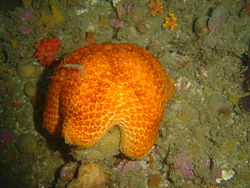
Picture of Velatida
- Source
- Wikipedia/Commons
- Credit
- Peter Southwood
- Licence
- CC BY-SA 3.0
- Commercial use
- the licence allows it
No 3D scan of Velatida was found in Sketchfab.
Smithsonian Open Access and MorphoSource were not reached for this taxon, so this list is what the others held rather than everything there is.
The description on this site
- Source
- Wikipedia, “Velatida”
- Licence
- CC BY-SA 4.0
This is what the site found, which is not the same as what exists.
Keep going
What may have been alongside itChevronida through timeFormations of the Early JurassicThe world it lived on
Occurrence data from the Paleobiology Database, CC BY 4.0. (Perrier 1893)