Bithynia
Bithynia is a genus of small freshwater snails with an operculum, aquatic prosobranch gastropod mollusks in the family Bithyniidae.

Uncredited · via Wikipedia/Commons. May be a photograph of a specimen, or an artist’s reconstruction — an interpretation of a skeleton, since colour and soft tissue are almost never preserved.
On record
Recorded, not inferred- Sits inside
- BithyniidaePBDB
- Diet
- grazerPBDB, for Rissooidea
- Life habit
- epifaunalPBDB, for Rissooidea
- Motility
- actively mobilePBDB, for Rissooidea
- Vision
- limitedPBDB, for Gastropoda
- Environment
- freshwaterPBDB, for Bithyniidae
Time the record covers
At least 165 million years on record.
The record covers at least 165.3 Mya to 11.7 ka. No occurrence read is dated outside 170.9 Mya to 0 Mya.
68 occurrences of Bithynia on record, most of them in the Miocene. The Paleobiology Database records this as a living group. Bar height is expected occurrences, not a count: each fossil is spread across the span it is dated to, so a tall narrow bar means tight dating and a low wide one means loose.
When
68 occurrences- Middle Jurassic1%
- Early Cretaceous1%
- Late Cretaceous1%
- Paleocene3%
- Eocene3%
- Oligocene1%
- Miocene65%
- Pliocene10%
- Pleistocene11%
- Holocene3%
These are dates about fossils, not the animal: the record can only begin after it arose and end before it died out, so either end may reach further. Shares are expected occurrences: a fossil dated to a span is counted partly in each period it straddles. More on what this infers.
Found in
16 formations
- Kirchberg Formation10
- Santa Maria di Ciciliano Formation3
- Grimmelfingen Formation3
- Afyon Formation2
- Headon Beds Formation2
- Vistula Formation2
Loading coastlines…
The named rock units Bithynia has been recovered from, largest first. Drawn where the rock is now, not where it formed. 36 occurrences have no formation on record, which is common for older literature.
Bithynia and its relatives
MioceneWhere Bithynia and its relatives were recorded in the Miocene.
Found in the same rock
720 taxa- Gyraulus12 sites
- Limax11 sites
- Pisidium7 sites
- Planorbis7 sites
- Prolagus oeningensis7 sites
- Rhinocerotidae7 sites
- Galerix6 sites
- Leuciscus6 sites
- Miodyromys aegercii6 sites
- Planorbarius6 sites
- Cepaea5 sites
- Ophisaurus5 sites
- Anisus (Odontogyrorbis) krambergeri4 sites
- Carychium sandbergeri4 sites
- Discus pleuradrus4 sites
- Gastrocopta acuminata4 sites
- Gastrocopta nouletiana4 sites
- Gekkonidae4 sites
- Helicidae4 sites
- Lacerta4 sites
- Lacertidae4 sites
- Megacricetodon minor4 sites
- Microdyromys4 sites
- Nesovitrea disciformis4 sites
The Paleobiology Database records 44 sites for Bithynia, and this reads all of them. The number is how many of those sites it was catalogued from too. The 24 sharing the most are listed.
This is not a list of everything alive at the time. It is only what has come out of the same ground as this animal and been written down.
Entered from
28 references- Early Miocene continental gastropods from new localities of the Molasse Basin in southern Germany21
- Synopsis of the Late Miocene mollusc fauna of the classical sections Richardhof and Eichkogel in the Vienna Basin (Austria, Pannonian, MN 9-MN11)4
- Moluscos continentales del Plio-Pleistoceno de la cuenca de Guadix-Baza4
- Vertebrate microfossils from the Upper Freshwater Molasse in the Swiss Molasse Basin: Implications for the evolution of the North Alpine Foreland Basin during the Miocene Climate Optimum3
- The section of Torre Picchio (Terni, Umbria, Central Italy): A Villafranchian site rich in vertebrates, molluscs, ostracods and plants.3
- Mesozoic and Cenozoic fossil Gastropoda from Yunnan3
- Stratigraphic and palaeogeographic significance of lacustrine molluscs from the Pliocene Viviparus beds in central Croatia2
- The Middle Miocene freshwater mollusk fauna of Lake Gacko (SE Bosnia and Herzegovina): taxonomic revision and paleoenvironmental analysis2
- Neogene Mollusken aus dem Tertiärbecken bei Afyon, Tuerkey2
- Neue Ergebnisse zur Stratigraphie der mittleren Serie der Oberen Süßwassermolasse Bayerns (New results on the stratigraphy of the middle series of upper Freshwater Molasse, Bavaria)2
- L'environnement côtier des Alpes-Maritimes à la fin de la transgression versilienne d'après l'étude biostratigraphique du site de l'Etoile à Nice (France)2
- Morza plejstocenskie w Polsce; osady, wiek i paleogeografia [Pleistocene seas in Poland; sediments, age and paleogeography]2
Each of the 68 occurrences read was entered from one of these publications, ordered by how many each accounts for. This is not a search for papers mentioning the name. 16 further references are not listed. Entries link to doi.org where the Paleobiology Database holds an identifier, and to its own record where it does not. Relayed as the Paleobiology Database holds them, not checked against what they resolve to.
Media and terms
Media content2
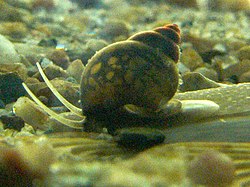
Picture of Bithynia
- Source
- Wikipedia/Commons
- Credit
- nobody named on the record
- Licence
- not stated by the source
- Commercial use
- cannot be read from the licence given — check the record
3D model
- Source
- Sketchfab
- Credit
- Frank McMains
- Licence
- CC Attribution
- Commercial use
- cannot be read from the licence given — check the record
Smithsonian Open Access was not reached for this taxon, so this list is what the others held rather than everything there is.
The description on this site
- Licence
- CC BY-SA 4.0
This is what the site found, which is not the same as what exists.
Keep going
What may have been alongside itBithyniidae through timeFormations of the MioceneThe world it lived on
Occurrence data from the Paleobiology Database, CC BY 4.0. Leach 1818