Boops
Boops is a genus of marine ray-finned fishes belonging to the family Sparidae, the seabreams and porgies. There are two species in this genus, one in the Eastern Atlantic and Mediterranean, and the other in the Western Indian Ocean.

riblje-oko.hr · CC BY-SA 3.0 · via Wikipedia/Commons. May be a photograph of a specimen, or an artist’s reconstruction — an interpretation of a skeleton, since colour and soft tissue are almost never preserved.
On record
Recorded, not inferred- Sits inside
- SparidaePBDB
- Diet
- carnivorePBDB, for Perciformes
- Life habit
- nektonicPBDB, for Perciformes
- Motility
- actively mobilePBDB, for Perciformes
Time the record covers
At least 10 million years on record.
The record covers at least 12.8 Mya to 2.58 Mya. No occurrence read is dated outside 33.9 Mya to 1.8 Mya.
18 occurrences of Boops on record, most of them in the Miocene. The Paleobiology Database records this as a living group, and the chart stops with its fossils rather than at the present. Bar height is expected occurrences, not a count: each fossil is spread across the span it is dated to, so a tall narrow bar means tight dating and a low wide one means loose.
When
18 occurrences- Oligocene2%
- Miocene53%
- Pliocene37%
- Pleistocene8%
These are dates about fossils, not the animal: the record can only begin after it arose and end before it died out, so either end may reach further. Shares are expected occurrences: a fossil dated to a span is counted partly in each period it straddles. More on what this infers.
Found in
2 formations
Loading coastlines…
The named rock units Boops has been recovered from, largest first. Drawn where the rock is now, not where it formed. 15 occurrences have no formation on record, which is common for older literature.
Boops and its relatives
MioceneWhere Boops and its relatives were recorded in the Miocene.
Found in the same rock
369 taxa- Bregmaceros albyi11 sites
- Gadiculus9 sites
- Spratelloides gracilis9 sites
- Maurolicus muelleri8 sites
- Trachurus7 sites
- Capros aper6 sites
- Lesueurigobius6 sites
- Carapus acus5 sites
- Deltentosteus5 sites
- Hygophum5 sites
- Sardina pilchardus5 sites
- Trachurus trachurus5 sites
- Alosa elongata4 sites
- Arnoglossus laterna4 sites
- Centriscus4 sites
- Dactylopterus4 sites
- Dentex4 sites
- Gobius4 sites
- Gobius xiphurus4 sites
- Lophius budegassa4 sites
- Solea4 sites
- Syngnathus albyi4 sites
- Alutera3 sites
- Arnoglossus3 sites
The Paleobiology Database records 18 sites for Boops, and this reads all of them. The number is how many of those sites it was catalogued from too. The 24 sharing the most are listed.
This is not a list of everything alive at the time. It is only what has come out of the same ground as this animal and been written down.
Entered from
11 references- Messinian marine fish communities of the Mediterranean Sea3
- The Zanclean marine fish fauna and palaeoenvironmental reconstruction of a coastal marine setting in the eastern Mediterranean2
- Fish otoliths from the Middle Miocene of Kienberg at Mikulov, Czech REpublic, Vienna Basin: Their paleoenvironmental and paleogeographic significance2
- Découverte d’une ichthyofaune marine dans les diatomites du Pliocène supérieur (Plaisancien) des environs d’Héraklion (Crète centrale, Grèce)2
- Données récentes sur Les téléostéens du Miocène et du Pliocéne d'Italie2
- Biogeography and climatology of Pliocene and Messinian fossil fish of eastern-central Italy2
- Lower Badenian fish otoliths of the Styrian and Lavanttal basins, with a revision of Weinfurter's type material1
- Paléobiodiversité et paléoenvironnements: l’exemple des gisements de poissons téléostéens du Messinien préévaporitique d’Oran et du bassin du Chélif (Algérie)1
- Boops roulei Arambourg (Teleostei, Percoidei) in the Messinian of Central Italy, with comments on systematics, paleoecology and zoogeography1
- Amnissos: un gisement clé pour la connaissance de l'ichthyofaune du Pliocène supérieur de Crète1
- Les otolithes des téléostéens de l'oligo-miocène Belge1
Each of the 18 occurrences read was entered from one of these publications, ordered by how many each accounts for. This is not a search for papers mentioning the name. Entries link to doi.org where the Paleobiology Database holds an identifier, and to its own record where it does not. Relayed as the Paleobiology Database holds them, not checked against what they resolve to.
Media and terms
Media content2
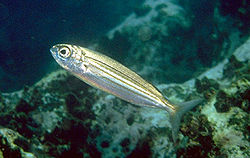
Picture of Boops
- Source
- Wikipedia/Commons
- Credit
- riblje-oko.hr
- Licence
- CC BY-SA 3.0
- Commercial use
- the licence allows it
CT scan
- Source
- MorphoSource
- Credit
- Bell Museum fishes
- Licence
- In Copyright
- Commercial use
- cannot be read from the licence given — check the record
- Specimen
- Notropis boops · JFBM:Fishes:45492
Smithsonian Open Access was not reached for this taxon, so this list is what the others held rather than everything there is.
The description on this site
- Source
- Wikipedia, “Boops”
- Licence
- CC BY-SA 4.0
This is what the site found, which is not the same as what exists.
Keep going
What may have been alongside itSparidae through timeFormations of the MioceneThe world it lived on
Occurrence data from the Paleobiology Database, CC BY 4.0. Cuvier 1814