Calopterygidae
Calopterygidae is a family of damselflies, in the superfamily Calopterygoidea. Members of Calopterygidae are commonly known as broad-winged damselflies, demoiselles, or jewelwings. These rather large damselflies have wingspans of 50–80 mm, are often metallic-coloured, and can be differentiated from other damselflies by the broader connection between the wings and the body, as opposed to the abrupt narrowing seen in other damselfly families. The family contains some 150 species.

Michael Apel · CC BY 2.5 · via Wikipedia/Commons. May be a photograph of a specimen, or an artist’s reconstruction — an interpretation of a skeleton, since colour and soft tissue are almost never preserved.
On record
Recorded, not inferred- Also called
- broad-winged damselflyPBDB
- Sits inside
- CalopterygoideaPBDB
- Diet
- carnivore, insectivorePBDB, for Odonata
- Life habit
- volantPBDB, for Odonata
- Motility
- fast-movingPBDB, for Odonata
- Vision
- well-developedPBDB, for Odonata
- Environment
- freshwater,terrestrialPBDB, for Odonata
Time the record covers
At least 44 million years on record.
The record covers at least 48.07 Mya to 3.6 Mya. No occurrence read is dated outside 56 Mya to 2.58 Mya.
13 occurrences of Calopterygidae on record, most of them in the Oligocene. The Paleobiology Database records this as a living group, and the chart stops with its fossils rather than at the present. Bar height is expected occurrences, not a count: each fossil is spread across the span it is dated to, so a tall narrow bar means tight dating and a low wide one means loose.
When
13 occurrencesThese are dates about fossils, not the animal: the record can only begin after it arose and end before it died out, so either end may reach further. Shares are expected occurrences: a fossil dated to a span is counted partly in each period it straddles. More on what this infers.
Found in
5 formations
- Florissant Formation2
- Niveau du gypse d'Aix Formation2
- Oya Formation1
- Gessoso-solfifera Formation1
- Ningming Formation1
Loading coastlines…
The named rock units Calopterygidae has been recovered from, largest first. Drawn where the rock is now, not where it formed. 6 occurrences have no formation on record, which is common for older literature.
Calopterygidae and its relatives
OligoceneWhere Calopterygidae and its relatives were recorded in the Oligocene.
Found in the same rock
516 taxa- Bibio2 sites
- Calosoma agassizi2 sites
- Cerambycidae2 sites
- Curculionidae2 sites
- Diptera2 sites
- Elateroidea2 sites
- Lestes2 sites
- Pentatomidae2 sites
- Plecia2 sites
- Termitidae2 sites
- ? Calamoideae indet.1 site
- Abadzekhia1 site
- Abadzekhia tarletskovi1 site
- Acantholyda erythrocephala1 site
- Achenium ingens1 site
- Achilleodinium1 site
- Achomosphaera1 site
- Actinodaphne1 site
- Aeoliscus1 site
- Aeoliscus heinrichi1 site
- Aeschnophlebia miocenica1 site
- Aeshna andancensi1 site
- Aeshna oligocenica1 site
- Allotrichia clara1 site
The Paleobiology Database records 11 sites for Calopterygidae, and this reads all of them. The number is how many of those sites it was catalogued from too. The 24 sharing the most are listed.
This is not a list of everything alive at the time. It is only what has come out of the same ground as this animal and been written down.
Entered from
12 references- Les Odonata fossiles: état actuel des connaissances. Huitième partie: Les Calopterygoidea fossiles (Odonata, Zygoptera)2
- A new calopterygid damselfly (Odonata, Zygoptera) from the Oligocene Ningming Basin, Guangxi, South China1
- The Rauenberg fossil Lagerstätte (Baden-Württemberg, Germany): A window into early Oligocene marine and coastal ecosystems of Central Europe1
- First fossil Calopterygoidea (Odonata: Zygoptera) from southeastern Asia: A new genus and species from the Paleogene of China1
- Afrotropical and Nearctic genera of Odonata in the French Oligocene: biogeographic and paleoclimatic implications (Insecta: Calopterygidae, Aeshnidae)1
- Damselfly and dragonfly nymphs in Eocene Baltic amber (Insecta: Odonata), with aspects of their palaeobiology1
- Fossil Zygoptera and Anisoptera from the upper Miocene of Monte Castellaro (Pesaro, Marches, central Italy) (Insecta Odonata Coenagrionidae, Lestidae, Sieblosiidae, Calopterygidae, Libellulidae)1
- Découverte du premier Calopteryx fossile du Miocéne de l'Ardèche (Odonata, Calopterygidae)1
- Un nouveau Calopterygidae fossile des laminites Oligocènes D'Armissan (Aude, France)1
- Nouvelles recherches sur quelques Insectes du Sannoisien D' Aix-en-Provence1
- Fossil Insects from Florissant, Colorado1
- The Tertiary Insects of North America1
Each of the 13 occurrences read was entered from one of these publications, ordered by how many each accounts for. This is not a search for papers mentioning the name. Entries link to doi.org where the Paleobiology Database holds an identifier, and to its own record where it does not. Relayed as the Paleobiology Database holds them, not checked against what they resolve to.
Media and terms
Media content1
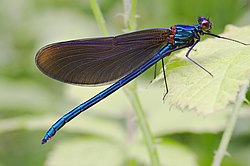
Picture of Calopterygidae
- Source
- Wikipedia/Commons
- Credit
- Michael Apel
- Licence
- CC BY 2.5
- Commercial use
- the licence allows it
No 3D scan of Calopterygidae was found in Sketchfab.
Smithsonian Open Access and MorphoSource were not reached for this taxon, so this list is what the others held rather than everything there is.
The description on this site
- Licence
- CC BY-SA 4.0
This is what the site found, which is not the same as what exists.
Keep going
What may have been alongside itCalopterygoidea through timeFormations of the OligoceneThe world it lived on
Occurrence data from the Paleobiology Database, CC BY 4.0. Selys-Longchamps 1850