Cambaridae
The Cambaridae are the largest of the four families of freshwater crayfish, with over 400 species. Most of the species in the family are native to the United States east of the Great Divide and Mexico, but fewer range north to Canada, and south to Guatemala and Honduras. Three live on the island of Cuba. The species in the genus Cambaroides are only found outside North America, as they are restricted to eastern Asia.

No machine-readable author provided. MikeMurphy assumed (based on copyright claims). · Public Domain · via Wikipedia/Commons. May be a photograph of a specimen, or an artist’s reconstruction — an interpretation of a skeleton, since colour and soft tissue are almost never preserved.
On record
Recorded, not inferred- Sits inside
- AstacoideaPBDB
- Diet
- carnivorePBDB, for Decapoda
- Life habit
- epifaunalPBDB, for Decapoda
- Motility
- actively mobilePBDB, for Malacostraca
- Vision
- well-developedPBDB, for Malacostraca
Time the record covers
At least 149 million years on record.
The record covers at least 205.7 Mya to 56 Mya. No occurrence read is dated outside 237 Mya to 51.1 Mya.
4 occurrences of Cambaridae on record, most of them in the Late Jurassic. The Paleobiology Database records this as a living group, and the chart stops with its fossils rather than at the present. Bar height is expected occurrences, not a count: each fossil is spread across the span it is dated to, so a tall narrow bar means tight dating and a low wide one means loose.
When
4 occurrences- Late Triassic25%
- Late Jurassic50%
- Eocene25%
These are dates about fossils, not the animal: the record can only begin after it arose and end before it died out, so either end may reach further. Shares are expected occurrences: a fossil dated to a span is counted partly in each period it straddles. More on what this infers.
Found in
3 formations
- Morrison Formation2
- Lithofacies Association II Formation · Chatham Group1
- Green River Formation1
Loading coastlines…
The named rock units Cambaridae has been recovered from, largest first. Drawn where the rock is now, not where it formed.
Cambaridae and its relatives
Late JurassicWhere Cambaridae and its relatives were recorded in the Late Jurassic.
Found in the same rock
83 taxa- Anguimorpha2 sites
- Diplodocidae2 sites
- Goniopholis2 sites
- Lacertilia2 sites
- Opisthias2 sites
- Paramacellodus2 sites
- Saurillodon2 sites
- Sphenodontia2 sites
- Theropoda2 sites
- Actinopterygii1 site
- Amia fragosa1 site
- Amia uintaensis1 site
- Amioidea1 site
- Arthropoda1 site
- Atractosteus simplex1 site
- Bahndwivici ammoskius1 site
- Bechleja rostrata1 site
- Camarasaurus1 site
- Chelydridae1 site
- Cionichthys1 site
- Cladophlebis1 site
- Clytiopsis1 site
- Coelurosauria1 site
- Coraciiformes1 site
The Paleobiology Database records 4 sites for Cambaridae, and this reads all of them. The number is how many of those sites it was catalogued from too. The 24 sharing the most are listed.
This is not a list of everything alive at the time. It is only what has come out of the same ground as this animal and been written down.
Entered from
3 references- Fruita Paleontological Area (Upper Jurassic, Morrison Formation), western Colorado: an example of terrestrial taphofacies analysis2
- Aetosaurus (Archosauromorpha) from the Upper Triassic of the Newark Supergroup, eastern United States, and its biochronological significance1
- Paleontology of the Green River Formation, with a review of the fish fauna1
Each of the 4 occurrences read was entered from one of these publications, ordered by how many each accounts for. This is not a search for papers mentioning the name. Each entry links to the Paleobiology Database's own record for the work.
Media and terms
Media content1
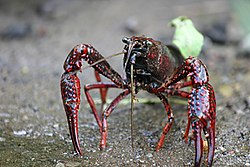
Picture of Cambaridae
- Source
- Wikipedia/Commons
- Credit
- No machine-readable author provided. MikeMurphy assumed (based on copyright claims).
- Licence
- Public Domain
- Commercial use
- the licence allows it
No 3D scan of Cambaridae was found in Sketchfab.
Smithsonian Open Access and MorphoSource were not reached for this taxon, so this list is what the others held rather than everything there is.
The description on this site
- Source
- Wikipedia, “Cambaridae”
- Licence
- CC BY-SA 4.0
This is what the site found, which is not the same as what exists.
Keep going
What may have been alongside itAstacoidea through timeFormations of the Late JurassicThe world it lived on
Occurrence data from the Paleobiology Database, CC BY 4.0. Hobbs 1942