Carcharhinus altimus
The bignose shark is a species of requiem shark, in the family Carcharhinidae. Distributed worldwide in tropical and subtropical waters, this migratory shark frequents deep waters around the edges of the continental shelf. It is typically found at depths of 90–430 m (300–1,410 ft), though at night it may move towards the surface or into shallower water. The bignose shark is plain-colored and grows to at least 2.7–2.8 m (8.9–9.2 ft) in length. It has a long, broad snout with prominent nasal skin flaps, and tall, triangular upper teeth. Its pectoral fins are long and almost straight, and there is a ridge on its back between the two dorsal fins.

Uncredited · via Wikipedia/Commons. May be a photograph of a specimen, or an artist’s reconstruction — an interpretation of a skeleton, since colour and soft tissue are almost never preserved.
On record
Recorded, not inferred- Also called
- bignose sharkPBDB
- Sits inside
- CarcharhinusPBDB
- Diet
- carnivorePBDB, for Carcharhiniformes
- Life habit
- nektonicPBDB, for Carcharhiniformes
- Motility
- actively mobilePBDB, for Carcharhiniformes
Time the record covers
At least 1.8 million years on record.
The record covers at least 3.6 Mya to 1.8 Mya. No occurrence read is dated outside 11.63 Mya to 774 ka.
4 occurrences of Carcharhinus altimus on record, most of them in the Pliocene. The Paleobiology Database records this as a living group, and the chart stops with its fossils rather than at the present. Bar height is expected occurrences, not a count: each fossil is spread across the span it is dated to, so a tall narrow bar means tight dating and a low wide one means loose.
When
4 occurrences- Miocene20%
- Pliocene47%
- Pleistocene34%
These are dates about fossils, not the animal: the record can only begin after it arose and end before it died out, so either end may reach further. Shares are expected occurrences: a fossil dated to a span is counted partly in each period it straddles. More on what this infers.
Found in
3 formations
Loading coastlines…
The named rock units Carcharhinus altimus has been recovered from, largest first. Drawn where the rock is now, not where it formed. 1 occurrence has no formation on record, which is common for older literature.
Carcharhinus altimus and its relatives
PlioceneWhere Carcharhinus altimus and its relatives were recorded in the Pliocene.
Found in the same rock
95 taxa- Carcharhinus leucas4 sites
- Carcharhinus obscurus4 sites
- Carcharodon carcharias4 sites
- Isurus oxyrinchus4 sites
- Carcharhinus brachyurus3 sites
- Carcharhinus limbatus3 sites
- Hemipristis serra3 sites
- Otodus megalodon3 sites
- Carcharhinus albimarginatus2 sites
- Carcharhinus falciformis2 sites
- Carcharhinus plumbeus2 sites
- Carcharias taurus2 sites
- Galeocerdo capellini2 sites
- Galeocerdo cuvier2 sites
- Heterodontus2 sites
- Myliobatis2 sites
- Nasolamia velox2 sites
- Sphyrna lewini2 sites
- Sphyrna zygaena2 sites
- Squalus2 sites
- Acropoma1 site
- Aetobatus1 site
- Aetobatus narinari1 site
- Aetomylaeus1 site
The Paleobiology Database records 4 sites for Carcharhinus altimus, and this reads all of them. The number is how many of those sites it was catalogued from too. The 24 sharing the most are listed.
This is not a list of everything alive at the time. It is only what has come out of the same ground as this animal and been written down.
Entered from
4 references- Sharks and rays (Chondrichthyes: Elasmobranchii) from the Peace River and Tamiami formations (Late Miocene–Early Pliocene) on the submerged continental shelf1
- A previously overlooked, highly diverse early Pleistocene elasmobranch assemblage from southern Taiwan1
- Selacifauna Pliocenica de Baja California Sur, Mexico y sus problemas de correlacion regional1
- Phyletic studies; part 1, Tiger sharks1
Each of the 4 occurrences read was entered from one of these publications, ordered by how many each accounts for. This is not a search for papers mentioning the name. Entries link to doi.org where the Paleobiology Database holds an identifier, and to its own record where it does not. Relayed as the Paleobiology Database holds them, not checked against what they resolve to.
Media and terms
Media content2

Picture of Carcharhinus altimus
- Source
- Wikipedia/Commons
- Credit
- nobody named on the record
- Licence
- not stated by the source
- Commercial use
- cannot be read from the licence given — check the record
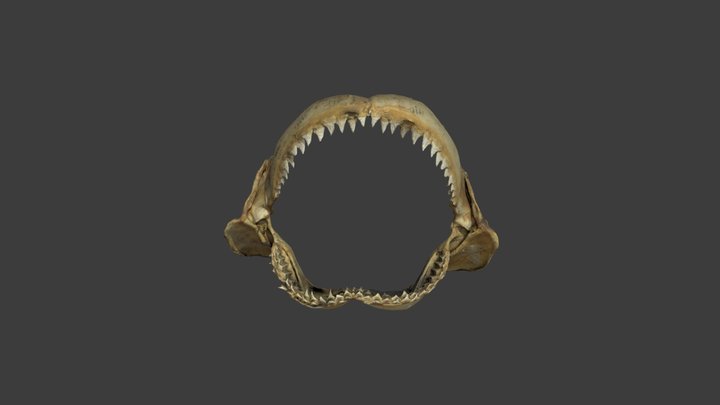
3D model
- Source
- Sketchfab
- Licence
- CC0 Public Domain
- Commercial use
- the licence allows it
Smithsonian Open Access and MorphoSource were not reached for this taxon, so this list is what the others held rather than everything there is.
The description on this site
- Licence
- CC BY-SA 4.0
This is what the site found, which is not the same as what exists.
Keep going
What may have been alongside itCarcharhinus through timeFormations of the PlioceneThe world it lived on
Occurrence data from the Paleobiology Database, CC BY 4.0. (Springer 1950)