Chimaeriformes
Chimaeras are cartilaginous fish in the order Chimaeriformes, known informally as ghost sharks, rat fish, spookfish, or rabbit fish; the last two names are also applied, respectively, to the ray-finned fish groups of Opisthoproctidae and Siganidae.

Linda Snook / MBNMS · Public Domain · via Wikipedia/Commons. May be a photograph of a specimen, or an artist’s reconstruction — an interpretation of a skeleton, since colour and soft tissue are almost never preserved.
On record
Recorded, not inferred- Also called
- chimaeraPBDB
- Sits inside
- HolocephalomorphaPBDB
- Diet
- carnivorePBDB
- Life habit
- nektobenthicPBDB
- Motility
- actively mobilePBDB
Time the record covers
At least 323 million years on record.
The record covers at least 323.6 Mya to 11.7 ka. No occurrence read is dated outside 326.9 Mya to 0 Mya.
369 occurrences of Chimaeriformes on record, most of them in the Late Cretaceous. The Paleobiology Database records this as a living group. Bar height is expected occurrences, not a count: each fossil is spread across the span it is dated to, so a tall narrow bar means tight dating and a low wide one means loose.
When
369 occurrences- Carboniferousunder 1%
- Middle Triassic3%
- Late Triassic5%
- Early Jurassic9%
- Middle Jurassic3%
- Late Jurassic3%
- Early Cretaceous5%
- Late Cretaceous41%
- Paleocene9%
- Eocene11%
- Oligocene2%
- Miocene4%
- Pliocene2%
- Pleistocene1%
- Holoceneunder 1%
These are dates about fossils, not the animal: the record can only begin after it arose and end before it died out, so either end may reach further. Shares are expected occurrences: a fossil dated to a span is counted partly in each period it straddles. More on what this infers.
Found in
122 formations
- Hornerstown Formation · Rancocas Group17
- Hell Creek Formation · Montana Group15
- La Meseta Formation14
- Falang Formation13
- Masuk Formation12
- Fox Hills Formation · Montana Group12
Loading coastlines…
The named rock units Chimaeriformes has been recovered from, largest first. Drawn where the rock is now, not where it formed. 98 further formations hold fewer occurrences each and are not listed. 78 occurrences have no formation on record, which is common for older literature.
Chimaeriformes and its relatives
Late CretaceousWhere Chimaeriformes and its relatives were recorded in the Late Cretaceous.
Found in the same rock
2,629 taxa- Hybodus21 sites
- Chimaeridae20 sites
- Edaphodon20 sites
- Ischyrhiza mira20 sites
- Cretalamna appendiculata17 sites
- Ischyodus bifurcatus17 sites
- Squalicorax kaupi17 sites
- Archaeolamna kopingensis16 sites
- Crocodylia16 sites
- Hadrosauridae16 sites
- Ischyodus16 sites
- Testudines15 sites
- Chondrichthyes14 sites
- Myliobatis14 sites
- Teleostei14 sites
- Carcharias13 sites
- Carcharias samhammeri13 sites
- Odontaspis winkleri13 sites
- Paralbula casei13 sites
- Squalicorax pristodontus13 sites
- Scapanorhynchus texanus12 sites
- Anomoeodus phaseolus11 sites
- Enchodus11 sites
- Enchodus ferox11 sites
The Paleobiology Database records 291 sites for Chimaeriformes, and this reads 240 of them. The number is how many of those sites it was catalogued from too. The 24 sharing the most are listed.
This is not a list of everything alive at the time. It is only what has come out of the same ground as this animal and been written down.
Entered from
168 references- A new species of Ischyodus (Chondrichthyes: Holocephali: Callorhynchidae) from upper Maastrichtian shallow marine facies of the Fox Hills and Hell Creek formations, Williston Basin, North Dakota, USA24
- Systematics of the Cretaceous-Paleogene chimaeroid fish of the genus Elasmodus (Chondrichthyes, Holocephali)17
- Catalogue of the Fossil Fishes in the British Museum (Natural History). Part II15
- An unusual shark assemblage from the Ladinian-Carnian interval of South China13
- Stratigraphic revision of Campanian (Upper Cretaceous) rocks in the Henry Basin, Utah12
- Paleocene chimaeroid fishes (Chondrichthyes: Holocephali) from the eastern United States, including two new species of Callorhinchus11
- Myriacanthid holocephalan remains from the Rhaetian (Upper Triassic) and Hettangian (Lower Jurassic) of Graubünden (Switzerland)11
- The Selsey Division (Bracklesham Group) at Lee-on-the-Solent, Gosport, (Hants)9
- A review of the Tertiary fossil Cetacea (Mammalia) localities in Australia7
- Chimaeroid fish remains from Seymour Island, Antarctic Peninsula6
- Middle Eocene chondrichthyan fauna from Antarctic Peninsula housed in the Museo de La Plata, Argentina5
- Condrictios fósiles del Plioceno Superior de la Formación Horcón, Región de Valparaíso, Chile central5
Each of the 369 occurrences read was entered from one of these publications, ordered by how many each accounts for. This is not a search for papers mentioning the name. 156 further references are not listed. Entries link to doi.org where the Paleobiology Database holds an identifier, and to its own record where it does not. Relayed as the Paleobiology Database holds them, not checked against what they resolve to.
Media and terms
Media content1
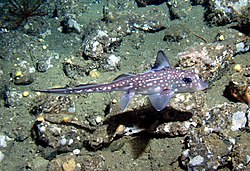
Picture of Chimaeriformes
- Source
- Wikipedia/Commons
- Credit
- Linda Snook / MBNMS
- Licence
- Public Domain
- Commercial use
- the licence allows it
No 3D scan of Chimaeriformes was found in MorphoSource and Sketchfab.
Smithsonian Open Access was not reached for this taxon, so this list is what the others held rather than everything there is.
The description on this site
- Source
- Wikipedia, “Chimaera”
- Licence
- CC BY-SA 4.0
This is what the site found, which is not the same as what exists.
Keep going
What may have been alongside itHolocephalomorpha through timeFormations of the Late CretaceousThe world it lived on
Occurrence data from the Paleobiology Database, CC BY 4.0. Obruchev 1953