Chlorophyta
Chlorophyta or chlorophytes is a major division of green algae, and is sister taxon to the other major division Charophyta as well as the proposed basal clade Prasinodermophyta, together with whom they form the major primary algae clade Viridiplantae.

Ernst Haeckel · Public Domain · via Wikipedia/Commons. May be a photograph of a specimen, or an artist’s reconstruction — an interpretation of a skeleton, since colour and soft tissue are almost never preserved.
On record
Recorded, not inferred- Also called
- green algaePBDB
- Sits inside
- ViridiplantaePBDB
- Diet
- "photoautotroph"PBDB
- Life habit
- epifaunalPBDB
- Motility
- stationary, attachedPBDB
- Environment
- lagoonal,coastal,inner shelf,marine,brackish,freshwaterPBDB
Time the record covers
At least 1799 million years on record.
The record covers at least 1800 Mya to 11.7 ka. No occurrence read is dated outside 2050 Mya to 0 Mya.
4,911 occurrences of Chlorophyta on record, most of them in the Early Cretaceous. The Paleobiology Database records this as a living group. Bar height is expected occurrences, not a count: each fossil is spread across the span it is dated to, so a tall narrow bar means tight dating and a low wide one means loose.
When
4,911 occurrences- Cambrianunder 1%
- Ordovician7%
- Silurian2%
- Devonian2%
- Carboniferous5%
- Permian13%
- Early Triassicunder 1%
- Middle Triassic3%
- Late Triassic6%
- Early Jurassicunder 1%
- Middle Jurassicunder 1%
- Late Jurassic4%
- Early Cretaceous14%
- Late Cretaceous8%
- Paleocene13%
- Eocene8%
- Oligoceneunder 1%
- Miocene2%
- Plioceneunder 1%
- Pleistocene4%
- Holoceneunder 1%
These are dates about fossils, not the animal: the record can only begin after it arose and end before it died out, so either end may reach further. Shares are expected occurrences: a fossil dated to a span is counted partly in each period it straddles. More on what this infers.
Found in
662 formations
- Polat Formation · Sultan Dagi Group219
- Sinjar Formation146
- Mauddud Limestone Formation104
- Safetdara Formation87
- Changxing Formation85
- Nayband Formation78
Loading coastlines…
The named rock units Chlorophyta has been recovered from, largest first. Drawn where the rock is now, not where it formed. 638 further formations hold fewer occurrences each and are not listed. 1,658 occurrences have no formation on record, which is common for older literature.
Chlorophyta and its relatives
Early CretaceousWhere Chlorophyta and its relatives were recorded in the Early Cretaceous.
Found in the same rock
2,972 taxa- Receptaculites55 sites
- Bryozoa40 sites
- Leiosphaeridia35 sites
- Ostracoda32 sites
- Crinoidea29 sites
- Gastropoda29 sites
- Rugosa22 sites
- Lunatisporites21 sites
- Cycadopites follicularis20 sites
- Favosites20 sites
- Trilobita20 sites
- Cyclocrinites19 sites
- Bivalvia18 sites
- Solenopora18 sites
- Densoisporites17 sites
- Girvanella17 sites
- Brachiopoda16 sites
- Calapoecia16 sites
- Ischadites16 sites
- Leptaena15 sites
- Bellerophontoidea14 sites
- Echinodermata14 sites
- Heliolites14 sites
- Kraeuselisporites14 sites
The Paleobiology Database records at least 1,133 sites for Chlorophyta, and this reads 240 of them. The number is how many of those sites it was catalogued from too. The 24 sharing the most are listed.
This is not a list of everything alive at the time. It is only what has come out of the same ground as this animal and been written down.
Entered from
899 references- Taxonomic and Paelogeographic Approaches to the Dasyclad Algae in the Upper Jurassic (Kimmeridgian)-Upper Cretaceous (Cenomanian) Peritidal Carbonates of the Fele (YassÝbel) Area (Western Taurides, Turkey)219
- A study of biostratigraphy of Sinjar Formation in selected sections from northern Iraq122
- Middle Cretaceous algal flora from the Mauddud Formation, Ratawi field, south Iraq104
- Brachiopods from the Cisuralian–Guadalupian of Darvaz, Tajikistan and implications for Permian stratigraphic correlations87
- Recherches géologiques sur le Crétacé inférieur de l'Estremadura (Portugal)84
- Distribution of pollen and spores in a subsurface marine Wilcox (Paleocene-Eocene) section in southwest Louisiana81
- Palaeocene reef complex of the Western Carpathians65
- Dasycladalean green algae and some problematic algae from the Upper Triassic of the Nayband Formation (northeast Iran)65
- Algues calcaires de la zone de Resita-Moldova Noua (Carpathes méridionales, Roumanie)62
- Marine Cretaceous-Paleogene biofacies and ichnofacies in southern Tibet, China, and their sedimentary significance58
- Depositional History of a Paleogene Carbonate Ramp (Western Cephalonia, Ionian Islands, Greece)53
- Site U134451
Each of the 4,911 occurrences read was entered from one of these publications, ordered by how many each accounts for. This is not a search for papers mentioning the name. 887 further references are not listed. Entries link to doi.org where the Paleobiology Database holds an identifier, and to its own record where it does not. Relayed as the Paleobiology Database holds them, not checked against what they resolve to.
Media and terms
Media content1
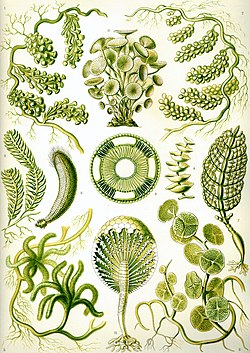
Picture of Chlorophyta
- Source
- Wikipedia/Commons
- Credit
- Ernst Haeckel
- Licence
- Public Domain
- Commercial use
- the licence allows it
No 3D scan of Chlorophyta was found in Sketchfab.
Smithsonian Open Access and MorphoSource were not reached for this taxon, so this list is what the others held rather than everything there is.
The description on this site
- Source
- Wikipedia, “Chlorophyta”
- Licence
- CC BY-SA 4.0
This is what the site found, which is not the same as what exists.
Keep going
What may have been alongside itViridiplantae through timeFormations of the Early CretaceousThe world it lived on
Occurrence data from the Paleobiology Database, CC BY 4.0. Reichenbach 1834