Colubrariidae
Colubrariidae are a taxonomic family of medium-sized sea snails, marine gastropod mollusks in the superfamily Buccinoidea. This family has no subfamilies.

H. Zell · CC BY-SA 3.0 · via Wikipedia/Commons. May be a photograph of a specimen, or an artist’s reconstruction — an interpretation of a skeleton, since colour and soft tissue are almost never preserved.
On record
Recorded, not inferred- Sits inside
- BuccinoideaPBDB
- Diet
- carnivorePBDB, for Neogastropoda
- Life habit
- epifaunalPBDB, for Neogastropoda
- Motility
- actively mobilePBDB, for Neogastropoda
- Vision
- limitedPBDB, for Gastropoda
Time the record covers
At least 124 million years on record.
The record covers at least 125.77 Mya to 774 ka. No occurrence read is dated outside 132.6 Mya to 11.7 ka.
53 occurrences of Colubrariidae on record, most of them in the Miocene. The Paleobiology Database records this as a living group. Bar height is expected occurrences, not a count: each fossil is spread across the span it is dated to, so a tall narrow bar means tight dating and a low wide one means loose.
When
53 occurrencesThese are dates about fossils, not the animal: the record can only begin after it arose and end before it died out, so either end may reach further. Shares are expected occurrences: a fossil dated to a span is counted partly in each period it straddles. More on what this infers.
Found in
17 formations
- Pirabas Formation20
- Muddy Creek Formation5
- Tentokuji Formation2
- Termofourà Formation2
- Kincaid Formation · Midway Group2
- Lodo Formation1
Loading coastlines…
The named rock units Colubrariidae has been recovered from, largest first. Drawn where the rock is now, not where it formed. 10 occurrences have no formation on record, which is common for older literature.
Colubrariidae and its relatives
MioceneWhere Colubrariidae and its relatives were recorded in the Miocene.
Found in the same rock
1,732 taxa- Colubraria20 sites
- Conus8 sites
- Latirus8 sites
- Oliva8 sites
- Turritella8 sites
- Barbatia7 sites
- Mitra7 sites
- Olivella7 sites
- Cancellaria6 sites
- Cardium6 sites
- Cerithium6 sites
- Chama6 sites
- Glycymeris6 sites
- Tellina6 sites
- Amauropsis5 sites
- Architectonica5 sites
- Architectonica nobilis5 sites
- Chlamys5 sites
- Fusinus5 sites
- Fusus5 sites
- Hipponix5 sites
- Lunatia5 sites
- Mercenaria5 sites
- Pachycrommium5 sites
The Paleobiology Database records 22 sites for Colubrariidae, and this reads all of them. The number is how many of those sites it was catalogued from too. The 24 sharing the most are listed.
This is not a list of everything alive at the time. It is only what has come out of the same ground as this animal and been written down.
Entered from
21 references- Localidades fossiliferas da Formacao Pirabas (Mioceno Inferior)19
- The gastropods of the older Tertiary of Australia (Part 1)6
- Cenozoic fossil mollusks from Western Pacific Islands; Gastropods (Volutidae through Terebridae)4
- Resilience of marine invertebrate communities during the early Cenozoic hyperthermals3
- Lower to Middle Miocene Mollusc assemblages from the Torino Hills (NW Italy): Synthesis of new data and chronostratigraphical arrangement2
- Warm-water influx into Japan Sea in the middle Pliocene - Molluscan faunas from the Tentokuji FOrmation around Mt. Taihei in Akita Prefecture2
- Les Mesogastropoda Fossiles du Cenozoïque étranger des Collections de L'Institute Royale des Sciences Naturelles de Belgique2
- Mollusken aus posttertiären Schichten von Celebes2
- New gastropod records from the Cenozoic of Hungary1
- Geología del Área de Estación Chañar-Junta de Chingoles. Regiones de Atacama y Coquimbo. Carta Geología de Chile. Serie Geología Básica. No 1501
- A paleobiotic survey of Caribbean faunas from the Neogene of the Isthmus of Panama1
- An Early Pleistocene molluscan assemblage from Fiji: gastropod faunal composition, paleoecology and biogeography1
Each of the 53 occurrences read was entered from one of these publications, ordered by how many each accounts for. This is not a search for papers mentioning the name. 9 further references are not listed. Entries link to doi.org where the Paleobiology Database holds an identifier, and to its own record where it does not. Relayed as the Paleobiology Database holds them, not checked against what they resolve to.
Media and terms
Media content1
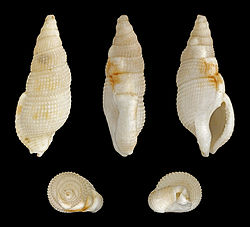
Picture of Colubrariidae
- Source
- Wikipedia/Commons
- Credit
- H. Zell
- Licence
- CC BY-SA 3.0
- Commercial use
- the licence allows it
No 3D scan of Colubrariidae was found in Sketchfab.
Smithsonian Open Access and MorphoSource were not reached for this taxon, so this list is what the others held rather than everything there is.
The description on this site
- Licence
- CC BY-SA 4.0
This is what the site found, which is not the same as what exists.
Keep going
What may have been alongside itBuccinoidea through timeFormations of the MioceneThe world it lived on
Occurrence data from the Paleobiology Database, CC BY 4.0. Dall 1904