Cruziana
Cruziana is a trace fossil consisting of elongate, bilobed, approximately bilaterally symmetrical burrows, usually preserved along bedding planes, with a sculpture of repeated striations that are mostly oblique to the long dimension. It is found in marine and freshwater sediments. It first appears in upper Fortunian rocks of northern Iran and northern Norway. Cruziana has been extensively studied because it has uses in biostratigraphy, and because the traces can reveal many aspects of their makers' behavior.

Uncredited · CC BY-SA 2.1 es · via Wikipedia/Commons. May be a photograph of a specimen, or an artist’s reconstruction — an interpretation of a skeleton, since colour and soft tissue are almost never preserved.
On record
Recorded, not inferred- Sits inside
- IchnofossilsPBDB
Time the record covers
At least 413 million years on record.
The record covers at least 538.8 Mya to 125.77 Mya. No occurrence read is dated outside 635 Mya to 121.4 Mya.
43 occurrences of Cruziana on record, most of them in the Ordovician. Bar height is expected occurrences, not a count: each fossil is spread across the span it is dated to, so a tall narrow bar means tight dating and a low wide one means loose.
When
43 occurrences- Cambrian35%
- Ordovician40%
- Silurian5%
- Devonian5%
- Carboniferous2%
- Middle Triassic5%
- Late Jurassic2%
- Early Cretaceous2%
These are dates about fossils, not the animal: the record can only begin after it arose and end before it died out, so either end may reach further. Shares are expected occurrences: a fossil dated to a span is counted partly in each period it straddles. More on what this infers.
Found in
29 formations
- Beach Formation · Bell Island Group8
- Dominion Formation · Bell Island Group3
- Mickwitzia Sandstone Formation2
- Pimenteira Formation2
- Ochre Cove Formation · Bell Island Group2
- Ingta Formation2
Loading coastlines…
The named rock units Cruziana has been recovered from, largest first. Drawn where the rock is now, not where it formed. 5 further formations hold fewer occurrences each and are not listed. 1 occurrence has no formation on record, which is common for older literature.
Cruziana and its relatives
OrdovicianWhere Cruziana and its relatives were recorded in the Ordovician.
Found in the same rock
357 taxa- Rusophycus10 sites
- Paleomerus4 sites
- Teichichnus4 sites
- Trilobita4 sites
- Diplichnites3 sites
- Diplocraterion3 sites
- Mickwitzia monilifera3 sites
- Mickwitzia pretiosa3 sites
- Mobergella3 sites
- Palaeophycus3 sites
- Planolites3 sites
- Protolyellia3 sites
- Rusophycus dispar3 sites
- Skolithos3 sites
- Spatangopsis3 sites
- Volborthella tenuis3 sites
- Arthrophycus2 sites
- Aulichnites2 sites
- Bergaueria2 sites
- Brachiopoda2 sites
- Chonetoidea2 sites
- Crinoidea2 sites
- Didymaulichnus lyelli2 sites
- Dimorphichnus2 sites
The Paleobiology Database records 31 sites for Cruziana, and this reads all of them. The number is how many of those sites it was catalogued from too. The 24 sharing the most are listed.
This is not a list of everything alive at the time. It is only what has come out of the same ground as this animal and been written down.
Entered from
24 references- Ichnology of the Upper Cambrian? to Lower Ordovician Bell Island and Wabana groups of eastern Newfoundland, Canada15
- Predation by early Cambrian trilobites on infaunal worms - evidence from the Swedish Mickwitzia Sandstone3
- When life got smart: The evolution of behavioral complexity through the Ediacaran and early Cambrian of NW Canada2
- The Malvinokaffric realm in the Devonian of Brazil2
- Upper Proterozoic and Cambrian rocks in the Caborca Region, Sonora, Mexico - physical stratigraphy, biostratigraphy, paleocurrent studies, and regional relations2
- Rapid volcanic ash entombment reveals the 3D anatomy of Cambrian trilobites1
- A new trackway possibly made by a trotting theropod at the Las Hoyas fossil site (Early Cretaceous, Cuenca Province, Spain): Identification, bio-dynamics and palaeoenvironmental implications1
- First Furongian (late Cambrian) trilobites from the Cantabrian Zone (north-western Spain)1
- Trilobites in early Cambrian tidal flats and the landward expansion of the Cambrian explosion1
- First report of a Meishucun-type early Cambrian (Stage 2) ichnofauna from the Malyi Karatau area (SE Kazakhstan): Palaeoichnological, palaeoecological and palaeogeographical implications1
- Footprints pull origin and diversification of dinosaur stem lineage deep into Early Triassic1
- Im Reich der Meerengel. Der Nusplinger Plattenkalk und seine Fossilien1
Each of the 43 occurrences read was entered from one of these publications, ordered by how many each accounts for. This is not a search for papers mentioning the name. 12 further references are not listed. Entries link to doi.org where the Paleobiology Database holds an identifier, and to its own record where it does not. Relayed as the Paleobiology Database holds them, not checked against what they resolve to.
Media and terms
Media content2

Picture of Cruziana
- Source
- Wikipedia/Commons
- Credit
- nobody named on the record
- Licence
- CC BY-SA 2.1 es
- Commercial use
- the licence allows it
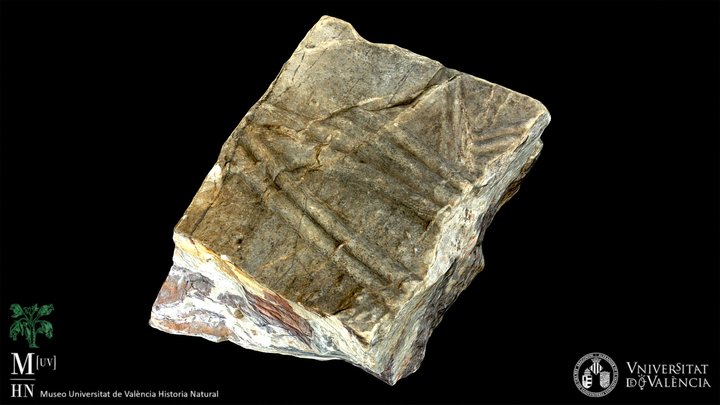
3D model
- Source
- Sketchfab
- Licence
- CC Attribution
- Commercial use
- cannot be read from the licence given — check the record
Smithsonian Open Access and MorphoSource were not reached for this taxon, so this list is what the others held rather than everything there is.
The description on this site
- Source
- Wikipedia, “Cruziana”
- Licence
- CC BY-SA 4.0
This is what the site found, which is not the same as what exists.
Keep going
What may have been alongside itIchnofossils through timeFormations of the OrdovicianThe world it lived on
Occurrence data from the Paleobiology Database, CC BY 4.0. d'Orbigny 1842