Rusophycus
Rusophycus is an ichnogenus of trace fossil allied to Cruziana. Rusophycus is the resting trace, recording the outline of the tracemaker; Cruziana is made when the organism moved. The sculpture of Rusophycus may reveal the approximate number of legs that the tracemaker had, although striations (scratchmarks) from a single leg may overlap or be repeated.

Wilson44691 · Public Domain · via Wikipedia/Commons. May be a photograph of a specimen, or an artist’s reconstruction — an interpretation of a skeleton, since colour and soft tissue are almost never preserved.
On record
Recorded, not inferred- Sits inside
- IchnofossilsPBDB
Time the record covers
At least 431 million years on record.
The record covers at least 525.5 Mya to 93.9 Mya. No occurrence read is dated outside 538.8 Mya to 89.8 Mya.
49 occurrences of Rusophycus on record, most of them in the Ordovician. Bar height is expected occurrences, not a count: each fossil is spread across the span it is dated to, so a tall narrow bar means tight dating and a low wide one means loose.
When
49 occurrencesThese are dates about fossils, not the animal: the record can only begin after it arose and end before it died out, so either end may reach further. Shares are expected occurrences: a fossil dated to a span is counted partly in each period it straddles. More on what this infers.
Found in
23 formations
- Beach Formation · Bell Island Group9
- Herkimer Formation · Clinton Group6
- Snowy Plains Formation · Mansfield Group4
- Mickwitzia Sandstone Formation2
- Pimenteira Formation2
- Pedroche Formation2
Loading coastlines…
The named rock units Rusophycus has been recovered from, largest first. Drawn where the rock is now, not where it formed. 6 occurrences have no formation on record, which is common for older literature.
Rusophycus and its relatives
OrdovicianWhere Rusophycus and its relatives were recorded in the Ordovician.
Found in the same rock
343 taxa- Cruziana9 sites
- Palaeophycus5 sites
- Trilobita5 sites
- Diplichnites4 sites
- Paleomerus4 sites
- Planolites4 sites
- Skolithos4 sites
- Arthrophycus3 sites
- Bergaueria perata3 sites
- Brachiopoda3 sites
- Dimorphichnus3 sites
- Dimorphichnus obliquus3 sites
- Diplocraterion3 sites
- Gastropoda3 sites
- Mickwitzia monilifera3 sites
- Mickwitzia pretiosa3 sites
- Mobergella3 sites
- Phycodes3 sites
- Protolyellia3 sites
- Psammichnites gigas3 sites
- Spatangopsis3 sites
- Teichichnus3 sites
- Volborthella tenuis3 sites
- Bergaueria2 sites
The Paleobiology Database records 30 sites for Rusophycus, and this reads all of them. The number is how many of those sites it was catalogued from too. The 24 sharing the most are listed.
This is not a list of everything alive at the time. It is only what has come out of the same ground as this animal and been written down.
Entered from
22 references- Ichnology of the Upper Cambrian? to Lower Ordovician Bell Island and Wabana groups of eastern Newfoundland, Canada11
- The Clinton of Western and Central New York7
- An ichnofossil assemblage from the Lower Carboniferous Snowy Plains Formation, Mansfield Basin, Australia4
- Arthrophycus in the Silurian of Alabama (USA) and the problem of compound trace fossils3
- Predation by early Cambrian trilobites on infaunal worms - evidence from the Swedish Mickwitzia Sandstone3
- The Malvinokaffric realm in the Devonian of Brazil3
- Trace and soft body fossils from the Pedroche Formation (Ovetian, Lower Cambrian of the Sierra de Córdoba, S Spain) and their relation to the Pedroche event2
- Lower Paleozoic trace fossils from eastern Newfoundland2
- Middle Triassic (Anisian-Ladinian) Tejra red beds and Late Triassic (Carnian) carbonate sedimentary records of southern Tunisia, Saharan Platform: Biostratigraphy, sedimentology and implication on regional stratigraphic correlations1
- Trilobites in early Cambrian tidal flats and the landward expansion of the Cambrian explosion1
- First report of a Meishucun-type early Cambrian (Stage 2) ichnofauna from the Malyi Karatau area (SE Kazakhstan): Palaeoichnological, palaeoecological and palaeogeographical implications1
- Ediacaran and Cambrian index fossils from Sonora, Mexico1
Each of the 49 occurrences read was entered from one of these publications, ordered by how many each accounts for. This is not a search for papers mentioning the name. 10 further references are not listed. Entries link to doi.org where the Paleobiology Database holds an identifier, and to its own record where it does not. Relayed as the Paleobiology Database holds them, not checked against what they resolve to.
Media and terms
Media content3
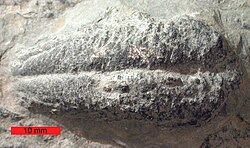
Picture of Rusophycus
- Source
- Wikipedia/Commons
- Credit
- Wilson44691
- Licence
- Public Domain
- Commercial use
- the licence allows it
Photogrammetry
- Source
- MorphoSource
- Licence
- not stated by the source
- Commercial use
- cannot be read from the licence given — check the record
- Specimen
- rusophycus sp. · MST:PALEO:MST-SP-13002
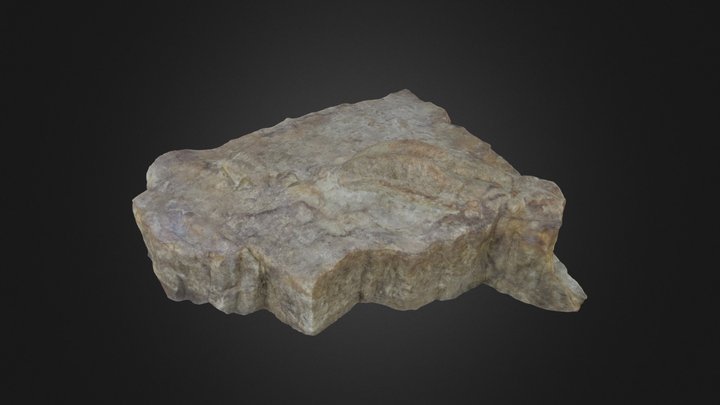
3D model
- Source
- Sketchfab
- Licence
- CC0 Public Domain
- Commercial use
- the licence allows it
Smithsonian Open Access was not reached for this taxon, so this list is what the others held rather than everything there is.
The description on this site
- Source
- Wikipedia, “Rusophycus”
- Licence
- CC BY-SA 4.0
This is what the site found, which is not the same as what exists.
Keep going
What may have been alongside itIchnofossils through timeFormations of the OrdovicianThe world it lived on
Occurrence data from the Paleobiology Database, CC BY 4.0. Hall 1852