Cycloneuralia
Cycloneuralia is a proposed clade of ecdysozoan animals including the Scalidophora, the Nematoida, and the extinct palaeoscolecids. It may be paraphyletic, or may be a sister group to Panarthropoda. Or perhaps Panarthropoda is paraphyletic with respect to Cycloneuralia. The group has also been considered a single phylum, sometimes given the old name Nemathelminthes. The uniting character is the nervous system organization with a circumpharyngeal brain and somata–neuropil–somata pattern. The name derives from the position of the brain around the pharynx.

Shunkina Ksenia · CC BY 3.0 · via Wikipedia/Commons. May be a photograph of a specimen, or an artist’s reconstruction — an interpretation of a skeleton, since colour and soft tissue are almost never preserved.
On record
Recorded, not inferred- Sits inside
- EcdysozoaPBDB
Time the record covers
At least 528 million years on record.
The record covers at least 529 Mya to 11.7 ka. No occurrence read is dated outside 538.8 Mya to 0 Mya.
124 occurrences of Cycloneuralia on record, most of them in the Miocene. The Paleobiology Database records this as a living group. Bar height is expected occurrences, not a count: each fossil is spread across the span it is dated to, so a tall narrow bar means tight dating and a low wide one means loose.
When
124 occurrences- Cambrianunder 1%
- Silurianunder 1%
- Devonianunder 1%
- Middle Triassic2%
- Early Jurassicunder 1%
- Early Cretaceous4%
- Late Cretaceous19%
- Eocene26%
- Oligoceneunder 1%
- Miocene44%
- Plioceneunder 1%
- Holoceneunder 1%
These are dates about fossils, not the animal: the record can only begin after it arose and end before it died out, so either end may reach further. Shares are expected occurrences: a fossil dated to a span is counted partly in each period it straddles. More on what this infers.
Found in
11 formations
- Sainte-Barbe Clays Formation · Wealden Group2
- Santa Maria Formation · Rosário do Sul Group2
- Lombardische Kieselkalk Formation1
- Brandon Bridge Formation1
- Helvetiafjellet Formation1
- Rott Formation1
Loading coastlines…
The named rock units Cycloneuralia has been recovered from, largest first. Drawn where the rock is now, not where it formed. 111 occurrences have no formation on record, which is common for older literature.
Cycloneuralia and its relatives
MioceneWhere Cycloneuralia and its relatives were recorded in the Miocene.
Found in the same rock
3,321 taxa- Araneae7 sites
- Gesomyrmex hoernesi4 sites
- Prenolepis henschei4 sites
- Segestria4 sites
- Ablator triguttatus3 sites
- Adorator hispidus3 sites
- Arachnida3 sites
- Archaea paradoxa3 sites
- Balticophasma3 sites
- Cretacimermis chironomae3 sites
- Ctenobethylus goepperti3 sites
- Diptera3 sites
- Episinus longimanus3 sites
- Ero permunda3 sites
- Forcipomyia3 sites
- Heydenius matutinus3 sites
- Nematoda3 sites
- Nylanderia pygmaea3 sites
- Orchestina baltica3 sites
- Pachycondyla succinea3 sites
- Plagiolepis klinsmanni3 sites
- Psocodea3 sites
- Segestria tomentosa3 sites
- Yantaromyrmex constrictus3 sites
The Paleobiology Database records 37 sites for Cycloneuralia, and this reads all of them. The number is how many of those sites it was catalogued from too. The 24 sharing the most are listed.
This is not a list of everything alive at the time. It is only what has come out of the same ground as this animal and been written down.
Entered from
32 references- Poinar, 201172
- Widespread mermithid nematode parasitism of Cretaceous insects11
- New fossil nematodes in Dominican and Baltic amber4
- Fossil nematodes from Mexican amber4
- Ueber ein Rhipidopteron und einige andere im bernstein eingeschlossene tiere4
- Evidence of intestinal parasites of dinosaurs2
- Nematode (Nematoda: Mermithidae) and hairworm (Nematomorpha: Chordodidae) parasites in Early Cretaceous amber2
- A new ascarid species in cynodont coprolite dated of 240 million years1
- Discovery of a 240 million year old nematode parasite egg in a cynodont coprolite sheds light on the early origin of pinworms in vertebrates1
- Palaeonema phyticum gen. n., sp. n. (Nematoda: Palaeonematidae fam. n.), a Devonian nematode associated with early land plants1
- Recent and fossil nematode parasites (Nematoda: Mermithidae) of Neotropical ants1
- Fossil evidence of phorid parasitism (Diptera: Phoridae) by allantonematid nematodes (Tylenchida: Allantonematidae)1
Each of the 124 occurrences read was entered from one of these publications, ordered by how many each accounts for. This is not a search for papers mentioning the name. 20 further references are not listed. Entries link to doi.org where the Paleobiology Database holds an identifier, and to its own record where it does not. Relayed as the Paleobiology Database holds them, not checked against what they resolve to.
Media and terms
Media content1
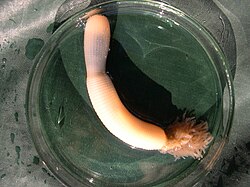
Picture of Cycloneuralia
- Source
- Wikipedia/Commons
- Credit
- Shunkina Ksenia
- Licence
- CC BY 3.0
- Commercial use
- the licence allows it
No 3D scan of Cycloneuralia was found in Sketchfab.
Smithsonian Open Access and MorphoSource were not reached for this taxon, so this list is what the others held rather than everything there is.
The description on this site
- Licence
- CC BY-SA 4.0
This is what the site found, which is not the same as what exists.
Keep going
What may have been alongside itEcdysozoa through timeFormations of the MioceneThe world it lived on
Occurrence data from the Paleobiology Database, CC BY 4.0. Ahlrichs 1995