Cystoidea
Cystoidea was defined as a class of extinct paleozoic blastozoan echinoderms established to encompass stalked taxa that were neither crinoids nor blastoids. It was shown to be polyphyletic in the late 1960s but continues to be used even in recent literature to discuss both rhombiferans and diploporitans.

Ernst Haeckel · Public Domain · via Wikipedia/Commons. May be a photograph of a specimen, or an artist’s reconstruction — an interpretation of a skeleton, since colour and soft tissue are almost never preserved.
On record
Recorded, not inferred- Sits inside
- PelmatozoaPBDB
- Diet
- suspension feederPBDB
- Life habit
- low-level epifaunalPBDB
- Motility
- stationary, attachedPBDB
- Environment
- marinePBDB, for Echinodermata
Time the record covers
At least 99 million years on record.
The record covers at least 509.7 Mya to 410.62 Mya. No occurrence read is dated outside 515.3 Mya to 387.95 Mya.
60 occurrences of Cystoidea on record, most of them in the Ordovician. Bar height is expected occurrences, not a count: each fossil is spread across the span it is dated to, so a tall narrow bar means tight dating and a low wide one means loose.
When
60 occurrences- Cambrian15%
- Ordovician63%
- Silurian8%
- Devonian13%
These are dates about fossils, not the animal: the record can only begin after it arose and end before it died out, so either end may reach further. Shares are expected occurrences: a fossil dated to a span is counted partly in each period it straddles. More on what this infers.
Found in
28 formations
- Wenallt Formation7
- Badger Flat Formation4
- Shin Brook Formation4
- Campile Formation · Duncannon Group3
- Antelope Valley Formation · Pogonip Group2
- Tonoloway Limestone Formation2
Loading coastlines…
The named rock units Cystoidea has been recovered from, largest first. Drawn where the rock is now, not where it formed. 4 further formations hold fewer occurrences each and are not listed. 13 occurrences have no formation on record, which is common for older literature.
Cystoidea and its relatives
OrdovicianWhere Cystoidea and its relatives were recorded in the Ordovician.
Found in the same rock
734 taxa- Crinoidea26 sites
- Bryozoa15 sites
- Gastropoda12 sites
- Leptaena11 sites
- Trepostomata10 sites
- Dalmanellidae9 sites
- Bivalvia8 sites
- Cryptostomata7 sites
- Orthambonites7 sites
- Ostracoda7 sites
- Pelmatozoa7 sites
- Rugosa7 sites
- Sowerbyella7 sites
- Strophomenoidea7 sites
- Brachiopoda6 sites
- Cornulites6 sites
- Dalmanella6 sites
- Eostropheodonta hirnantensis6 sites
- Glyptorthis6 sites
- Hindella incipiens6 sites
- Leonaspis6 sites
- Lingulida6 sites
- Orthoidea6 sites
- Palaeocopida6 sites
The Paleobiology Database records 59 sites for Cystoidea, and this reads all of them. The number is how many of those sites it was catalogued from too. The 24 sharing the most are listed.
This is not a list of everything alive at the time. It is only what has come out of the same ground as this animal and been written down.
Entered from
32 references- The Ordovician-Silurian boundary in the Garth area of southwest Powys, Wales10
- Species diversity patterns in some middle Ordovician communities from California-Nevada5
- Geology of the Bristol and Wallace quadrangles, Virginia4
- Fossils in the Ordovician Tuffs Northeastern Maine, with a section on Trilobita by Harry B. Whittington4
- Chlupáč et al., 19983
- The brachiopods of the Duncannon Group (Middle-Upper Ordovician) of southeast Ireland3
- Middle Cambrian cystoid (sensu lato) stem columnals from Bornholm, Denmark3
- Trilobite assemblages in the Devonian of the Barrandian area and their relations to palaeoenvironments2
- New data on the distribution of brachiopods in the Johvi Stage of North Estonia2
- Marine faunal assemblages in the Siurian-Devonian Keyser Limestone of the central Appalachians2
- Evenness, richness and the Cambrian-Paleozoic faunal transition in North America: an assemblage-level perspective1
- High-latitude pelmatozoan-bryozoan mud-mounds from the Late Ordovician northern Gondwana platform1
Each of the 60 occurrences read was entered from one of these publications, ordered by how many each accounts for. This is not a search for papers mentioning the name. 20 further references are not listed. Entries link to doi.org where the Paleobiology Database holds an identifier, and to its own record where it does not. Relayed as the Paleobiology Database holds them, not checked against what they resolve to.
Media and terms
Media content1
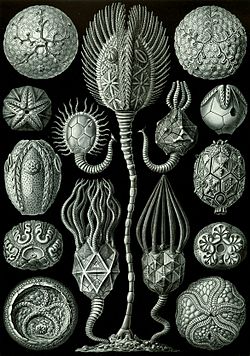
Picture of Cystoidea
- Source
- Wikipedia/Commons
- Credit
- Ernst Haeckel
- Licence
- Public Domain
- Commercial use
- the licence allows it
No 3D scan was found. Smithsonian Open Access, MorphoSource and Sketchfab were all searched.
The description on this site
- Source
- Wikipedia, “Cystoidea”
- Licence
- CC BY-SA 4.0
This is what the site found, which is not the same as what exists.
Keep going
What may have been alongside itPelmatozoa through timeFormations of the OrdovicianThe world it lived on
Occurrence data from the Paleobiology Database, CC BY 4.0. von Buch 1846