Emydura
Searched as Emydura dentata. The Paleobiology Database treats Emydura as the accepted name.
Emydura, also known commonly as the Australian short-necked turtles, is a genus of turtles in the family Chelidae. The genus was paraphyletic with Elseya. Consequently, it was split into two genera Myuchelys and Elseya by Thomson and Georges in 2009. Turtles of the genus Emydura can grow quite large, 30 cm (12 in) or more is not unusual, and have a life span of around 20–30 years. They generally do not hibernate as their warmer climate lets them remain active all year round; they also spend more time in the water than other turtles. They are considered omnivorous but rely on a constant supply of meat to remain healthy, feeding on basically anything that will fit into their mouth. They are characterised by a white stripe starting at the nose and leading down the neck, as well as a more ridged shell. In Australia, the public require a basic reptiles licence to purchase these turtles; taking from the wild is strictly prohibited.

Peripitus · CC BY-SA 3.0 · via Wikipedia/Commons. May be a photograph of a specimen, or an artist’s reconstruction — an interpretation of a skeleton, since colour and soft tissue are almost never preserved.
On record
Recorded, not inferred- Sits inside
- ChelidaePBDB
- Diet
- piscivorePBDB, for Chelidae
- Life habit
- amphibious, solitaryPBDB, for Chelidae
- Motility
- actively mobilePBDB, for Osteichthyes
- Environment
- freshwaterPBDB, for Chelidae
Time the record covers
At most 2.8 million years on record.
The one occurrence read is dated to somewhere between 5.333 Mya and 2.58 Mya, which is a dating window rather than a span.
1 occurrence of Emydura on record, most of them in the Pliocene. The Paleobiology Database records this as a living group, and the chart stops with its fossils rather than at the present. Bar height is expected occurrences, not a count: each fossil is spread across the span it is dated to, so a tall narrow bar means tight dating and a low wide one means loose.
When
1 occurrences- Pliocene100%
These are dates about fossils, not the animal: the record can only begin after it arose and end before it died out, so either end may reach further. Shares are expected occurrences: a fossil dated to a span is counted partly in each period it straddles. More on what this infers.
Emydura and its relatives
PlioceneWhere Emydura and its relatives were recorded in the Pliocene.
Found in the same rock
237 taxa- Macropus3 sites
- Meiolaniidae3 sites
- Protemnodon3 sites
- Rattus3 sites
- Aepyprymnus rufescens2 sites
- Aves2 sites
- Bettongia2 sites
- Bettongia penicillata2 sites
- Chelodina longicollis2 sites
- Crocodylia2 sites
- Crocodylus johnstoni2 sites
- Diprotodon optatum2 sites
- Hydromys2 sites
- Macropodidae2 sites
- Macropus (Petrogale)2 sites
- Mioceratodus anemosyrus2 sites
- Passeriformes2 sites
- Pelecanus tirarensis2 sites
- Perameles2 sites
- Petaurus breviceps2 sites
- Potorous2 sites
- Pseudocheirus peregrinus2 sites
- Pseudomys2 sites
- Rodentia2 sites
The Paleobiology Database records 15 sites for Emydura, and this reads all of them. The number is how many of those sites it was catalogued from too. The 24 sharing the most are listed.
This is not a list of everything alive at the time. It is only what has come out of the same ground as this animal and been written down.
Entered from
1 referenceEach of the 1 occurrence read was entered from one of these publications, ordered by how many each accounts for. This is not a search for papers mentioning the name. Each entry links to the Paleobiology Database's own record for the work.
Media and terms
Media content2
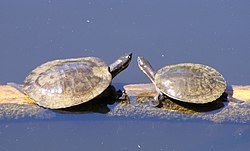
Picture of Emydura
- Source
- Wikipedia/Commons
- Credit
- Peripitus
- Licence
- CC BY-SA 3.0
- Commercial use
- the licence allows it
Structured light scan
- Source
- MorphoSource
- Licence
- not stated by the source
- Commercial use
- cannot be read from the licence given — check the record
- Specimen
- Emydura macquarii · nmb:C1774
Smithsonian Open Access was not reached for this taxon, so this list is what the others held rather than everything there is.
The description on this site
- Source
- Wikipedia, “Emydura”
- Licence
- CC BY-SA 4.0
This is what the site found, which is not the same as what exists.
Keep going
What may have been alongside itChelidae through timeFormations of the PlioceneThe world it lived on
Occurrence data from the Paleobiology Database, CC BY 4.0. Bonaparte 1836