Enchodontidae
Enchodontidae is an extinct family of marine enchodontoid aulopiform ray-finned fish from the Cretaceous to potentially the Eocene, being found worldwide. The family itself was diverse within its body form though unlike other enchodontoids, most genera within the family possessed rows of scutes behind the head and sides of the body. Like a large amount of extinct groups, the origin of enchodontids have remained obscured though this is mostly due to a large diversification event that happened in the Late Aptian to Middle Cenomanian. Though the family is diverse in their range and anatomy, all known members were predatory with most living in more shallow, near-shore environments.

Ghedoghedo · CC BY-SA 4.0 · via Wikipedia/Commons. May be a photograph of a specimen, or an artist’s reconstruction — an interpretation of a skeleton, since colour and soft tissue are almost never preserved.
On record
Recorded, not inferred- Sits inside
- AlepisauroideaPBDB
- Diet
- carnivorePBDB
- Life habit
- nektonicPBDB, for Aulopiformes
- Motility
- actively mobilePBDB, for Aulopiformes
Time the record covers
At least 141 million years on record.
The record covers at least 161.5 Mya to 20.45 Mya. No occurrence read is dated outside 165.3 Mya to 15.98 Mya.
352 occurrences of Enchodontidae on record, most of them in the Late Cretaceous. Bar height is expected occurrences, not a count: each fossil is spread across the span it is dated to, so a tall narrow bar means tight dating and a low wide one means loose.
When
352 occurrences- Middle Jurassicunder 1%
- Early Cretaceous2%
- Late Cretaceous95%
- Paleocene1%
- Eocene2%
- Mioceneunder 1%
These are dates about fossils, not the animal: the record can only begin after it arose and end before it died out, so either end may reach further. Shares are expected occurrences: a fossil dated to a span is counted partly in each period it straddles. More on what this infers.
Found in
111 formations
- Greenhorn Limestone Formation · Colorado Group29
- Fox Hills Formation · Montana Group25
- Carlile Shale Formation · Colorado Group10
- Mooreville Chalk Formation · Selma Group8
- Niobrara Formation8
- Ahlen Formation8
Loading coastlines…
The named rock units Enchodontidae has been recovered from, largest first. Drawn where the rock is now, not where it formed. 87 further formations hold fewer occurrences each and are not listed. 80 occurrences have no formation on record, which is common for older literature.
Enchodontidae and its relatives
Late CretaceousWhere Enchodontidae and its relatives were recorded in the Late Cretaceous.
Found in the same rock
2,104 taxa- Enchodus85 sites
- Cretalamna appendiculata50 sites
- Squalicorax pristodontus38 sites
- Squalicorax32 sites
- Squalicorax kaupi32 sites
- Squalicorax falcatus30 sites
- Carcharias samhammeri29 sites
- Mosasauridae29 sites
- Archaeolamna kopingensis28 sites
- Enchodus gladiolus28 sites
- Ischyrhiza mira28 sites
- Stephanodus28 sites
- Cretoxyrhina mantelli27 sites
- Teleostei27 sites
- Enchodus petrosus26 sites
- Paralbula casei25 sites
- Xiphactinus audax25 sites
- Enchodus shumardi24 sites
- Protosphyraena24 sites
- Elasmosauridae22 sites
- Enchodus dirus22 sites
- Pseudohypolophus mcnultyi22 sites
- Pycnodontidae22 sites
- Testudines22 sites
The Paleobiology Database records 268 sites for Enchodontidae, and this reads 240 of them. The number is how many of those sites it was catalogued from too. The 24 sharing the most are listed.
This is not a list of everything alive at the time. It is only what has come out of the same ground as this animal and been written down.
Entered from
188 references- Chondrichthyan and osteichthyan paleofaunas from the Cretaceous (Late Maastrichtian) Fox Hills Formation of North Dakota, USA: paleoecology, paleogeography, and extinction24
- The vertebrate fauna of the Selma Formation of Alabama, part VIII, the fishes10
- Marine vertebrate faunas from the Maastrichtian phosphates of Benguérir (Ganntour Basin, Morocco): Biostratigraphy, palaeobiogeography and palaeoecology9
- Sélaciens du Crétacé (Albien-Maastrichtien) d'Angola8
- The marine vertebrate faunas from the Late Cretaceous phosphates of Syria8
- Fossil fishes from the basal Greenhorn Limestone (Upper Cretaceous, Late Cenomanian) in Russell County, Kansas7
- Vertébrés fossiles du bassin du Niger [Fossil vertebrates of the Niger basin]6
- The fossil fishes of the English Chalk. Part II6
- Ergebnisse der Forschungsreisen Prof. E. Stromers in den Wüsten Ägyptens II. Wirbeltierreste der Baharije-Stufe (unterstes Cenoman) 16. Neue Untersuchungen an den Fischresten5
- Fossil marine vertebrates (Chondrichthyes, Actinopterygii, Reptilia) from the Upper Cretaceous of Akkermanovka (Orenburg Oblast, Southern Urals, Russia)4
- Marine fishes (Chondrichthyes, Holocephali, Actinopterygii) from the Upper Cretaceous (Campanian) Rybushka Formation near Beloe Ozero, Saratov Oblast, Russia4
- Cenomanian bonebed faunas from the northeastern margin, Western Interior Seaway4
Each of the 352 occurrences read was entered from one of these publications, ordered by how many each accounts for. This is not a search for papers mentioning the name. 176 further references are not listed. Entries link to doi.org where the Paleobiology Database holds an identifier, and to its own record where it does not. Relayed as the Paleobiology Database holds them, not checked against what they resolve to.
Media and terms
Media content1
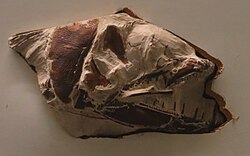
Picture of Enchodontidae
- Source
- Wikipedia/Commons
- Credit
- Ghedoghedo
- Licence
- CC BY-SA 4.0
- Commercial use
- the licence allows it
No 3D scan of Enchodontidae was found in MorphoSource and Sketchfab.
Smithsonian Open Access was not reached for this taxon, so this list is what the others held rather than everything there is.
The description on this site
- Licence
- CC BY-SA 4.0
This is what the site found, which is not the same as what exists.
Keep going
What may have been alongside itAlepisauroidea through timeFormations of the Late CretaceousThe world it lived on
Occurrence data from the Paleobiology Database, CC BY 4.0. Woodward 1901