Martes foina
The beech marten, also known as the stone marten, house marten or white breasted marten, is a species of marten native to much of Europe and Central Asia, though it has established a feral population in North America. It is listed as Least Concern on the IUCN Red List on account of its wide distribution, its large population, and its presence in a number of protected areas. It is superficially similar to the European pine marten, but differs from it by its smaller size and habitat preferences. While the pine marten is a forest specialist, the beech marten is a more generalist and adaptable species, occurring in a number of open and forest habitats.

Charles J. Sharp · CC BY-SA 4.0 · via Wikipedia/Commons. May be a photograph of a specimen, or an artist’s reconstruction — an interpretation of a skeleton, since colour and soft tissue are almost never preserved.
On record
Recorded, not inferred- Sits inside
- MartesPBDB
- Diet
- carnivore, omnivorePBDB, for Mustelidae
- Life habit
- scansorialPBDB, for Martes
- Motility
- actively mobilePBDB, for Osteichthyes
- Environment
- terrestrialPBDB, for Eutheria
Time the record covers
At most 2.6 million years on record.
Every occurrence read is dated to somewhere between 2.58 Mya and 0 Mya, and nothing in the dating separates them, so that window is what the record shows rather than a span.
10 occurrences of Martes foina on record, most of them in the Pleistocene. Bar height is expected occurrences, not a count: each fossil is spread across the span it is dated to, so a tall narrow bar means tight dating and a low wide one means loose.
When
10 occurrences- Pleistocene99%
- Holocene1%
These are dates about fossils, not the animal: the record can only begin after it arose and end before it died out, so either end may reach further. Shares are expected occurrences: a fossil dated to a span is counted partly in each period it straddles. More on what this infers.
Martes foina and its relatives
PleistoceneWhere Martes foina and its relatives were recorded in the Pleistocene.
Found in the same rock
145 taxa- Vulpes vulpes5 sites
- Meles meles4 sites
- Apodemus3 sites
- Apodemus mystacinus3 sites
- Dama dama3 sites
- Equus3 sites
- Martes martes3 sites
- Aves2 sites
- Bos primigenius2 sites
- Canis2 sites
- Canis lupus2 sites
- Capra ibex2 sites
- Cervus2 sites
- Cervus elaphus2 sites
- Crocidura russula2 sites
- Felis silvestris2 sites
- Lynx lynx2 sites
- Meriones2 sites
- Microtus guentheri2 sites
- Mus musculus2 sites
- Myotis2 sites
- Panthera pardus2 sites
- Rhinolophus blasii2 sites
- Rhinolophus hipposideros2 sites
The Paleobiology Database records 10 sites for Martes foina, and this reads all of them. The number is how many of those sites it was catalogued from too. The 24 sharing the most are listed.
This is not a list of everything alive at the time. It is only what has come out of the same ground as this animal and been written down.
Entered from
10 references- Paleolithic subsistence strategies and changes in site use at Klissoura Cave 1 (Peloponnese, Greece)1
- Pleistocene Mustelidae (Carnivora) from Paleolithic site in Kudaro Caves in the Caucasus1
- Quaternary large mammals from the Apidima Caves (Lakonia, S. Peloponnese, Greece1
- Mittelpleistozane Saugetierfaunen aus Mitteleuropa - der Versuch einer biostratigraphischen Zuordnung1
- Un cas peu commun de conservation de certains tetrapodes dans le syteme karstique de Cerbului (Roumanie). [An uncommon case of the preservation of certain Tetrapoda in the Cerbului karst system, Romania1
- Dwarf deer and other Late Pleistocene fauna of the Simonelli Cave in Crete1
- The faunal remains of Iraq e Zigan, a Late Pleistocene site on Mt. Carmel1
- Principaux gisements paleontologiques Francais du Pleistocene Moyen: Essai de classification1
- Grabungen in der Zwergelefanten-Höhle „Charkadio” auf der Insel Tilos (Dodekanes, Griechenland)1
- The small mammals of the Guela Cave1
Each of the 10 occurrences read was entered from one of these publications, ordered by how many each accounts for. This is not a search for papers mentioning the name. Entries link to doi.org where the Paleobiology Database holds an identifier, and to its own record where it does not. Relayed as the Paleobiology Database holds them, not checked against what they resolve to.
Media and terms
Media content2

Picture of Martes foina
- Source
- Wikipedia/Commons
- Credit
- Charles J. Sharp
- Licence
- CC BY-SA 4.0
- Commercial use
- the licence allows it
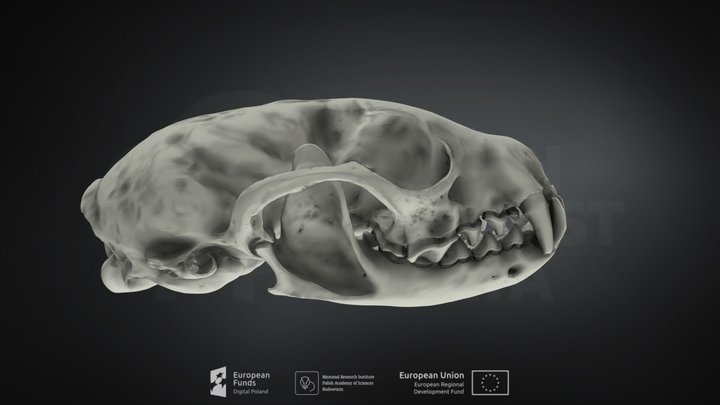
3D model
- Source
- Sketchfab
- Licence
- CC Attribution
- Commercial use
- cannot be read from the licence given — check the record
Smithsonian Open Access and MorphoSource were not reached for this taxon, so this list is what the others held rather than everything there is.
The description on this site
- Licence
- CC BY-SA 4.0
This is what the site found, which is not the same as what exists.
Keep going
What may have been alongside itMartes through timeFormations of the PleistoceneThe world it lived on
Occurrence data from the Paleobiology Database, CC BY 4.0. (Erxleben 1777)