Meles meles
The European badger, also known as the Eurasian badger, is a species of badger in the family Mustelidae native to Europe and West Asia and parts of Central Asia. It is classified as least concern on the IUCN Red List due to its wide range and large, stable population size which is thought to be increasing in some regions. Several subspecies are recognised, with the nominate subspecies predominating in most of Europe. In the UK it is the only extant species, and is simply known as the "badger".

Charles J. Sharp · CC BY-SA 4.0 · via Wikipedia/Commons. May be a photograph of a specimen, or an artist’s reconstruction — an interpretation of a skeleton, since colour and soft tissue are almost never preserved.
On record
Recorded, not inferred- Also called
- European badgerPBDB
- Sits inside
- MelesPBDB
- Diet
- carnivore, omnivorePBDB, for Meles
- Life habit
- semifossorialPBDB, for Meles
- Motility
- actively mobilePBDB, for Osteichthyes
- Environment
- terrestrialPBDB, for Eutheria
Time the record covers
At least 762 thousand years on record.
The record covers at least 774 ka to 11.7 ka. No occurrence read is dated outside 2.58 Mya to 0 Mya.
43 occurrences of Meles meles on record, most of them in the Pleistocene. The Paleobiology Database records this as a living group. Bar height is expected occurrences, not a count: each fossil is spread across the span it is dated to, so a tall narrow bar means tight dating and a low wide one means loose.
When
43 occurrences- Pleistocene88%
- Holocene12%
These are dates about fossils, not the animal: the record can only begin after it arose and end before it died out, so either end may reach further. Shares are expected occurrences: a fossil dated to a span is counted partly in each period it straddles. More on what this infers.
Found in
2 formations
Loading coastlines…
The named rock units Meles meles has been recovered from, largest first. Drawn where the rock is now, not where it formed. 41 occurrences have no formation on record, which is common for older literature.
Meles meles and its relatives
PleistoceneWhere Meles meles and its relatives were recorded in the Pleistocene.
Found in the same rock
442 taxa- Microtus21 sites
- Sus scrofa20 sites
- Equus18 sites
- Lepus18 sites
- Cervus elaphus16 sites
- Vulpes vulpes16 sites
- Arvicola14 sites
- Canis lupus13 sites
- Cervus13 sites
- Myodes13 sites
- Apodemus sylvaticus12 sites
- Allocricetus11 sites
- Capreolus capreolus11 sites
- Cricetus cricetus11 sites
- Megaloceros10 sites
- Microtus arvalis10 sites
- Ursus arctos10 sites
- Bos primigenius9 sites
- Crocidura9 sites
- Equus caballus9 sites
- Glis glis9 sites
- Bison8 sites
- Dama dama8 sites
- Mimomys8 sites
The Paleobiology Database records 43 sites for Meles meles, and this reads all of them. The number is how many of those sites it was catalogued from too. The 24 sharing the most are listed.
This is not a list of everything alive at the time. It is only what has come out of the same ground as this animal and been written down.
Entered from
30 references- I giacimenti Quaternari di vertebrati fossili nell'Italia Nord-Orientale8
- Mittelpleistozane Saugetierfaunen aus Mitteleuropa - der Versuch einer biostratigraphischen Zuordnung4
- From tortoises to elephants: the impact of elephants in the broad spectrum diet at Bolomor Cave (MIS 9–5 Spain)2
- Quaternary large mammals from the Apidima Caves (Lakonia, S. Peloponnese, Greece2
- New microstratigraphic horizons in the vertebrate chronology of the Hungarian Pleistocene2
- Marine mammals fossil remains and synthesis of the sedimentary and paleontological record of the Furninha Cave Pleistocene (Peniche, Portugal)1
- Badger (Meles meles) predation on European pond turtle (Emys orbicularis) during the Eemian interglacial (MIS 5e)1
- Pleistocene Mustelidae (Carnivora) from Paleolithic site in Kudaro Caves in the Caucasus1
- Paleontological and stratigraphical research in Loutrá Aridéas bear cave (Almopia Speleopark, Pella, Macedonia, Greece)1
- Missing mammals from mesolithic middens: A comparison of the fossil and archaeological records from Scotland1
- Le gisement Pleistocene moyen et superieur d'Artenac (Saint-Mary, Charent): premier bilan interdisciplinaire1
- Biochronology of the Pleistocene deposits at Betfia (Bihor, Romania)1
Each of the 43 occurrences read was entered from one of these publications, ordered by how many each accounts for. This is not a search for papers mentioning the name. 18 further references are not listed. Entries link to doi.org where the Paleobiology Database holds an identifier, and to its own record where it does not. Relayed as the Paleobiology Database holds them, not checked against what they resolve to.
Media and terms
Media content3

Picture of Meles meles
- Source
- Wikipedia/Commons
- Credit
- Charles J. Sharp
- Licence
- CC BY-SA 4.0
- Commercial use
- the licence allows it
CT scan
- Source
- MorphoSource
- Licence
- In Copyright
- Commercial use
- cannot be read from the licence given — check the record
- Specimen
- Meles meles · ummz:mammals:122594
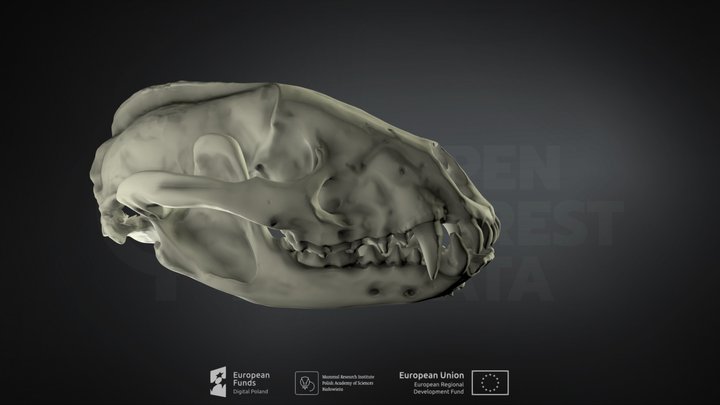
3D model
- Source
- Sketchfab
- Licence
- CC Attribution
- Commercial use
- cannot be read from the licence given — check the record
Smithsonian Open Access was not reached for this taxon, so this list is what the others held rather than everything there is.
The description on this site
- Licence
- CC BY-SA 4.0
This is what the site found, which is not the same as what exists.
Keep going
What may have been alongside itMeles through timeFormations of the PleistoceneThe world it lived on
Occurrence data from the Paleobiology Database, CC BY 4.0. (Linnaeus 1758)