Melanitta nigra
The common scoter is a large sea duck, 43–54 cm (17–21 in) in length, which breeds over the far north of Europe and the Palearctic east to the Olenyok River. The black scoter of North America and eastern Siberia was formerly considered to be a subspecies.

Stephan Sprinz · CC BY-SA 4.0 · via Wikipedia/Commons. May be a photograph of a specimen, or an artist’s reconstruction — an interpretation of a skeleton, since colour and soft tissue are almost never preserved.
On record
Recorded, not inferred- Also called
- common scoterPBDB
- Sits inside
- MelanittaPBDB
- Diet
- herbivorePBDB, for Anatinae
- Life habit
- volantPBDB, for Anatinae
- Motility
- actively mobilePBDB, for Theropoda
- Environment
- freshwaterPBDB, for Anatinae
Time the record covers
At least 3.5 million years on record.
The record covers at least 3.6 Mya to 11.7 ka. No occurrence read is dated outside 5.333 Mya to 0 Mya.
11 occurrences of Melanitta nigra on record, most of them in the Pleistocene. The Paleobiology Database records this as a living group. Bar height is expected occurrences, not a count: each fossil is spread across the span it is dated to, so a tall narrow bar means tight dating and a low wide one means loose.
When
11 occurrences- Pliocene9%
- Pleistocene73%
- Holocene18%
These are dates about fossils, not the animal: the record can only begin after it arose and end before it died out, so either end may reach further. Shares are expected occurrences: a fossil dated to a span is counted partly in each period it straddles. More on what this infers.
Found in
2 formations
- Cromer Forest Bed Formation2
- Yorktown Formation · Chesapeake Group1
Loading coastlines…
The named rock units Melanitta nigra has been recovered from, largest first. Drawn where the rock is now, not where it formed. 8 occurrences have no formation on record, which is common for older literature.
Melanitta nigra and its relatives
PleistoceneWhere Melanitta nigra and its relatives were recorded in the Pleistocene.
Found in the same rock
609 taxa- Mergus serrator5 sites
- Somateria mollissima5 sites
- Alca torda3 sites
- Branta leucopsis3 sites
- Delphinus3 sites
- Gadus3 sites
- Laridae3 sites
- Larus3 sites
- Melanitta fusca3 sites
- Pinguinus impennis3 sites
- Puffinus puffinus3 sites
- Anas2 sites
- Anas platyrhynchos2 sites
- Anatidae2 sites
- Anserini2 sites
- Aves2 sites
- Balaena mysticetus2 sites
- Bubo bubo2 sites
- Cepphus grylle2 sites
- Corvus corone2 sites
- Cygnus columbianus2 sites
- Equus caballus2 sites
- Esox lucius2 sites
- Gavia stellata2 sites
The Paleobiology Database records 11 sites for Melanitta nigra, and this reads all of them. The number is how many of those sites it was catalogued from too. The 24 sharing the most are listed.
This is not a list of everything alive at the time. It is only what has come out of the same ground as this animal and been written down.
Entered from
10 references- Humans and marine resource interaction reappraised: Archaeofauna remains during the late Pleistocene and Holocene in Cantabrian Spain2
- Pleistocene birds of Gruta da Furninha (Peniche-Portugal): a paleontological and paleoenvironmental aproach1
- Declining foraging returns from an inexhaustible resource? Abundance indices and beluga whaling in the western Canadian Arctic1
- A catalogue of British Pleistocene birds identified by Colin JO Harrison and stored in the Natural History Museum, London, (Department of Palaeontology)1
- Bird bones from Jettböle I, a site in the Neolithic Åland archipelago in the northern Baltic1
- Miocene and Pliocene birds from the Lee Creek Mine, North Carolina1
- Gruta da Figueira Brava: Pleistocene marine mammals1
- Animal bones from the Late Weichselian in Norway1
- The Pleistocene birds of south-eastern England1
- Birds of the Cromer Forest Bed series of the East Anglian Pleistocene1
Each of the 11 occurrences read was entered from one of these publications, ordered by how many each accounts for. This is not a search for papers mentioning the name. Entries link to doi.org where the Paleobiology Database holds an identifier, and to its own record where it does not. Relayed as the Paleobiology Database holds them, not checked against what they resolve to.
Media and terms
Media content1
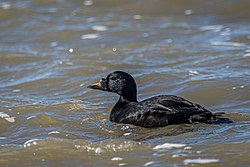
Picture of Melanitta nigra
- Source
- Wikipedia/Commons
- Credit
- Stephan Sprinz
- Licence
- CC BY-SA 4.0
- Commercial use
- the licence allows it
No 3D scan of Melanitta nigra was found in Sketchfab.
Smithsonian Open Access and MorphoSource were not reached for this taxon, so this list is what the others held rather than everything there is.
The description on this site
- Licence
- CC BY-SA 4.0
This is what the site found, which is not the same as what exists.
Keep going
What may have been alongside itMelanitta through timeFormations of the PleistoceneThe world it lived on
Occurrence data from the Paleobiology Database, CC BY 4.0. (Linnaeus 1758)