Ophidion
Ophidion is a genus of cusk-eels.

Etrusko25 · CC BY-SA 3.0 · via Wikipedia/Commons. May be a photograph of a specimen, or an artist’s reconstruction — an interpretation of a skeleton, since colour and soft tissue are almost never preserved.
On record
Recorded, not inferred- Sits inside
- OphidiidaePBDB
- Diet
- carnivore, parasitePBDB, for Ophidiiformes
- Life habit
- nektobenthicPBDB, for Ophidiiformes
- Motility
- actively mobilePBDB, for Ophidiiformes
Time the record covers
At least 37 million years on record.
The record covers at least 37.71 Mya to 129 ka. No occurrence read is dated outside 41.03 Mya to 11.7 ka.
22 occurrences of Ophidion on record, most of them in the Pleistocene. The Paleobiology Database records this as a living group. Bar height is expected occurrences, not a count: each fossil is spread across the span it is dated to, so a tall narrow bar means tight dating and a low wide one means loose.
When
22 occurrences- Eocene18%
- Miocene5%
- Pliocene18%
- Pleistocene59%
These are dates about fossils, not the animal: the record can only begin after it arose and end before it died out, so either end may reach further. Shares are expected occurrences: a fossil dated to a span is counted partly in each period it straddles. More on what this infers.
Found in
7 formations
- Palos Verdes Sand Formation6
- Barton Beds Formation2
- Lindos Bay Formation2
- Barton Clay Formation1
- Yorktown Formation · Chesapeake Group1
- Tamiami Formation1
Loading coastlines…
The named rock units Ophidion has been recovered from, largest first. Drawn where the rock is now, not where it formed. 8 occurrences have no formation on record, which is common for older literature.
Ophidion and its relatives
PleistoceneWhere Ophidion and its relatives were recorded in the Pleistocene.
Found in the same rock
1,549 taxa- Deltentosteus7 sites
- Dentex7 sites
- Gobius7 sites
- Lesueurigobius7 sites
- Myliobatis californica7 sites
- Carapus acus6 sites
- Carcharodon carcharias6 sites
- Ceratoscopelus maderensis6 sites
- Chilara taylori6 sites
- Galeorhinus galeus6 sites
- Genyonemus lineatus6 sites
- Muraena conger6 sites
- Seriphus politus6 sites
- Triakis semifasciata6 sites
- Aphia5 sites
- Carcharhinus5 sites
- Cepola5 sites
- Cymatogaster aggregata5 sites
- Engraulis mordax5 sites
- Heterodontus francisci5 sites
- Hirtoscala tincta5 sites
- Isurus oxyrinchus5 sites
- Lepidogobius lepidus5 sites
- Paralichthys californicus5 sites
The Paleobiology Database records 20 sites for Ophidion, and this reads all of them. The number is how many of those sites it was catalogued from too. The 24 sharing the most are listed.
This is not a list of everything alive at the time. It is only what has come out of the same ground as this animal and been written down.
Entered from
12 references- The Zanclean marine fish fauna and palaeoenvironmental reconstruction of a coastal marine setting in the eastern Mediterranean3
- Pleistocene fish otoliths from the Mediterranean Basin: a synthesis3
- Fish remains, mostly otoliths and teeth, from the Palos Verdes Sand (Late Pleistocene) of California3
- Faunal Horizons of the Barton Beds in Hampshire3
- Pleistocene marine fish invasions and paleoenvironmental reconstructions in the eastern Mediterranean2
- Fish records from the Pleistocene of southern California in the collections of the Los Angeles County Museum2
- Integrated taphonomy of an avian death assemblage in marine sediments from the late Pliocene of Florida1
- Preliminary List of the Marine Fishes and Other Vertebrate Remains from the Late Pleistocene Palos Verdes Sand Formation at Costa Mesa, Orange County, California1
- Teleost fish otoliths from Lee Creek Mine, Aurora, North Carolina (Yorktown Formation: Pliocene)1
- Die Fischfauna aus dem Mittelmiozän von Twistringen1
- Otoliths and other fish remains from a Long Beach, California, Pliocene deposit1
- Contribution à l'étude des Poissons fossiles des Antiles1
Each of the 22 occurrences read was entered from one of these publications, ordered by how many each accounts for. This is not a search for papers mentioning the name. Entries link to doi.org where the Paleobiology Database holds an identifier, and to its own record where it does not. Relayed as the Paleobiology Database holds them, not checked against what they resolve to.
Media and terms
Media content2
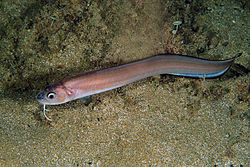
Picture of Ophidion
- Source
- Wikipedia/Commons
- Credit
- Etrusko25
- Licence
- CC BY-SA 3.0
- Commercial use
- the licence allows it

CT scan
- Source
- MorphoSource
- Licence
- In Copyright
- Commercial use
- cannot be read from the licence given — check the record
- Specimen
- Nerophis ophidion · YPM:VZ:YPM ICH 003569
Smithsonian Open Access was not reached for this taxon, so this list is what the others held rather than everything there is.
The description on this site
- Licence
- CC BY-SA 4.0
This is what the site found, which is not the same as what exists.
Keep going
What may have been alongside itOphidiidae through timeFormations of the PleistoceneThe world it lived on
Occurrence data from the Paleobiology Database, CC BY 4.0. (Linnaeus 1758)