Ophthalmosauridae
Ophthalmosauridae is an extinct family of thunnosaur ichthyosaurs from the Middle Jurassic to the early Late Cretaceous worldwide. Almost all ichthyosaurs from the Middle Jurassic onwards belong to the family, until the extinction of ichthyosaurs in the early Late Cretaceous. Ophthalmosaurids appeared worldwide during early Bajocian, subsequent to the disappearance of most other ichthyosaur lineages after the end of the Toarcian. Currently, the oldest known ophthalmosaurids is Mollesaurus from the early Bajocian of Argentina, as well as indeterminate remains of the same age from Luxembourg and Canada. Named by George H. Baur, in 1887, the family contains the basal taxa like Ophthalmosaurus. Appleby (1956) named the taxon Ophthalmosauria which was followed by some authors, but these two names are often treated as synonyms; Ophthalmosauridae has the priority over Ophthalmosauria. However, some researchers argue that Ophthalmosauridae should be restricted to the group typically referred to as Ophthalmosaurinae, with classic Platypterygiinae instead being referred to as Undorosauridae or Brachypterygiidae and Ophthalmosauria being used to unite these two groups.

User:Captmondo · CC BY-SA 3.0 · via Wikipedia/Commons. May be a photograph of a specimen, or an artist’s reconstruction — an interpretation of a skeleton, since colour and soft tissue are almost never preserved.
On record
Recorded, not inferred- Sits inside
- BaracromiaPBDB
- Diet
- carnivorePBDB, for Ichthyosauria
- Life habit
- nektonicPBDB, for Ichthyopterygia
- Motility
- actively mobilePBDB, for Ichthyosauria
- Environment
- marinePBDB, for Ichthyosauria
Time the record covers
At least 74 million years on record.
The record covers at least 174.7 Mya to 100.5 Mya. No occurrence read is dated outside 201.4 Mya to 66 Mya.
194 occurrences of Ophthalmosauridae on record, most of them in the Early Cretaceous. Bar height is expected occurrences, not a count: each fossil is spread across the span it is dated to, so a tall narrow bar means tight dating and a low wide one means loose.
When
194 occurrences- Early Jurassicunder 1%
- Middle Jurassic8%
- Late Jurassic31%
- Early Cretaceous50%
- Late Cretaceous11%
These are dates about fossils, not the animal: the record can only begin after it arose and end before it died out, so either end may reach further. Shares are expected occurrences: a fossil dated to a span is counted partly in each period it straddles. More on what this infers.
Found in
50 formations
- Toolebuc Formation · Rolling Downs Group15
- West Melbury Marly Chalk Formation · Chalk Group13
- Vaca Muerta Formation11
- Zapata Formation8
- Sundance Formation7
- Oxford Clay Formation · Ancholme Group7
Loading coastlines…
The named rock units Ophthalmosauridae has been recovered from, largest first. Drawn where the rock is now, not where it formed. 26 further formations hold fewer occurrences each and are not listed. 59 occurrences have no formation on record, which is common for older literature.
Ophthalmosauridae and its relatives
Early CretaceousWhere Ophthalmosauridae and its relatives were recorded in the Early Cretaceous.
Found in the same rock
501 taxa- Platypterygius24 sites
- Platypterygius australis17 sites
- Plesiosauria14 sites
- Ichthyosauria13 sites
- Ophthalmosaurus13 sites
- Pervushovisaurus campylodon13 sites
- Elasmosauridae10 sites
- Pliosauridae8 sites
- Ophthalmosaurinae7 sites
- Inoceramus6 sites
- Platypterygiinae6 sites
- Ophthalmosaurus icenicus5 sites
- Platypterygius americanus5 sites
- Sisteronia seeleyi5 sites
- Theropoda5 sites
- Cretalamna appendiculata4 sites
- Geosaurus4 sites
- Muraenosaurus leedsii4 sites
- Neusticemys neuquina4 sites
- Pterodactyloidea4 sites
- Pterosauria4 sites
- Acamptonectes densus3 sites
- Chimaeridae3 sites
- Cretalamna3 sites
The Paleobiology Database records 164 sites for Ophthalmosauridae, and this reads all of them. The number is how many of those sites it was catalogued from too. The 24 sharing the most are listed.
This is not a list of everything alive at the time. It is only what has come out of the same ground as this animal and been written down.
Entered from
122 references- High diversity in Cretaceous ichthyosaurs from Europe prior to their extinction12
- The Australian Cretaceous ichthyosaur Platypterygius australis: A description and review of postcranial remains9
- New ophthalmosaurid ichthyosaurs from the European Lower Cretaceous demonstrate extensive ichthyosaur survival across the Jurassic–Cretaceous boundary6
- Mesozoic marine reptiles of Russia and other former Soviet republics6
- Taxonomy of Platypterygius campylodon and the diversity of the last ichthyosaurs5
- Présence du genre Platypterygius (Ichthyosauria, Reptilia) dans le Cénomanien inférieur de Villers-sur-Mer (Normandie, France)5
- A new family of Ichthyosaurs, the Undorosauridae fam. nov. from the Volgian stage of the European part of Russia5
- Extinction of fish-shaped marine reptiles associated with reduced evolutionary rates and global environmental volatility4
- A Lower Cretaceous ichthyosaur graveyard in deep marine slope channel deposits at Torres del Paine National Park, southern Chile4
- Origin, biodiversity, and extinction of Cretaceous ichthyosaurs4
- Bridging the southern gap: First definitive evidence of Late Jurassic ichthyosaurs from Antarctica and their dispersion routes3
- Jack and Etheridge, 18923
Each of the 194 occurrences read was entered from one of these publications, ordered by how many each accounts for. This is not a search for papers mentioning the name. 110 further references are not listed. Entries link to doi.org where the Paleobiology Database holds an identifier, and to its own record where it does not. Relayed as the Paleobiology Database holds them, not checked against what they resolve to.
Media and terms
Media content1
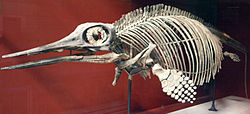
Picture of Ophthalmosauridae
- Source
- Wikipedia/Commons
- Credit
- User:Captmondo
- Licence
- CC BY-SA 3.0
- Commercial use
- the licence allows it
No 3D scan of Ophthalmosauridae was found in MorphoSource and Sketchfab.
Smithsonian Open Access was not reached for this taxon, so this list is what the others held rather than everything there is.
The description on this site
- Licence
- CC BY-SA 4.0
This is what the site found, which is not the same as what exists.
Keep going
What may have been alongside itBaracromia through timeFormations of the Early CretaceousThe world it lived on
Occurrence data from the Paleobiology Database, CC BY 4.0. (Andrews 1910)