Orcinus
Orcinus is a genus of Delphinidae (dolphins), in the infraorder Cetacea. It includes the largest delphinoid species, Orcinus orca, known as the orca or killer whale. Two extinct species are recognized, Orcinus paleorca and O. citoniensis, known from fossils. The other extinct species O. meyeri is disputed.

Robert Pittman · Public Domain · via Wikipedia/Commons. May be a photograph of a specimen, or an artist’s reconstruction — an interpretation of a skeleton, since colour and soft tissue are almost never preserved.
On record
Recorded, not inferred- Also called
- killer whalePBDB
- Sits inside
- DelphinidaePBDB
- Diet
- piscivore, carnivorePBDB, for Delphinidae
- Life habit
- aquatic, depth=surfacePBDB, for Cetacea
- Motility
- actively mobilePBDB, for Cetacea
- Environment
- marine,freshwaterPBDB, for Odontoceti
Time the record covers
At least 3.5 million years on record.
The record covers at least 3.6 Mya to 11.7 ka. No occurrence read is dated outside 7.246 Mya to 0 Mya.
47 occurrences of Orcinus on record. The Paleobiology Database records this as a living group. Bar height is expected occurrences, not a count: each fossil is spread across the span it is dated to, so a tall narrow bar means tight dating and a low wide one means loose.
When
47 occurrences- Mioceneunder 1%
- Pliocene9%
- Pleistocene26%
- Holocene64%
These are dates about fossils, not the animal: the record can only begin after it arose and end before it died out, so either end may reach further. Shares are expected occurrences: a fossil dated to a span is counted partly in each period it straddles. More on what this infers.
Found in
9 formations
- Setana Formation2
- Cromer Forest Bed Formation2
- Red Crag Formation1
- Sanuki Formation1
- Tangahoe Formation1
- Greta Siltstone Formation1
Loading coastlines…
The named rock units Orcinus has been recovered from, largest first. Drawn where the rock is now, not where it formed. 36 occurrences have no formation on record, which is common for older literature.
Found in the same rock
197 taxa- Delphinapterus leucas6 sites
- Balaenoptera physalus5 sites
- Physeter macrocephalus5 sites
- Balaenoptera musculus4 sites
- Rangifer tarandus4 sites
- Balaena3 sites
- Balaenopteridae3 sites
- Bison priscus3 sites
- Cetacea3 sites
- Coelodonta antiquitatis3 sites
- Mammuthus meridionalis3 sites
- Mammuthus primigenius3 sites
- Megaloceros giganteus3 sites
- Mysticeti3 sites
- Ontocetus emmonsi3 sites
- Phocidae3 sites
- Phocoena phocoena3 sites
- Physeter3 sites
- Scaldicetus caretti3 sites
- Ziphiidae3 sites
- Acipenser2 sites
- Alces2 sites
- Anancus arvernensis2 sites
- Balaenidae2 sites
The Paleobiology Database records 45 sites for Orcinus, and this reads all of them. The number is how many of those sites it was catalogued from too. The 24 sharing the most are listed.
This is not a list of everything alive at the time. It is only what has come out of the same ground as this animal and been written down.
Entered from
22 references- Foraging behaviour and ecology of transient killer whales (Orcinus orca)13
- Determining the ages of sub-fossil cetacean remains, found in the Carse of Stirling, Scotland6
- Late Pleistocene and Holocene whale remains (Cetacea) from Denmark and adjacent countries: Species, distribution, chronology, and trace element concentrations5
- A list of fossil cetaceans in Japan4
- The Kor & Bot collection revisited, with a biostratigraphic interpretation of the Early Pleistocene Oosterschelde Fauna (Oosterschelde Estuary, the Netherlands)2
- The Jortveit farm wetland: A Neolithic fishing site on the Skagerrak coast, Norway1
- Evaluating ancient whale exploitation on the northern Oregon coast through ancient DNA and aooarchaeological analysis1
- Holocene environmental changes and the seal (Phocidae) fauna of the Baltic Sea: coming, going and staying1
- The Eurogeul—first report of the palaeontological, palynological and archaeological investigations of this part of the North Sea1
- Whales, dorphines [dolphins] and porpoises off Shiretoko1
- Sea mammal hunting and the Neoglacial: An archaeofaunal study of environmental change and subsistence technology at Margaret Bay, Unalaska1
- Cetacans of Isla de Guadalupe, Baja California, Mexcico1
Each of the 47 occurrences read was entered from one of these publications, ordered by how many each accounts for. This is not a search for papers mentioning the name. 10 further references are not listed. Entries link to doi.org where the Paleobiology Database holds an identifier, and to its own record where it does not. Relayed as the Paleobiology Database holds them, not checked against what they resolve to.
Media and terms
Media content3
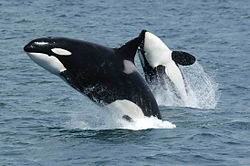
Picture of Orcinus
- Source
- Wikipedia/Commons
- Credit
- Robert Pittman
- Licence
- Public Domain
- Commercial use
- the licence allows it
Structured light scan
- Source
- MorphoSource
- Licence
- In Copyright
- Commercial use
- cannot be read from the licence given — check the record
- Specimen
- Orcinus sp. · UWBM:Mammalogy:UWBM:Mamm:26183
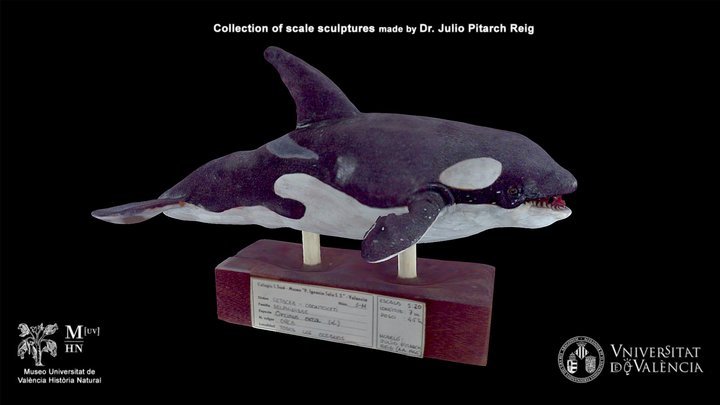
3D model
- Source
- Sketchfab
- Licence
- CC Attribution
- Commercial use
- cannot be read from the licence given — check the record
The description on this site
- Source
- Wikipedia, “Orcinus”
- Licence
- CC BY-SA 4.0
This is what the site found, which is not the same as what exists.
Keep going
What may have been alongside itDelphinidae through timeThe world it lived on
Occurrence data from the Paleobiology Database, CC BY 4.0. Fitzinger 1860