Ornithorhynchus anatinus
The platypus, sometimes referred to as the duck-billed platypus, is a semiaquatic, egg-laying mammal endemic to eastern Australia, including Tasmania. The platypus is the sole living representative of its family Ornithorhynchidae and genus Ornithorhynchus, though a number of related species appear in the fossil record. Together with the four species of echidna, it is one of the five extant species of monotremes, mammals that lay eggs instead of giving birth to live young. Like other monotremes, the platypus has a sense of electrolocation, which it uses to detect prey in water while its eyes, ears and nostrils are closed. It is one of the few species of venomous mammals, as the male platypus has a spur on each hind foot that delivers an extremely painful venom.

Charles J. Sharp · CC BY-SA 4.0 · via Wikipedia/Commons. May be a photograph of a specimen, or an artist’s reconstruction — an interpretation of a skeleton, since colour and soft tissue are almost never preserved.
On record
Recorded, not inferred- Sits inside
- OrnithorhynchusPBDB
- Diet
- insectivore, herbivorePBDB, for Ornithorhynchidae
- Life habit
- amphibiousPBDB, for Ornithorhynchus
- Motility
- actively mobilePBDB, for Osteichthyes
- Environment
- terrestrialPBDB, for Mammalia
Time the record covers
At least 2.5 million years on record.
The record covers at least 2.58 Mya to 11.7 ka. No occurrence read is dated outside 5.333 Mya to 0 Mya.
3 occurrences of Ornithorhynchus anatinus on record. The Paleobiology Database records this as a living group. Bar height is expected occurrences, not a count: each fossil is spread across the span it is dated to, so a tall narrow bar means tight dating and a low wide one means loose.
When
3 occurrences- Pliocene33%
- Pleistocene33%
- Holocene33%
These are dates about fossils, not the animal: the record can only begin after it arose and end before it died out, so either end may reach further. Shares are expected occurrences: a fossil dated to a span is counted partly in each period it straddles. More on what this infers.
Found in the same rock
68 taxa- Aepyprymnus rufescens1 site
- Antechinus flavipes1 site
- Antechinus stuartii1 site
- Bettongia penicillata1 site
- Caretta caretta1 site
- Carphodactylus1 site
- Cercartetus caudatus1 site
- Chelodina (Chelydera) rugosa1 site
- Chelodina longicollis1 site
- Chelodina novaeguineae1 site
- Chelonia1 site
- Chelonia mydas1 site
- Crocodylus johnstoni1 site
- Crocodylus porosus1 site
- Dasyurus hallucatus1 site
- Dasyurus maculatus1 site
- Dermochelys coriacea1 site
- Diprotodon1 site
- Emydura1 site
- Emydura dentata1 site
- Eretmochelys imbricata1 site
- Hydromys1 site
- Isoodon macrourus1 site
- Lagorchestes conspicillatus1 site
The Paleobiology Database records 3 sites for Ornithorhynchus anatinus, and this reads all of them. The number is how many of those sites it was catalogued from too. The 24 sharing the most are listed.
This is not a list of everything alive at the time. It is only what has come out of the same ground as this animal and been written down.
Entered from
3 references- Tropical Rainforests of North Queensland: Their Conservation Significance1
- Notes on the occurrence of monotreme remains in the Pliocene of New South Wales1
- On an extinct monotreme, Ornithorhynchus agilis1
Each of the 3 occurrences read was entered from one of these publications, ordered by how many each accounts for. This is not a search for papers mentioning the name. Each entry links to the Paleobiology Database's own record for the work.
Media and terms
Media content2

Picture of Ornithorhynchus anatinus
- Source
- Wikipedia/Commons
- Credit
- Charles J. Sharp
- Licence
- CC BY-SA 4.0
- Commercial use
- the licence allows it
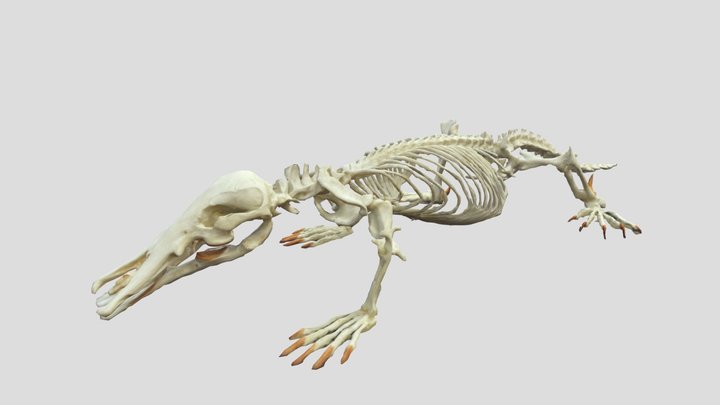
3D model
- Source
- Sketchfab
- Credit
- JChanteloupUPS
- Licence
- CC Attribution
- Commercial use
- cannot be read from the licence given — check the record
Smithsonian Open Access and MorphoSource were not reached for this taxon, so this list is what the others held rather than everything there is.
The description on this site
- Source
- Wikipedia, “Platypus”
- Licence
- CC BY-SA 4.0
This is what the site found, which is not the same as what exists.
Keep going
What may have been alongside itOrnithorhynchus through timeThe world it lived on
Occurrence data from the Paleobiology Database, CC BY 4.0. Shaw 1792