Osteolepiformes
Osteolepiformes, also known as Osteolepidida, is a group of prehistoric lobe-finned fishes which first appeared during the Devonian period. The order contains the families Canowindridae, Megalichthyidae, Osteolepididae and Tristichopteridae, in addition to several monotypic families. The order is generally considered to be paraphyletic because the characters that define it are mainly attributes of stem tetrapodomorphs.

Nobu Tamura ( http://spinops.blogspot.com ) · CC BY 2.5 · via Wikipedia/Commons. May be a photograph of a specimen, or an artist’s reconstruction — an interpretation of a skeleton, since colour and soft tissue are almost never preserved.
On record
Recorded, not inferred- Sits inside
- OsteolepididaPBDB
- Motility
- actively mobilePBDB, for Osteichthyes
Time the record covers
At least 127 million years on record.
The record covers at least 410.62 Mya to 283.3 Mya. No occurrence read is dated outside 413.02 Mya to 274.4 Mya.
59 occurrences of Osteolepiformes on record, most of them in the Devonian. Bar height is expected occurrences, not a count: each fossil is spread across the span it is dated to, so a tall narrow bar means tight dating and a low wide one means loose.
When
59 occurrences- Devonian69%
- Carboniferous22%
- Permian8%
These are dates about fossils, not the animal: the record can only begin after it arose and end before it died out, so either end may reach further. Shares are expected occurrences: a fossil dated to a span is counted partly in each period it straddles. More on what this infers.
Found in
27 formations
- Aztec Siltstone Formation16
- Elbert Formation3
- Cutler Formation2
- Catskill Formation2
- Parting Formation2
- Corradigbee Formation · Hatchery Creek Group2
Loading coastlines…
The named rock units Osteolepiformes has been recovered from, largest first. Drawn where the rock is now, not where it formed. 3 further formations hold fewer occurrences each and are not listed. 11 occurrences have no formation on record, which is common for older literature.
Osteolepiformes and its relatives
DevonianWhere Osteolepiformes and its relatives were recorded in the Devonian.
Found in the same rock
390 taxa- Osteolepidae21 sites
- Dipnoi7 sites
- Glyptolepis7 sites
- Asterolepis5 sites
- Holoptychiidae5 sites
- Litoptychus bryanti5 sites
- Megalichthys5 sites
- Acanthodes4 sites
- Rhadinichthys4 sites
- Sarcopterygii4 sites
- Tristichopteridae4 sites
- Acanthodii3 sites
- Bothriolepis nitida3 sites
- Cryptolepis grossi3 sites
- Ctenacanthidae3 sites
- Donnrosenia schaefferi3 sites
- Ectosteorhachis nitidus3 sites
- Elasmobranchii3 sites
- Ganosteus3 sites
- Gastropoda3 sites
- Haplacanthus marginalis3 sites
- Holoptychius nobilissimus3 sites
- Megalichthys hibberti3 sites
- Milesacanthus antarctica3 sites
The Paleobiology Database records 56 sites for Osteolepiformes, and this reads all of them. The number is how many of those sites it was catalogued from too. The 24 sharing the most are listed.
This is not a list of everything alive at the time. It is only what has come out of the same ground as this animal and been written down.
Entered from
33 references- Crossopterygian fishes from the Devonian of Antarctica: systematics, relationships and biogeographic significance16
- Late Devonian fresh-water fishes from the western United States5
- A new species of the Devonian actinopterygian fish Moythomasia from Belarus3
- A synopsis of the classification of the British Palaeozoic rocks, with a systematic description of the British Palaeozoic fossils.Fasciculus 3, Mollusca and Palaeozoic fishes3
- Depositional environment, stratigraphy, structure and paleobiology of the Hatchery Creek Group (Early–?Middle Devonian) near Wee Jasper, New South Wales2
- Vertebrate correlation of the Upper Devonian and Lower Carboniferous on the East European Platform2
- Vertebrates from the Halgaito Tongue of the Cutler Formation, Permian of San Juan County, Utah2
- Redescription of Americlus rankini (Woodward, 1868) (Pancrustacea: Cyclida: Americlidae) and interpretation of its systematic placement, morphology, and paleoecology1
- A new species of Megalichthys (Sarcopterygii, Megalichthyidae) from the Upper Devonian (Famennian) of Pennsylvania, U.S.A., and a report on the cosmine-covered osteolepiform fossils of the Catskill Formation1
- New insights into Late Devonian vertebrates and associated fauna from the Cuche Formation (Floresta Massif, Colombia)1
- New finds of fishes in the lower uppermost Famennian (Upper Devonian) of Сentral Russia and habitats of the Khovanshchinian vertebrate assemblages1
- High latitude Gondwanan Famennian biodiversity patterns - evidence from the South African Witpoort Formation (Cape Supergroup, Witteberg Group)1
Each of the 59 occurrences read was entered from one of these publications, ordered by how many each accounts for. This is not a search for papers mentioning the name. 21 further references are not listed. Entries link to doi.org where the Paleobiology Database holds an identifier, and to its own record where it does not. Relayed as the Paleobiology Database holds them, not checked against what they resolve to.
Media and terms
Media content1
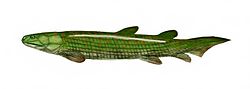
Picture of Osteolepiformes
- Source
- Wikipedia/Commons
- Credit
- Nobu Tamura ( http://spinops.blogspot.com )
- Licence
- CC BY 2.5
- Commercial use
- the licence allows it
No 3D scan of Osteolepiformes was found in MorphoSource and Sketchfab.
Smithsonian Open Access was not reached for this taxon, so this list is what the others held rather than everything there is.
The description on this site
- Licence
- CC BY-SA 4.0
This is what the site found, which is not the same as what exists.
Keep going
What may have been alongside itOsteolepidida through timeFormations of the DevonianThe world it lived on
Occurrence data from the Paleobiology Database, CC BY 4.0. Berg 1937