Dipnoi
Lungfish, also known as dipnoans, are freshwater vertebrates belonging to the class Dipnoi. Lungfish are best known for their innovative respiratory system, including the ability to breathe air, and derived structures within Sarcopterygii, including the presence of lobed fins with a well-developed internal skeleton. Lungfish represent the closest living relatives of the tetrapods. The mouths of lungfish typically bear tooth plates, which are used to crush hard shelled organisms.

Mitch Ames · CC BY-SA 4.0 · via Wikipedia/Commons. May be a photograph of a specimen, or an artist’s reconstruction — an interpretation of a skeleton, since colour and soft tissue are almost never preserved.
On record
Recorded, not inferred- Also called
- lungfishPBDB
- Sits inside
- DipnomorphaPBDB
- Motility
- actively mobilePBDB, for Osteichthyes
- Environment
- lagoonal,marine,brackish,freshwaterPBDB
Time the record covers
At least 438 million years on record.
The record covers at least 438.6 Mya to 11.7 ka. No occurrence read is dated outside 443.1 Mya to 0 Mya.
830 occurrences of Dipnoi on record, most of them in the Devonian. The Paleobiology Database records this as a living group. Bar height is expected occurrences, not a count: each fossil is spread across the span it is dated to, so a tall narrow bar means tight dating and a low wide one means loose.
When
830 occurrences- Silurianunder 1%
- Devonian22%
- Carboniferous4%
- Permian6%
- Early Triassic3%
- Middle Triassic3%
- Late Triassic15%
- Early Jurassicunder 1%
- Middle Jurassic2%
- Late Jurassic6%
- Early Cretaceous8%
- Late Cretaceous15%
- Paleoceneunder 1%
- Eocene2%
- Oligocene4%
- Miocene5%
- Pliocene2%
- Pleistocene2%
- Holoceneunder 1%
These are dates about fossils, not the animal: the record can only begin after it arose and end before it died out, so either end may reach further. Shares are expected occurrences: a fossil dated to a span is counted partly in each period it straddles. More on what this infers.
Found in
292 formations
- Chinle Formation46
- Morrison Formation31
- Namba Formation21
- La Colonia Formation19
- Koobi Fora Formation · Omo Group18
- Cloverly Formation14
Loading coastlines…
The named rock units Dipnoi has been recovered from, largest first. Drawn where the rock is now, not where it formed. 268 further formations hold fewer occurrences each and are not listed. 86 occurrences have no formation on record, which is common for older literature.
Dipnoi and its relatives
DevonianWhere Dipnoi and its relatives were recorded in the Devonian.
Found in the same rock
2,246 taxa- Protopterus47 sites
- Arganodus38 sites
- Theropoda35 sites
- Ceratodus34 sites
- Clarias29 sites
- Osteichthyes27 sites
- Polypterus26 sites
- Lates23 sites
- Reptilia23 sites
- Crocodylus22 sites
- Testudines22 sites
- Crocodylia21 sites
- Actinopterygii20 sites
- Euthecodon brumpti20 sites
- Trionyx20 sites
- Geochelone19 sites
- Synodontis19 sites
- Crocodylus niloticus18 sites
- Mammalia16 sites
- Redfieldiidae15 sites
- Apachesaurus gregorii14 sites
- Lepidotes14 sites
- Archosauria13 sites
- Hybodus13 sites
The Paleobiology Database records 660 sites for Dipnoi, and this reads 240 of them. The number is how many of those sites it was catalogued from too. The 24 sharing the most are listed.
This is not a list of everything alive at the time. It is only what has come out of the same ground as this animal and been written down.
Entered from
431 references- Late Triassic (Carnian and Norian) Tetrapods from the Southwestern United States30
- Freshwater Fishes and their paleobiotic implications18
- The end of the dinosaur era in Patagonia (NatGeo Project)16
- Étude derestes de poissons du Crétacé saharien [Study of fish remains from the Saharan Cretaceous]15
- Terrestrial and Freshwater Turtles of Early Cretaceous Australia14
- Tetrapod localities from the Triassic of the SE of European Russia13
- The Middle Devonian fishes of the Baltic States (Estonia, Latvia) and Belarus13
- A review of the Tertiary fossil Cetacea (Mammalia) localities in Australia12
- A revision of Australian Mesozoic and Cenozoic lungfish of the family Neoceratodontidae (Osteichthyes:Dipnoi), with a description of four new species12
- Connely, 200211
- Catalogue of the Fossil Fishes in the British Museum (Natural History). Part II11
- End-Devonian extinction and a bottleneck in the early evolution of modern jawed vertebrates10
Each of the 830 occurrences read was entered from one of these publications, ordered by how many each accounts for. This is not a search for papers mentioning the name. 419 further references are not listed. Entries link to doi.org where the Paleobiology Database holds an identifier, and to its own record where it does not. Relayed as the Paleobiology Database holds them, not checked against what they resolve to.
Media and terms
Media content2
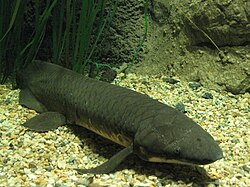
Picture of Dipnoi
- Source
- Wikipedia/Commons
- Credit
- Mitch Ames
- Licence
- CC BY-SA 4.0
- Commercial use
- the licence allows it
CT scan
- Source
- MorphoSource
- Licence
- not stated by the source
- Commercial use
- cannot be read from the licence given — check the record
- Specimen
- Dipnoi sp. · dpc:IGM 184734
The description on this site
- Source
- Wikipedia, “Lungfish”
- Licence
- CC BY-SA 4.0
This is what the site found, which is not the same as what exists.
Keep going
What may have been alongside itDipnomorpha through timeFormations of the DevonianThe world it lived on
Occurrence data from the Paleobiology Database, CC BY 4.0. (Müller 1884)