Pelecanus occidentalis
The brown pelican is a bird of the pelican family, Pelecanidae, one of three species found in the Americas and one of two that feed by diving into water. It is found on the Atlantic Coast from New Jersey to the mouth of the Amazon River, and along the Pacific Coast from British Columbia to Peru, including the Galapagos Islands. The nominate subspecies in its breeding plumage has a white head with a yellowish wash on the crown. The nape and neck are dark maroon–brown. The upper sides of the neck have white lines along the base of the gular pouch, and the lower fore neck has a pale yellowish patch. The male and female are similar, but the female is slightly smaller. The nonbreeding adult has a white head and neck. The pink skin around the eyes becomes dull and gray in the nonbreeding season. It lacks any red hue, and the pouch is strongly olivaceous ochre-tinged and the legs are olivaceous gray to blackish-gray.

Frank Schulenburg · CC BY-SA 4.0 · via Wikipedia/Commons. May be a photograph of a specimen, or an artist’s reconstruction — an interpretation of a skeleton, since colour and soft tissue are almost never preserved.
On record
Recorded, not inferred- Also called
- brown pelicanPBDB
- Sits inside
- PelecanusPBDB
- Diet
- carnivorePBDB, for Coelurosauria
- Life habit
- ground dwelling, solitaryPBDB, for Theropoda
- Motility
- actively mobilePBDB, for Theropoda
- Environment
- marinePBDB, for Pelecaniformes
- Mass
- 3.7 kgWikidata
Time the record covers
At most 129 thousand years on record.
Every occurrence read is dated to somewhere between 129 ka and 0 Mya, and nothing in the dating separates them, so that window is what the record shows rather than a span.
17 occurrences of Pelecanus occidentalis on record, most of them in the Holocene. The Paleobiology Database records this as a living group. Bar height is expected occurrences, not a count: each fossil is spread across the span it is dated to, so a tall narrow bar means tight dating and a low wide one means loose.
When
17 occurrences- Pleistocene6%
- Holocene94%
These are dates about fossils, not the animal: the record can only begin after it arose and end before it died out, so either end may reach further. Shares are expected occurrences: a fossil dated to a span is counted partly in each period it straddles. More on what this infers.
Pelecanus occidentalis and its relatives
HoloceneWhere Pelecanus occidentalis and its relatives were recorded in the Holocene.
Found in the same rock
159 taxa- Ardea herodias7 sites
- Anas6 sites
- Anatinae6 sites
- Anserinae6 sites
- Larus6 sites
- Phalacrocorax6 sites
- Phalacrocorax auritus6 sites
- Phalacrocorax penicillatus6 sites
- Sula sula6 sites
- Tyto alba6 sites
- Uria6 sites
- Anser caerulescens5 sites
- Antigone canadensis5 sites
- Aythya5 sites
- Buteo5 sites
- Corvus brachyrhynchos5 sites
- Corvus corax5 sites
- Numenius americanus5 sites
- Phoenicopterus ruber5 sites
- Sula5 sites
- Buteo jamaicensis4 sites
- Limosa fedoa4 sites
- Melanitta4 sites
- Polyborus plancus4 sites
The Paleobiology Database records 17 sites for Pelecanus occidentalis, and this reads all of them. The number is how many of those sites it was catalogued from too. The 24 sharing the most are listed.
This is not a list of everything alive at the time. It is only what has come out of the same ground as this animal and been written down.
Entered from
7 references- Avian remains from late pre-colonial Amerindian sites on islands of the Venezuelan Caribbean6
- Prehistoric human impacts on California birds: evidence from the Emeryville shellmoumd avifauna6
- Prehistoric exploitation of birds on the Pacific coast of Chiapas, Mexico1
- A late Pleistocene avifauna from San Miguel Island, California1
- Remains of rare and extinct birds from Illinois Indian sites1
- Bird remains from the West Indies1
- Ancient records of birds from the island of St. Croix with observations on extinct and living birds of Puerto Rico1
Each of the 17 occurrences read was entered from one of these publications, ordered by how many each accounts for. This is not a search for papers mentioning the name. Entries link to doi.org where the Paleobiology Database holds an identifier, and to its own record where it does not. Relayed as the Paleobiology Database holds them, not checked against what they resolve to.
Media and terms
Media content2
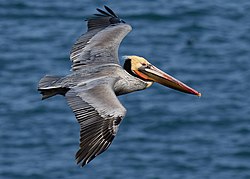
Picture of Pelecanus occidentalis
- Source
- Wikipedia/Commons
- Credit
- Frank Schulenburg
- Licence
- CC BY-SA 4.0
- Commercial use
- the licence allows it
CT scan
- Source
- MorphoSource
- Licence
- In Copyright
- Commercial use
- cannot be read from the licence given — check the record
- Specimen
- Pelecanus occidentalis · TxVP:M:16833
Smithsonian Open Access was not reached for this taxon, so this list is what the others held rather than everything there is.
The description on this site
- Licence
- CC BY-SA 4.0
This is what the site found, which is not the same as what exists.
Keep going
What may have been alongside itPelecanus through timeFormations of the HoloceneThe world it lived on
Occurrence data from the Paleobiology Database, CC BY 4.0. (Linnaeus 1766)