Pentacrinites
Pentacrinites is an extinct genus of crinoids that lived from the Hettangian to the Bathonian of Asia, Europe, North America, and New Zealand. Their stems are pentagonal to star-shaped in cross-section and are the most commonly preserved parts. Pentacrinites are commonly found in the Pentacrinites Bed of the Early Jurassic of Lyme Regis, Dorset, England. Pentacrinites can be recognized by the extensions all around the stem, which are long, unbranching, and of increasing length further down, the very small cup and 5 long freely branching arms.

NobuTamura email:nobu.tamura@yahoo.com www.palaeocritti.com · CC BY-SA 3.0 · via Wikipedia/Commons. May be a photograph of a specimen, or an artist’s reconstruction — an interpretation of a skeleton, since colour and soft tissue are almost never preserved.
On record
Recorded, not inferred- Sits inside
- PentacrinitidaePBDB
- Diet
- suspension feederPBDB, for Isocrinida
- Life habit
- epifaunalPBDB, for Isocrinida
- Motility
- stationaryPBDB, for Isocrinida
- Vision
- blindPBDB, for Crinoidea
- Environment
- marinePBDB, for Echinodermata
Time the record covers
At least 205 million years on record.
The record covers at least 243.43 Mya to 37.71 Mya. No occurrence read is dated outside 251.902 Mya to 33.9 Mya.
152 occurrences of Pentacrinites on record, most of them in the Early Jurassic. Bar height is expected occurrences, not a count: each fossil is spread across the span it is dated to, so a tall narrow bar means tight dating and a low wide one means loose.
When
152 occurrences- Early Triassicunder 1%
- Middle Triassic7%
- Late Triassic16%
- Early Jurassic36%
- Middle Jurassic15%
- Late Jurassic12%
- Early Cretaceous7%
- Late Cretaceous3%
- Paleocene3%
- Eocene2%
These are dates about fossils, not the animal: the record can only begin after it arose and end before it died out, so either end may reach further. Shares are expected occurrences: a fossil dated to a span is counted partly in each period it straddles. More on what this infers.
Found in
54 formations
- Kap Leslie Formation6
- Calcari Oolitici di S. Vigilio Formation5
- Whitby Mudstone Formation4
- Lautaro Formation4
- Twin Creek Limestone Formation3
- Cassian Formation3
Loading coastlines…
The named rock units Pentacrinites has been recovered from, largest first. Drawn where the rock is now, not where it formed. 30 further formations hold fewer occurrences each and are not listed. 68 occurrences have no formation on record, which is common for older literature.
Pentacrinites and its relatives
Early JurassicWhere Pentacrinites and its relatives were recorded in the Early Jurassic.
Found in the same rock
2,099 taxa- Astarte20 sites
- Ostrea20 sites
- Serpula18 sites
- Gryphaea17 sites
- Plagiostoma17 sites
- Pleuromya15 sites
- Echinoidea14 sites
- Pecten14 sites
- Belemnitida13 sites
- Lima13 sites
- Pinna13 sites
- Terebratula13 sites
- Cidaris12 sites
- Pleurotomaria12 sites
- Trigonia12 sites
- Chlamys textoria11 sites
- Dentalium11 sites
- Liostrea11 sites
- Modiolus11 sites
- Gastropoda10 sites
- Nuculana10 sites
- Protocardia10 sites
- Rhynchonella10 sites
- Ammonitida9 sites
The Paleobiology Database records 136 sites for Pentacrinites, and this reads all of them. The number is how many of those sites it was catalogued from too. The 24 sharing the most are listed.
This is not a list of everything alive at the time. It is only what has come out of the same ground as this animal and been written down.
Entered from
98 references- Dynamische Palaookologie und taxonomische Bearbeitung des Unterjura (Hettangium bis unteres Sinemurium) auf der Schwabischen Alb8
- Brachiopods from the "Calcari Oolitici di S. Vigilio" (Toarcian-Aalenian) and "Rosso Ammonitico" (Upper Bajocian) in the central Lessinian Alps (Province of Verona, Italy): a preliminary note5
- The Mesozoic and Cenozoic Echinodermata of the United States5
- On the Zone of Avicula contorta, and the Lower Lias of the South of England5
- The Impact of Global Warming and Anoxia on Marine Benthic Community Dynamics: an Example from the Toarcian (Early Jurassic)4
- Genesis and environmental significance of Upper Cretaceous shell concentrations from the Cauvery Basin, southern India4
- Geology and mineral deposits of southeastern Alaska4
- Unpublished data3
- Aportaciones a la estratigrafía y paleontología del Triásico Medio de los alrededores de Agost, Alicante [Contribution to the stratigraphy and paleontology of the Middle Triassic in the proximities of Agost, Alicante]3
- Biostratigraphie, Fauna und Mikropaläontologie des Untertoarcium-Profiles von Unterstürmig (Oberfranken, Süddeutschland)3
- Die Fauna der sogenannten Cardita- und Raibler-Schichten in den Nordtiroler und bayerischen Alpen.3
- Das Westliche Süd-Tirol: geologisch dargestellt3
Each of the 152 occurrences read was entered from one of these publications, ordered by how many each accounts for. This is not a search for papers mentioning the name. 86 further references are not listed. Entries link to doi.org where the Paleobiology Database holds an identifier, and to its own record where it does not. Relayed as the Paleobiology Database holds them, not checked against what they resolve to.
Media and terms
Media content1
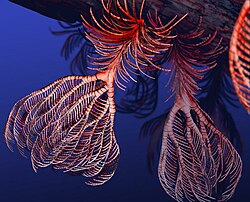
Picture of Pentacrinites
- Source
- Wikipedia/Commons
- Credit
- NobuTamura email:nobu.tamura@yahoo.com www.palaeocritti.com
- Licence
- CC BY-SA 3.0
- Commercial use
- the licence allows it
No 3D scan is on file for Pentacrinites.
This entry was cached before the site began recording what Smithsonian Open Access, MorphoSource and Sketchfab did, so a search that failed cannot be told from one that found nothing.
The description on this site
- Licence
- CC BY-SA 4.0
This is what the site found, which is not the same as what exists.
Keep going
What may have been alongside itPentacrinitidae through timeFormations of the Early JurassicThe world it lived on
Occurrence data from the Paleobiology Database, CC BY 4.0. Blumenbach 1804