Percidae
The Percidae are a family of ray-finned fish, part of the order Perciformes, which are found in fresh and brackish waters of the Northern Hemisphere. The majority are Nearctic, but there are also Palearctic species. The family contains nearly 250 species in 12 genera. The perches and their relatives are in this family; well-known species include the walleye, sauger, ruffe, and three species of perch. However, small fish known as darters are also a part of this family.

Originally uploaded to English Wikipedia by en:User:Hadal · Public Domain · via Wikipedia/Commons. May be a photograph of a specimen, or an artist’s reconstruction — an interpretation of a skeleton, since colour and soft tissue are almost never preserved.
On record
Recorded, not inferred- Also called
- perchPBDB
- Sits inside
- PercoideiPBDB
- Diet
- carnivorePBDB, for Perciformes
- Life habit
- nektonicPBDB, for Perciformes
- Motility
- actively mobilePBDB, for Perciformes
- Environment
- freshwaterPBDB
Time the record covers
At least 51 million years on record.
The record covers at least 51.1 Mya to 11.7 ka. No occurrence read is dated outside 56 Mya to 0 Mya.
64 occurrences of Percidae on record, most of them in the Miocene. The Paleobiology Database records this as a living group. Bar height is expected occurrences, not a count: each fossil is spread across the span it is dated to, so a tall narrow bar means tight dating and a low wide one means loose.
When
64 occurrencesThese are dates about fossils, not the animal: the record can only begin after it arose and end before it died out, so either end may reach further. Shares are expected occurrences: a fossil dated to a span is counted partly in each period it straddles. More on what this infers.
Found in
10 formations
- Miretrain Marl Formation9
- Volhyn Beds Formation4
- Green River Formation3
- Cromer Forest Bed Formation3
- Aral Formation2
- Reuver clay Formation2
Loading coastlines…
The named rock units Percidae has been recovered from, largest first. Drawn where the rock is now, not where it formed. 37 occurrences have no formation on record, which is common for older literature.
Percidae and its relatives
MioceneWhere Percidae and its relatives were recorded in the Miocene.
Found in the same rock
769 taxa- Sander10 sites
- Perca9 sites
- Sander lucioperca9 sites
- Esox lucius7 sites
- Leobergia zaissanica7 sites
- Diaphus6 sites
- Equus6 sites
- Anatidae5 sites
- Aves5 sites
- Bregmaceros5 sites
- Conger5 sites
- Glyptophidium5 sites
- Grammonus5 sites
- Leuciscus5 sites
- Mimomys5 sites
- Perca fluviatilis5 sites
- Rutilus5 sites
- Silurus5 sites
- Testudo5 sites
- Acipenser4 sites
- Bathyclupea4 sites
- Castor4 sites
- Cervidae4 sites
- Cyprinidae4 sites
The Paleobiology Database records 41 sites for Percidae, and this reads all of them. The number is how many of those sites it was catalogued from too. The 24 sharing the most are listed.
This is not a list of everything alive at the time. It is only what has come out of the same ground as this animal and been written down.
Entered from
22 references- Late Miocene and Pliocene pikeperches (Teleostei, Percidae) of southeastern Europe20
- Fish otoliths from the Lutetian of the Aquitaine Basin (SW France), a breakthrough in the knowledge of the European Eocene ichthyofauna10
- A new Sarmatian (late Middle Miocene) vertebrate assemblage from the periphery of the Forecarpathian Basin4
- After Hopewell in Southern Québec4
- A comparison of fish community structure along several paleoenvironments of Eocene Fossil Lake, Wyoming: a preliminary report3
- The Vertebrata of the Forest Bed Series of Norfolk and Suffolk3
- Vertebrates from the Pontian of the Shkodova Gora Locality (Northwestern Black Sea Region, Upper Miocene)2
- Biostratigraphy and paleoecology of continental Tertiary vertebrate faunas in the Lower Rhine Embayment (NW-Germany)2
- The Stratigraphy and Small Mammals from the Aral Formation, the Altynshokysu Locality, Northern Aral Area2
- The Early Middle Pleistocene vertebrate fauna from Little Oakley, Essex2
- The Zanclean marine fish fauna and palaeoenvironmental reconstruction of a coastal marine setting in the eastern Mediterranean1
- A new Miocene ape and locomotion in the ancestor of great apes and humans1
Each of the 64 occurrences read was entered from one of these publications, ordered by how many each accounts for. This is not a search for papers mentioning the name. 10 further references are not listed. Entries link to doi.org where the Paleobiology Database holds an identifier, and to its own record where it does not. Relayed as the Paleobiology Database holds them, not checked against what they resolve to.
Media and terms
Media content1
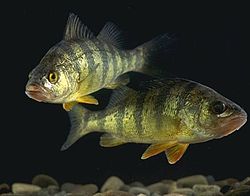
Picture of Percidae
- Source
- Wikipedia/Commons
- Credit
- Originally uploaded to English Wikipedia by en:User:Hadal
- Licence
- Public Domain
- Commercial use
- the licence allows it
No 3D scan was found. Smithsonian Open Access, MorphoSource and Sketchfab were all searched.
The description on this site
- Source
- Wikipedia, “Percidae”
- Licence
- CC BY-SA 4.0
This is what the site found, which is not the same as what exists.
Keep going
What may have been alongside itPercoidei through timeFormations of the MioceneThe world it lived on
Occurrence data from the Paleobiology Database, CC BY 4.0. Cuvier 1816