Phyllopachyceras
Phyllopachyceras is an extinct genus of ammonoid cephalopods belonging to the family Phylloceratidae. These nektonic carnivores lived in the Cretaceous, from Hauterivian to Maastrichtian to age.

Hectonichus · CC BY-SA 3.0 · via Wikipedia/Commons. May be a photograph of a specimen, or an artist’s reconstruction — an interpretation of a skeleton, since colour and soft tissue are almost never preserved.
On record
Recorded, not inferred- Sits inside
- PhylloceratinaePBDB
- Diet
- carnivorePBDB, for Phylloceratida
- Life habit
- nektonicPBDB, for Phylloceratida
- Motility
- actively mobilePBDB, for Phylloceratida
- Vision
- well-developedPBDB, for Cephalopoda
- Environment
- marinePBDB, for Cephalopoda
Time the record covers
At least 89 million years on record.
The record covers at least 161.5 Mya to 72.2 Mya. No occurrence read is dated outside 168.2 Mya to 66 Mya.
565 occurrences of Phyllopachyceras on record, most of them in the Early Cretaceous. Bar height is expected occurrences, not a count: each fossil is spread across the span it is dated to, so a tall narrow bar means tight dating and a low wide one means loose.
When
565 occurrences- Middle Jurassicunder 1%
- Early Cretaceous90%
- Late Cretaceous10%
These are dates about fossils, not the animal: the record can only begin after it arose and end before it died out, so either end may reach further. Shares are expected occurrences: a fossil dated to a span is counted partly in each period it straddles. More on what this infers.
Found in
42 formations
- Donji Milanovac Formation22
- Bersek Marl Formation19
- El Mergueb Formation · M' Chergua Group18
- Miria Formation14
- Budden Canyon Formation12
- Maiolica Formation10
Loading coastlines…
The named rock units Phyllopachyceras has been recovered from, largest first. Drawn where the rock is now, not where it formed. 18 further formations hold fewer occurrences each and are not listed. 400 occurrences have no formation on record, which is common for older literature.
Phyllopachyceras and its relatives
Early CretaceousWhere Phyllopachyceras and its relatives were recorded in the Early Cretaceous.
Found in the same rock
574 taxa- Barremites95 sites
- Phylloceras (Hypophylloceras) ponticuli58 sites
- Anahamulina48 sites
- Lytoceras48 sites
- Subpulchellia37 sites
- Holcodiscus34 sites
- Karsteniceras34 sites
- Spitidiscus28 sites
- Crioceratites27 sites
- Hamulinites27 sites
- Phylloceras25 sites
- Euphylloceras thetys24 sites
- Protetragonites22 sites
- Bochianites neocomiensis20 sites
- Protetragonites crebrisulcatus20 sites
- Anahamulina subcylindrica19 sites
- Paraspiticeras18 sites
- Pseudophyllites indra18 sites
- Neolissoceras grasianum17 sites
- Dissimilites16 sites
- Gunnarites kalika16 sites
- Neolissoceras16 sites
- Crioceratites (Emericiceras) thiollierei15 sites
- Lytoceras subfimbriatum15 sites
The Paleobiology Database records 479 sites for Phyllopachyceras, and this reads 240 of them. The number is how many of those sites it was catalogued from too. The 24 sharing the most are listed.
This is not a list of everything alive at the time. It is only what has come out of the same ground as this animal and been written down.
Entered from
68 references- L'évolution des ammonites du Valanginien-Hauterivien inférieur du bassin Vocontien et de la plate-form Provençale (sud-est de la France): relations avec la stratigraphie séquentielle et implications biostratigraphiques218
- Lower Barremian ammonite biostratigraphy in the Subbetic Domain (Betic Cordillera, southern Spain)93
- Ammonites (Phylloceratina, Lytoceratina and Ancyloceratina) and organic-walled dinoflagellate cysts from the Late Barremian in Boljetin, eastern Serbia22
- Integrated Lower Cretaceous biostratigraphy of the Bersek Quarry, Gerecse Mountains, Transdanubian Range. Hungary22
- Ammonite biostratigraphy of the uppermost Hauterivian in the Betic Cordillera (SE Spain)19
- Ammonoid and foraminiferal biostratigraphy from uppermost Valanginian to lowermost Barremian of the Jebel Boulahouajeb section (northern Tunisia)18
- Maastrichtian Non-Heteromorph Ammonites from the Miria Formation, Western Australia16
- Ammonites of Early Cretaceous age (Valanginian and Hauterivian) from the Pacific Coast states13
- Barremian pyritic ammonites from the western External Rif (northwest Morocco)11
- Early Crioceratites (heteromorphic ammonites) from the lower Hauterivian of south-eastern France: systematics, intraspecific variation and biostratigraphic implications11
- Cretaceous stratigraphy in the Chikubetsu area, Hokaido9
- Renouvellement des ammonites en fosse Vocontienne a la limite Valanginien-Hauterivien [Ammonite turnover in the Vocontian trough at the Valanginian-Hauterivian boundary]8
Each of the 565 occurrences read was entered from one of these publications, ordered by how many each accounts for. This is not a search for papers mentioning the name. 56 further references are not listed. Entries link to doi.org where the Paleobiology Database holds an identifier, and to its own record where it does not. Relayed as the Paleobiology Database holds them, not checked against what they resolve to.
Media and terms
Media content1
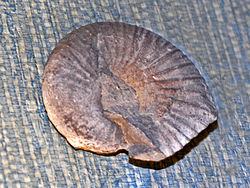
Picture of Phyllopachyceras
- Source
- Wikipedia/Commons
- Credit
- Hectonichus
- Licence
- CC BY-SA 3.0
- Commercial use
- the licence allows it
No 3D scan was found. Smithsonian Open Access, MorphoSource and Sketchfab were all searched.
The description on this site
- Licence
- CC BY-SA 4.0
This is what the site found, which is not the same as what exists.
Keep going
What may have been alongside itPhylloceratinae through timeFormations of the Early CretaceousThe world it lived on
Occurrence data from the Paleobiology Database, CC BY 4.0. (Spath 1925)