Scutelleridae
Scutelleridae is a family of true bugs. They are commonly known as jewel (stink) bugs or metallic shield bugs due to their often unique coloration. With the name based on the Asian genus Scutellera, they are also known as shield-backed bugs due to the enlargement of the thoracic scutellum into a continuous shield over the abdomen and wings. This latter characteristic distinguishes them from most other families within Heteroptera, and may lead to misidentification as a beetle rather than a bug. These insects use their piercing-sucking mouthparts to feed on plant juices from a variety of different species, including some commercial crops. Closely related to stink bugs, they may also produce an offensive odour when disturbed. There are around 450 species worldwide.

Benjamint444 · CC BY-SA 3.0 · via Wikipedia/Commons. May be a photograph of a specimen, or an artist’s reconstruction — an interpretation of a skeleton, since colour and soft tissue are almost never preserved.
On record
Recorded, not inferred- Also called
- metallic shield bugPBDB
- Sits inside
- PentatomoideaPBDB
- Motility
- actively mobilePBDB, for Arthropoda
- Environment
- terrestrialPBDB, for Insecta
Time the record covers
At least 55 million years on record.
The record covers at least 59.24 Mya to 3.6 Mya. No occurrence read is dated outside 61.66 Mya to 2.58 Mya.
22 occurrences of Scutelleridae on record, most of them in the Miocene. The Paleobiology Database records this as a living group, and the chart stops with its fossils rather than at the present. Bar height is expected occurrences, not a count: each fossil is spread across the span it is dated to, so a tall narrow bar means tight dating and a low wide one means loose.
When
22 occurrencesThese are dates about fossils, not the animal: the record can only begin after it arose and end before it died out, so either end may reach further. Shares are expected occurrences: a fossil dated to a span is counted partly in each period it straddles. More on what this infers.
Found in
8 formations
- Upper Freshwater-Molasse Formation7
- Rott Formation3
- Moler Formation2
- Menat Formation1
- Salt Formation1
- Hydrobienkalk Formation1
Loading coastlines…
The named rock units Scutelleridae has been recovered from, largest first. Drawn where the rock is now, not where it formed. 5 occurrences have no formation on record, which is common for older literature.
Scutelleridae and its relatives
MioceneWhere Scutelleridae and its relatives were recorded in the Miocene.
Found in the same rock
1,105 taxa- Coleoptera6 sites
- Curculionidae5 sites
- Anisoptera4 sites
- Eysarcoris4 sites
- Polyphaga4 sites
- Tectocoris angustilobatus4 sites
- Tettigoniidae4 sites
- Apioninae3 sites
- Bibio brevis3 sites
- Bibio fusiformis3 sites
- Bibio moestus3 sites
- Bibionidae3 sites
- Camponotites lignitus3 sites
- Diptera3 sites
- Formica orbata3 sites
- Hydrophilus spectabilis3 sites
- Ichneumonidae3 sites
- Lygaeidae3 sites
- Lytta aesculapii3 sites
- Plecia3 sites
- Tipula3 sites
- Aeshnidae2 sites
- Anchomenus bipunctatus2 sites
- Anthophorites veterana2 sites
The Paleobiology Database records 16 sites for Scutelleridae, and this reads all of them. The number is how many of those sites it was catalogued from too. The 24 sharing the most are listed.
This is not a list of everything alive at the time. It is only what has come out of the same ground as this animal and been written down.
Entered from
12 references- Heer, 18536
- Eocene insects from Denmark4
- Geocorisae (Landwanzen) aus den Oberoligocanen Ablagerungen von Rott3
- Insekten in Geschieben - Überblick über den Kenntnisstand und Beschreibung von Neufunden1
- Late Cenozoic insect faunas in the northwestern region of Kagoshima Prefecture, Japan1
- Piton, 19401
- Poissons, crustacés et insectes fossiles de l'Oligocène du Puy-de-Mur (Auvergne)1
- Die Insektenfauna des Mainzer Hydrobienkalks1
- Les insectes fossiles des terrains oligocènes de France1
- Die fossilen Insekten von Ungarn, mit besonderer Berücksichtigung der Entwicklung der europäischen Insekten-fauna1
- Die Insekten der "Plattigen Steinmergels" von Brunstatt1
- Heer, 18641
Each of the 22 occurrences read was entered from one of these publications, ordered by how many each accounts for. This is not a search for papers mentioning the name. Entries link to doi.org where the Paleobiology Database holds an identifier, and to its own record where it does not. Relayed as the Paleobiology Database holds them, not checked against what they resolve to.
Media and terms
Media content2

Picture of Scutelleridae
- Source
- Wikipedia/Commons
- Credit
- Benjamint444
- Licence
- CC BY-SA 3.0
- Commercial use
- the licence allows it
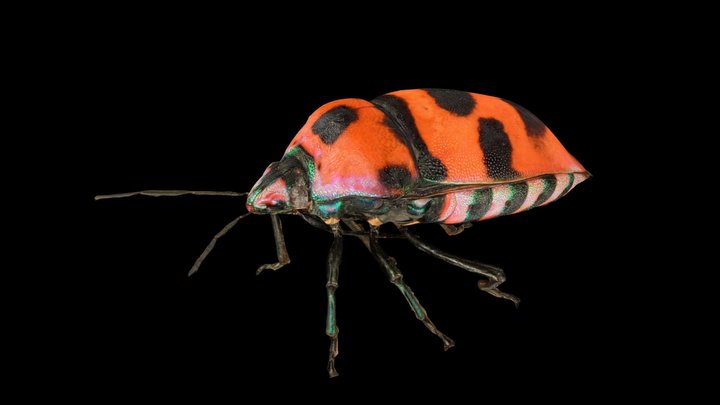
3D model
- Source
- Sketchfab
- Licence
- CC0 Public Domain
- Commercial use
- the licence allows it
Smithsonian Open Access and MorphoSource were not reached for this taxon, so this list is what the others held rather than everything there is.
The description on this site
- Licence
- CC BY-SA 4.0
This is what the site found, which is not the same as what exists.
Keep going
What may have been alongside itPentatomoidea through timeFormations of the MioceneThe world it lived on
Occurrence data from the Paleobiology Database, CC BY 4.0. (Leach 1815)